
• Menu
  • Skip to primary navigation
  • Skip to main content
  • Skip to primary sidebar

Country Life In BC Logo

The agricultural news source in British Columbia since 1915

  • Headlines
  • Calendar
  • Subscribe
  • Advertise
  • About
  • Archives
  • Contact
  • Search
  • Headlines
  • Calendar
  • Subscribe
  • Advertise
  • About
  • Archives
  • Contact
  • Search

Primary Sidebar

Originally published:

JUNE 2023
Vol. 109 Issue 6

Subscribe Now!

Sign up for free weekly FARM NEWS UPDATES

Select list(s) to subscribe to


By submitting this form, you are consenting to receive marketing emails from: Country Life in BC. You can revoke your consent to receive emails at any time by using the SafeUnsubscribe® link, found at the bottom of every email. Emails are serviced by Constant Contact
Your information will not be
shared or sold ever

Stories In This Edition

Dry heat hits

Blossoms of hope

Pest pressures shift

Field-scale trials essential for adaptive farming

Editorial: Peak producton

Back 40: Technology running laps around producers

Viewpoint: Remembering Craig Evans, practical visionary

Sod industry sees slow recovery from disasters

BC Veg looks beyond legal challenges

Teaching moment

Ag Briefs: EcoFarm rebrands, expands mandate

Ag Briefs: Vegetable roundup

Ag Briefs: Replant program revamped

New agriculture minister settling into her role

Fruit specialists take extension in new direction

Record beef prices trigger mixed feelings

CFIA proposes traceability updates

Sidebar: Not fair for Fairs

Bison export hit by century-old regulations

Island 4-H beef show kicks off season

New farmers institutes form to address gaps

BC research farm steals show at cranberry congress

Award-winning products from BC ingredients

Sidebar: Seed-and crowdfunding sprout distillery

Seed producer takes a page from the craft beer movement

Seed sales plateau following pandemic boost

Diversification, patience help honey sector grow

Long road leads to RNG

Sidebar: Biogas production a sieable investment of time and money

Farmer-first tech drives efficiency, sustainability

Farm Story: Strong opinions spark spontaneous achievement

UFV brings fresh perspective to agriculture

Urban farming venture sticks close to home

Barriere expo supports youth in agriculture

Woodshed: Delta & Deborah have a heart-to-heart

Gala sparks the passion for Ag in the Classroom

Judes Kitchen: Harvest some herbs for Dad’s day

More Headlines

Follow us on Facebook

Comments Box SVG iconsUsed for the like, share, comment, and reaction icons

6 days ago

... See MoreSee Less

View Comments
  • Likes: 4
  • Shares: 0
  • Comments: 0

Comment on Facebook

6 days ago

On the last day of the BC Organic Conference, Thursday, Molly Thurston of Pearl Agricultural Consulting helped growers learn how to manage bugs such as codling moth, wireworm, and rootworm in organic growing systems. Her talk alongside Renee Prasad included hands-on activities in which participants checked out various traps and examined pests under microscopes. Be sure to look for more upcoming ag events on our online calendar at www.countrylifeinbc.com/calendar/

#BCAg
... See MoreSee Less

On the last day of the BC Organic Conference, Thursday, Molly Thurston of Pearl Agricultural Consulting helped growers learn how to manage bugs such as codling moth, wireworm, and rootworm in organic growing systems. Her talk alongside Renee Prasad included hands-on activities in which participants checked out various traps and examined pests under microscopes. Be sure to look for more upcoming ag events on our online calendar at www.countrylifeinbc.com/calendar/

#BCAg
View Comments
  • Likes: 15
  • Shares: 0
  • Comments: 0

Comment on Facebook

1 week ago

Well-known organic farmer and podcaster Jordan Marr gets interviewed by Country Life in BC’s own columnist and potato mavin Anna Helmer during the opening session of the BC Organic Conference at Harrison Hot Springs yesterday. Sessions run today (Wednesday) and Thursday and include organic and regenerative growing practices and expanding and advocating for the organic sector, all under the background of the newly launched Organic BC banner.

#BCAg
... See MoreSee Less

Well-known organic farmer and podcaster Jordan Marr gets interviewed by Country Life in BC’s own columnist and potato mavin Anna Helmer during the opening session of the BC Organic Conference at Harrison Hot Springs yesterday. Sessions run today (Wednesday) and Thursday and include organic and regenerative growing practices and expanding and advocating for the organic sector, all under the background of the newly launched Organic BC banner.

#BCAg
View Comments
  • Likes: 37
  • Shares: 2
  • Comments: 1

Comment on Facebook

Interested in finding out more about this

3 weeks ago

Today, we remember those who sacrificed their lives or their well-being for our freedom. Lest we forget. ... See MoreSee Less

Today, we remember those who sacrificed their lives or their well-being for our freedom. Lest we forget.
View Comments
  • Likes: 8
  • Shares: 0
  • Comments: 0

Comment on Facebook

1 month ago

FarmFolk CItyFolk is hosting its biennial BC Seed Gathering in Harrison Hot Springs November 27 and 28. Farmers, gardeners and seed advocates are invited to learn more about seed through topics like growing perennial vegetables for seed, advances in seed breeding for crop resilience, seed production as a whole and much more. David Catzel, BC Seed Security program manager with FF/CF will talk about how the Citizen Seed Trail program is helping advance seed development in BC. Expect newcomers, experts and seed-curious individuals to talk about how seed saving is a necessity for food security. ... See MoreSee Less

Link thumbnail

BC Seed Gathering - FarmFolk CityFolk

farmfolkcityfolk.ca

Save the date for our upcoming 2023 BC Seed Gathering happening this November 3rd and 4th at the Richmond Kwantlen Polytechnic University campus.
View Comments
  • Likes: 1
  • Shares: 0
  • Comments: 0

Comment on Facebook

Subscribe | Advertise

The agricultural news source in British Columbia since 1915
  • Email
  • Facebook

Sod industry sees slow recovery from disasters

Two farms have vastly different flood recovery experiences

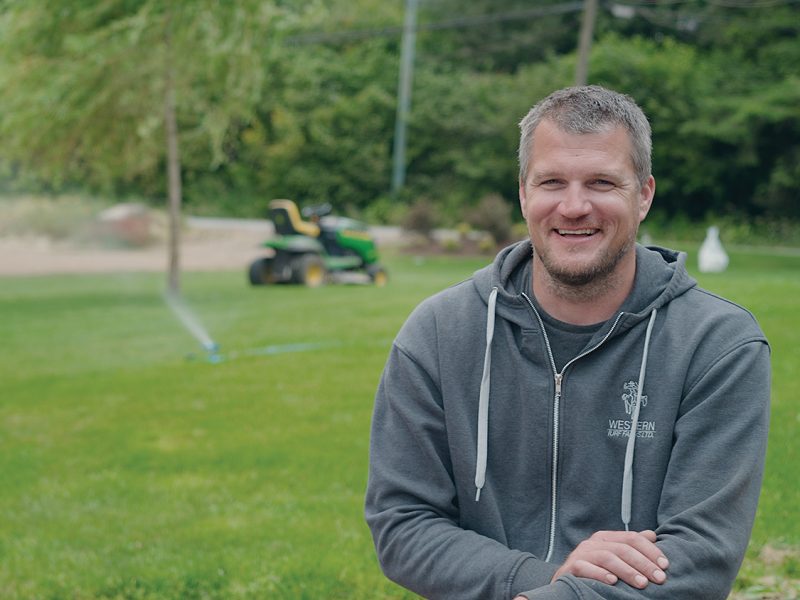
Rob Rindt of Western Turf Farms says they are still recovering from the November 2021 flooding. SUBMITTED

May 31, 2023 bySandra Tretick

ABBOTSFORD – BC’s turf industry has yet to recover from the double effects of the pandemic and the November 2021 floods, which sped up the contraction of a sector heavily concentrated in the Fraser Valley.

Sales were already on a downward trend from the sector’s peak of $12 million in 2017, although they rebounded slightly last year to $10 million according to Statistics Canada estimates released in April. This was up slightly from $9.9 million in 2021, a level not seen since 2007 and down nearly 18% from the 2017 high.

While the number of farms has dropped by half since 2012 to just 24 last year, acreage remained steady for more than a decade at around 2,000 acres until the pandemic. Acreage dropped from 1,810 in 2020, to just 1,640 in 2021 before creeping back up to 1,727 acres in 2022.

But it remains to be seen whether the industry will rebound.

“Anecdotally, I would say that among other things, homes have gotten a lot bigger while lot sizes are getting smaller, so there’s not a lot of room for landscape,” says Jerry Rousseau, executive director of the Western Canada Turfgrass Association, which primarily represents professional sports turf managers as well as five sod farmers.

“I’ve also noticed that people don’t seem to like caring for their lawns as in previous generations, even basic stuff like mowing,” Rousseau says.

Seventeen months after the November 2021 flooding, two Abbotsford sod farmers spoke to Country Life in BC about their recovery.

Rob Rindt, general manager of family-owned Western Turf Farms Ltd., lives in Langley. He grows sod on 100 acres there and 400 acres on Marion Road in Sumas Prairie, where the farm’s shop and main office are located. It’s also where three of his four brothers as well as his parents, who started the farm in the 1950s, live.

The family was forced to flee the farm when the Nooksack River overflowed into Sumas Prairie in November 2021 and the Barrowtown pump station couldn’t keep up.

A week later, Rindt was able to make the trip out to the farm by boat. He recalled smelling diesel on the trip, like “all the fuel tanks are just letting all the fuel into the water, all the chemicals, all the oil in the water.” The full impact of the contaminants has yet to be seen.

“It was pretty crazy, just seeing everything you worked for your whole life underwater,” he says.

In addition to flooded fields and buildings, the farm lost machinery and equipment. Rindt estimates that they are millions of dollars out of pocket. Rindt turned 39 earlier this year so he has time to rebuild, but replacing everything on cash flow alone means it will be a long time before the operation – the largest in BC – is back to normal.

Western supplies golf courses, municipalities, landscape contractors, builders and homeowners in BC and Alberta with some US sales, but since the flood it’s been focused exclusively on meeting local demand.

It’s been a challenging time for the whole family.

“They’re still dealing with it,” he says. “It was pretty hard on everybody. What I have learned is how fast things can just disappear. It kind of opened my eyes to appreciate and to try to enjoy life a little bit more. Enjoy family.”

The experience is partly what led Rindt to run for Township of Langley council last fall.

“I grew up in Langley Township and the way we were going, it’s a joke” says Rindt. “There’s no proper maintenance or ditching, you know, like regular annual maintenance.”

Not far from Western’s Abbotsford operations, another turf farm, Bos Sod Farms Inc., saw its fields on Dixon Road flooded.

The farm was started in 1993 by Bert Bos, who had come to the coast from Alberta where his family ran a dairy farm after emigrating from Holland.

He specializes in sod for golf courses and sells as far as California and Ontario, but BC, Alberta, Washington and Nevada are his primary markets. He also sells to landscapers and homeowners.

“Everything that we grow is actually done on sand that we bring in,” says Bos. “So we’re a little bit different that way.”

Bos thinks the sand actually may have helped his fields recover faster from the flooding because the drainage was a little better. He also thinks the volume of water helped dilute contaminants.

“It wasn’t waterlogged quite as long,” he says. “The grass still looked relatively good [after the water receded] but the cold snap that happened in December, that kind of kicked the grass back pretty hard.”

He says the flood weakened the grass so it couldn’t handle the unusually low temperatures. They didn’t lose any crops, but remediation took extra time.

“We had a five-month gap where we did not harvest,” says Bos. “We were able to get back in operation in April [of 2022].”

That gap is unusual for the farm, because they normally harvest 11 or 12 months of the year. Bos notes that they were able to make up all the lost sales in the same year.

“On the business side, it actually hasn’t been too bad considering,” he says. “We’re able to get back on our feet and carry on our business.”

Unlike Western, Bos was able to drive all of his motorized machinery to higher ground so he only lost some equipment that he couldn’t move or was lower priority. But he didn’t have flood insurance on his house because the premium for flood and septic backflow was so high. Because he was offered insurance but chose not to insure, Bos says he didn’t quality for provincial or federal help.

“So their reasoning is, if it’s readily and reasonably available, then you don’t qualify,” he laments. “I think you could debate that. $9,000 is not a reasonable cost.”

Bos has filed an appeal, but he’s still waiting for a response.

He also thinks the upgrades and repairs that have been done to the dyke infrastructure thus far are inadequate.

“If you don’t want to do the necessary infrastructure upgrades, you have to be prepared to help out the individuals that are impacted by an event like this,” he says.

On a positive note, Bos expanded the farm and purchased 45 additional acres last year, bringing him up to a total of 165 acres and they rebuilt the office, which he says is “new and improved.”

The BC Ministry of Agriculture and Food says the primary market for sod produced in BC is the housing industry and, to a lesser extent, sports fields and golf courses. Turfgrass production is scattered throughout the province with about two-thirds grown in the Lower Mainland, on Vancouver Island and in the Okanagan.

Related Posts

You may be interested in these posts from the same category.

Previous Post: « Ranchers’ markets, practices praised
Next Post: Cherry harvest firming up »

Copyright © 2025 Country Life in BC · All Rights Reserved