• Menu
  • Skip to primary navigation
  • Skip to main content
  • Skip to primary sidebar

Country Life In BC Logo

The agricultural news source in British Columbia since 1915

  • Headlines
  • Calendar
  • Subscribe
  • Advertise
  • About
  • Archives
  • Contact
  • Search
  • Headlines
  • Calendar
  • Subscribe
  • Advertise
  • About
  • Archives
  • Contact
  • Search

Primary Sidebar

Current Issue:

FEBRUARY 2026
Vol. 112 Issue 2

Subscribe Now!

Sign up for free weekly FARM NEWS UPDATES

Loading form…

Your information will not be
shared or sold ever

Follow us on Facebook

Comments Box SVG iconsUsed for the like, share, comment, and reaction icons

6 hours ago

The Township of Langley Farm and Ranch Exhibition Society is hosting a public open house this evening to gather input on plans to transform the historic Belmont Farm into an agricultural exhibition, education and heritage hub. Farmers, ranchers, and community members are invited to share their feedback. The open house is at the George Preston Rec Centre, 6-8 pm.

Township of Langley Farm and Ranch Exhibition Society
#BCAg
... See MoreSee Less

The Township of Langley Farm and Ranch Exhibition Society is hosting a public open house this evening to gather input on plans to transform the historic Belmont Farm into an agricultural exhibition, education and heritage hub. Farmers, ranchers, and community members are invited to share their feedback. The open house is at the George Preston Rec Centre, 6-8 pm. 

Township of Langley Farm and Ranch Exhibition Society 
#BCAg
View Comments
  • Likes: 6
  • Shares: 0
  • Comments: 0

Comment on Facebook

9 hours ago

The sold-out Southern Interior Horticulture show continues today. Education sessions range from rodent control to new tree fruit varieties, with the afternoon devoted to improving spraying techniques for orchardists and vineyard managers. When not listening to speakers, producers are checking the trade show.

#BCAg
... See MoreSee Less

The sold-out Southern Interior Horticulture show continues today. Education sessions range from rodent control to new tree fruit varieties, with the afternoon devoted to improving spraying techniques for orchardists and vineyard managers. When not listening to speakers, producers are checking the trade show.

#BCAg
View Comments
  • Likes: 6
  • Shares: 0
  • Comments: 0

Comment on Facebook

11 hours ago

The BC Poultry Association has lowered its avian flu biosecurity threat level from red to yellow, citing declining HPAI risk factors and fewer wild bird infections. Strong biosecurity practices helped BC limit cases this winter to 38 premises, down from 81 last year. For more, see today's Farm News Update from Country Life in #BCAg#BCAg ... See MoreSee Less

Link thumbnail

Poultry biosecurity notches down

www.countrylifeinbc.com

Declining risk factors for highly pathogenic avian influenza (HPAI) have prompted the BC Poultry Association to lower the industry’s biosecurity threat level from red to yellow. The decision…
View Comments
  • Likes: 11
  • Shares: 2
  • Comments: 1

Comment on Facebook

🐥💛

1 day ago

The application deadline for cost-shared funding through the Buy BC program is coming up on February 20. Up to $2 million through the Buy BC Partnership Program is available annually to BC producers and processors to support local marketing activities that increase consumer awareness of BC agriculture and BC food and beverages. For more information, visit buybcpartnershipprogram.ca/.

Buy BC

#BCAg
... See MoreSee Less

Link thumbnail

Home - Buy BC Partnership Program

buybcpartnershipprogram.ca

Buy BC Partnership Program Increase your visibility with Buy BC The Buy BC Partnership Program is a fundamental component of Buy BC that provides up to $2 million in cost-shared funding annually to lo...
View Comments
  • Likes: 3
  • Shares: 0
  • Comments: 0

Comment on Facebook

1 day ago

The Sik-E-Dakh (Glen Vowell) First Nation's Skeena Fresh hydroponic operation has doubled production capacity thanks to a $130,632 Northern Development Infrastructure Trust grant. Growing lettuce, kale, herbs and more in shipping containers, the operation uses 90% less water than traditional farming while providing 1,200 people with year-round access to fresh, locally grown greens. Their story is in the February edition of Country Life in BC, the agricultural news source for BC’s farmers and ranchers.

Northern Development Initiative Trust
#BCAg
... See MoreSee Less

The Sik-E-Dakh (Glen Vowell) First Nations Skeena Fresh hydroponic operation has doubled production capacity thanks to a $130,632 Northern Development Infrastructure Trust grant. Growing lettuce, kale, herbs and more in shipping containers, the operation uses 90% less water than traditional farming while providing 1,200 people with year-round access to fresh, locally grown greens. Their story is in the February edition of Country Life in BC, the agricultural news source for BC’s farmers and ranchers. 

Northern Development Initiative Trust 
#BCAg
View Comments
  • Likes: 15
  • Shares: 1
  • Comments: 0

Comment on Facebook

Subscribe | Advertise

The agricultural news source in British Columbia since 1915
  • Email
  • Facebook

Tree decline linked to fungi, pests

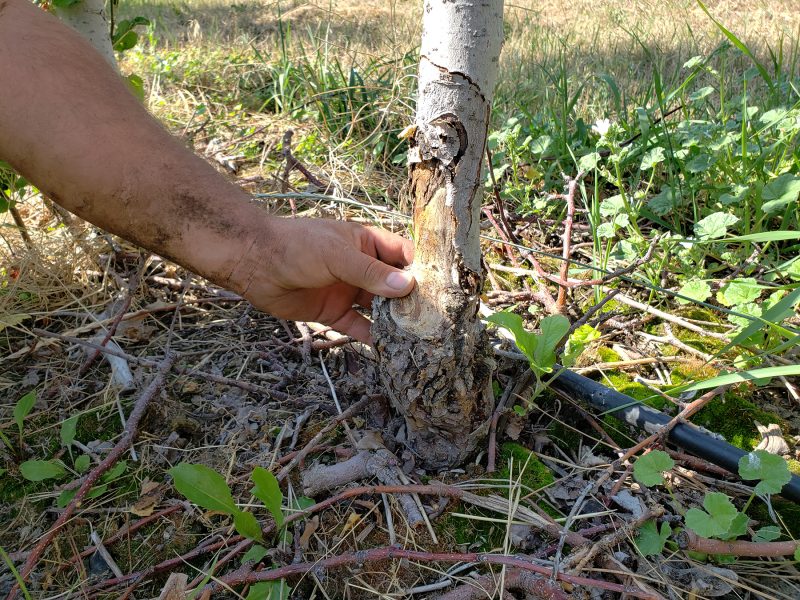
Root stock dying from sudden apple death. Myrna Stark Leader photo

July 27, 2022 byTom Walker

The graft union is a critical juncture when it comes to Sudden Apple Death (SAD) a phenomenon that affects young apple trees across the Okanagan.

Staff from the Summerland Research and Development Centre delivered a SAD update on July 13, noting that it presents as a combination of factors whose effects may be accelerated by climate, soil conditions and growing systems.

The primary factor in SAD is Cytospora, a fungal pathogen that impact apple trees at the graft union, says Jesse MacDonald, the knowledge and technology transfer specialist at Summerland.

“We are finding that [it] forms cankers at the graft union,” he says.“It is considered a mild pathogen, but in recent years it has been playing a more important role in orchard health in the Okanagan.”

The second major factor is apple clearwing moth, an invasive species that is reaching critical mass in most orchards in the Okanagan and also attacks the graft union.

“The arrival of ACW corresponds with SAD occurrence,” says MacDonald.

The combination of fungal and insect attacks is reduced water transport through the graft union, indicated by clear signs of water stress.

The situation is exacerbated by a greater number of days each year with extreme heat.

“We are getting more 35° C days and the trees need more water than they have in the past,” says MacDonald.

Under those conditions, well-drained soils that lack good water-holding capacity become a liability, according to Kirsten Hannam, a systems agro-ecologist examining water, carbon and nutrient dynamics in soils.

“Shallow, coarse-textured soils that lack organic matter do not retain water,” notes Hannam.

The high-density growing systems that have been popular with growers may be a liability, too.

“I’ve looked at older trees with bigger trunks that have huge cankers and huge ACM damage and they show less impact,” notes MacDonald.

MacDonald says the research is continuing, with potential solutions including more robust rootstocks.

The lecture was part of a new series of extension offerings that reflects the work of the province’s tree fruit industry stabilization initiative.

The series is organized in conjunction with the BC Institute of Agrologists and spearheaded by Adrian Arts, the province’s tree fruit and grape specialist and owner of Kamla Orchards in Summerland.

Related Posts

You may be interested in these posts from the same category.

Federal budget kills Living Labs

Cherry bonanza no jubilee

Arts leads BCFGA forward

Stabilization initiative yet to bear fruit

Agrologists focus on reconciliation

Wine industry faces losses

Fruit volumes down, quality up

Previous Post: « Fruit volumes down, quality up
Next Post: Peace leads real estate »

Copyright © 2026 Country Life in BC · All Rights Reserved