• Menu
  • Skip to primary navigation
  • Skip to main content
  • Skip to primary sidebar

Country Life In BC Logo

The agricultural news source in British Columbia since 1915

  • Headlines
  • Calendar
  • Subscribe
  • Advertise
  • About
  • Archives
  • Contact
  • Search
  • Headlines
  • Calendar
  • Subscribe
  • Advertise
  • About
  • Archives
  • Contact
  • Search

Primary Sidebar

Originally published:

SEPTEMBER 2020
Vol. 106 Issue 9

Subscribe Now!

Sign up for free weekly FARM NEWS UPDATES

Select list(s) to subscribe to


By submitting this form, you are consenting to receive marketing emails from: Country Life in BC. You can revoke your consent to receive emails at any time by using the SafeUnsubscribe® link, found at the bottom of every email. Emails are serviced by Constant Contact
Your information will not be
shared or sold ever

Stories In This Edition

Under one roof

Creating community in abundance

Farms to retain tax status

Armyworm keeps its distance this summer

Smile with your eyes

Fall back

Back 40: Finding what we need in a COVID-19 world

Viewpoint: Exports play a vital role in BC’s farm economy

Field days feeling the pinch of social distancing rules

Sidebar: Pacific Agriculture Show goes virtual

AgSafe makes changes to board structure

Makin’ hay

Metro Vancouver targets carbon-neutral future

Changes to land commission kick in this fall

Creston initiative keeps workers, town safe

Ag Briefs: Dairy industry selects new entrants

Ag Briefs: Top vet appointed

Ag Briefs: BC youth offer perspectives

Sheep producers told to bear with wildlife

Disease has sheep producers on defensive

Pandemic creates virtual season for 4-H clubs

Delta development puts agrihoods to the test

Three-tier system being floated for livestock watering

Short-term roller coaster for beef market

Beef prices up

Global outlook is bright for beef producers

Council supports efforts to improve water quality

New orchardist takes on key ministry role

Unprecedented rise in machine harvesting

Soft landings mean better blueberries

Province readers sprayer program for delivery

Wheat growers tap into heirloom grains

High-flying pans grounded by pandemic protocols

Farm Story: The right machine makes harvesting potatoes a breeze

Organic soil requirements need science, guesswork

Relay cropping checks all the boxes

Flower growers ponder COVID-19 impacts

Best practices must guide COVID-19 hiring

Woodshed: No place like home for Deborah and the dogs

Former caregiver brings donkey therapy to Island

No one leaves Abundance without a zucchini

Building community, building a future

Jude’s Kitchen: Harvest colours

More Headlines

Follow us on Facebook

Comments Box SVG iconsUsed for the like, share, comment, and reaction icons

6 days ago

... See MoreSee Less

View Comments
  • Likes: 4
  • Shares: 0
  • Comments: 0

Comment on Facebook

7 days ago

On the last day of the BC Organic Conference, Thursday, Molly Thurston of Pearl Agricultural Consulting helped growers learn how to manage bugs such as codling moth, wireworm, and rootworm in organic growing systems. Her talk alongside Renee Prasad included hands-on activities in which participants checked out various traps and examined pests under microscopes. Be sure to look for more upcoming ag events on our online calendar at www.countrylifeinbc.com/calendar/

#BCAg
... See MoreSee Less

On the last day of the BC Organic Conference, Thursday, Molly Thurston of Pearl Agricultural Consulting helped growers learn how to manage bugs such as codling moth, wireworm, and rootworm in organic growing systems. Her talk alongside Renee Prasad included hands-on activities in which participants checked out various traps and examined pests under microscopes. Be sure to look for more upcoming ag events on our online calendar at www.countrylifeinbc.com/calendar/

#BCAg
View Comments
  • Likes: 15
  • Shares: 0
  • Comments: 0

Comment on Facebook

1 week ago

Well-known organic farmer and podcaster Jordan Marr gets interviewed by Country Life in BC’s own columnist and potato mavin Anna Helmer during the opening session of the BC Organic Conference at Harrison Hot Springs yesterday. Sessions run today (Wednesday) and Thursday and include organic and regenerative growing practices and expanding and advocating for the organic sector, all under the background of the newly launched Organic BC banner.

#BCAg
... See MoreSee Less

Well-known organic farmer and podcaster Jordan Marr gets interviewed by Country Life in BC’s own columnist and potato mavin Anna Helmer during the opening session of the BC Organic Conference at Harrison Hot Springs yesterday. Sessions run today (Wednesday) and Thursday and include organic and regenerative growing practices and expanding and advocating for the organic sector, all under the background of the newly launched Organic BC banner.

#BCAg
View Comments
  • Likes: 37
  • Shares: 2
  • Comments: 1

Comment on Facebook

Interested in finding out more about this

3 weeks ago

Today, we remember those who sacrificed their lives or their well-being for our freedom. Lest we forget. ... See MoreSee Less

Today, we remember those who sacrificed their lives or their well-being for our freedom. Lest we forget.
View Comments
  • Likes: 8
  • Shares: 0
  • Comments: 0

Comment on Facebook

1 month ago

FarmFolk CItyFolk is hosting its biennial BC Seed Gathering in Harrison Hot Springs November 27 and 28. Farmers, gardeners and seed advocates are invited to learn more about seed through topics like growing perennial vegetables for seed, advances in seed breeding for crop resilience, seed production as a whole and much more. David Catzel, BC Seed Security program manager with FF/CF will talk about how the Citizen Seed Trail program is helping advance seed development in BC. Expect newcomers, experts and seed-curious individuals to talk about how seed saving is a necessity for food security. ... See MoreSee Less

Link thumbnail

BC Seed Gathering - FarmFolk CityFolk

farmfolkcityfolk.ca

Save the date for our upcoming 2023 BC Seed Gathering happening this November 3rd and 4th at the Richmond Kwantlen Polytechnic University campus.
View Comments
  • Likes: 1
  • Shares: 0
  • Comments: 0

Comment on Facebook

Subscribe | Advertise

The agricultural news source in British Columbia since 1915
  • Email
  • Facebook

Unprecedented rise in machine harvesting

COVID-19 labour shortage accelerates mechanization trend among berry growers

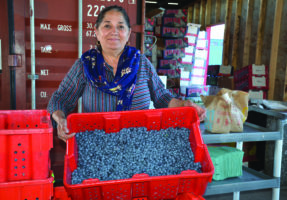
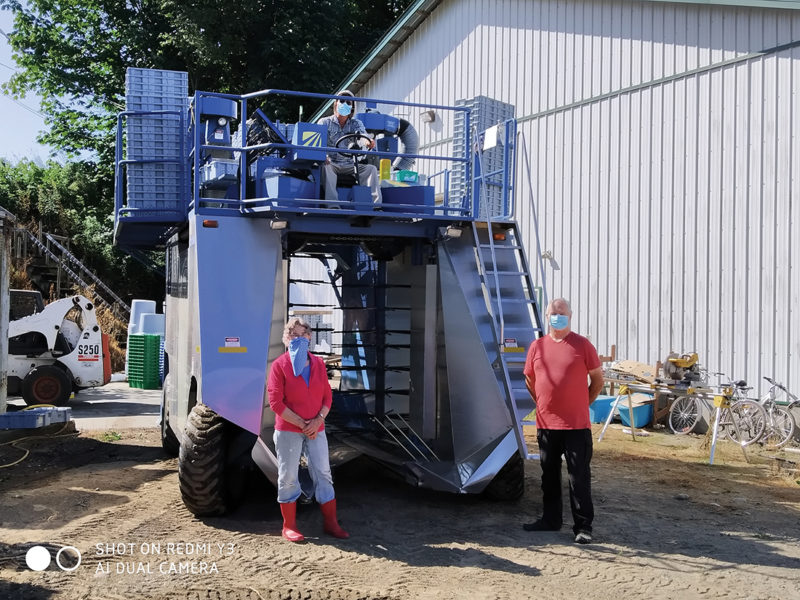
Linda and Kerry Seale stand by the harvester used for picking berries at Blueberry Junction in Abbotsford. PHOTO / SARBMEET SINGH

September 1, 2020 bySarbmeet Singh

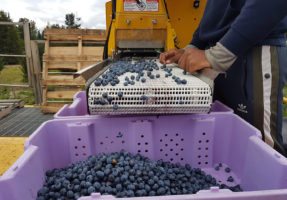
ABBOTSFORD – Blueberry growers have turned to mechanical harvesting in unprecedented numbers this year due to a shortage of labour and impacts of COVID-19.

While growers usually employ thousands of hand harvesters, this year saw hundreds of machines harvesting berries across the Fraser Valley.

Although farmers have been using machines for several years, many did so out of necessity this year rather than choice.

Sarbjit Kaur Gill from Prairie Fruit Farm in Chilliwack says he was forced to lease a berry harvester this season.

“We have Duke and Bluecrop varieties at our farm. Usually, we prefer first picking with hands while the second picking is performed with the machines. However, due to shortage of labour, we used a machine for the first picking as well,” he says. “I feel this was a very bad year for the farmers. Firstly, we couldn’t procure the machine and secondly, the wet condition of the field made operating it a challenge, causing us great financial loss.”

Rajinder Singh Lally, owner of Lally Farms in Abbotsford, believes mechanical harvesting is the future of berry picking.

“The delay in picking results in over-ripening of berries, which leads to a decline in price of the fruit. As there was a shortage of labour, we used three machines per farm to pick the fruit. From this experience, I feel that machines are a more cost-effective alternative and we are planning to purchase more machines in the coming years,” says Lally.

But the results don’t please everyone.

“I have been engaged in agriculture for 40 years. Last year, we used machines on less than 10% of our acreage but this year approximately 40% of our acreage was picked by machines. We deal in the fresh market but this year, I had to go for processing due to mechanized harvesting,” says one disappointed Abbotsford farmer, who did not want to be named.

Cost savings

Mechanized picking and hand picking each have their advantages, the chief one being cost.

While hand picking costs around 50 to 60 cents per pound, mechanical harvesting costs just 15 to 20 cents a pound. Hand picking is much slower in comparison to mechanized picking. On average, one picker can pick up to 400 pounds of berries whereas a machine can pick up to three acres in a day, or upwards of 60,000 pounds of berries.

Despite the apparent advantages, mechanized picking does have a downside. Machine-harvested berries are mostly used for processing and the prices for processed berries are much less compared to the fresh market.

“In the fresh market, blueberries can be sold at $1 to $2 per pound during the season. On the other hand, the processed berries can fetch up to 60 to 65 cents per pound only. While it saves the picking cost, there is a decline in the profits made from the mechanically harvested berry,” says Kerry Seale, from Blueberry Junction in Abbotsford. “We felt the labour pains during the previous years. So, we decided to grow some varieties that can be easily picked with machines.”

The labour issues associated with COVID-19 have more growers considering such moves this year.

“Due to CERB and COVID, there was a huge shortage of labour. Many farmers opted for mechanized picking this year,” says Anju Gill, executive director of the BC Blueberry Council. “In case of mechanized harvesting, prior arrangements like pruning are required well ahead of the harvesting. Due to lack of these arrangements, it led to ineffective picking by machines also. However, at the same time, there are some growers that grow berries for processing only and they always pick using the machines.”

Parm Bains, president of Westberry Farms in Abbotsford, says machines have been popular among farmers for several years as farmers looked to cut costs as production has grown and labour costs have risen.

“There has been a significant rise in the production and acres of blueberries in British Columbia during the last few decades. In the 80s, we had 20 million pounds of berries and last year we had over 200 million pounds,” says Bains. “Around 17,000 to 18,000 workers are needed but only around 6,000 pickers are available. More and more machines are coming to the market every year as farmers are trying to save money on picking side.”

The shortage of pickers was front-and-centre this year due to COVID-19, among other factors.

“Farmers struggled to pick berries,” says Bains. “Fields were wet. Besides labour, machines were also not available in time.”

While more berries went to processing, Bains says it’s difficult to gauge the impact on grower revenues.

“At this moment we are hoping for better prices in comparison to last year,” he says.

Related Posts

You may be interested in these posts from the same category.

New executive director for blueberries

Gill shifts to greenhouses

Researchers probe blueberry disease

Fraser Valley flooding continues

BC blueberry crop down 30%

BC Blueberry Council gets a new chair

Wind machines in Surrey face blowback

Flight ban strands workers

Blueberry growers dodge US complaint

US holds blueberry hearing

BC Blueberry council set for elections

US investigating blueberries

Previous Post: « BC Tree Fruits prepares to sell assets, apples
Next Post: Turkey sales up »

Copyright © 2025 Country Life in BC · All Rights Reserved