
• Menu
  • Skip to primary navigation
  • Skip to main content
  • Skip to primary sidebar

Country Life In BC Logo

The agricultural news source in British Columbia since 1915

  • Headlines
  • Calendar
  • Subscribe
  • Advertise
  • About
  • Archives
  • Contact
  • Search
  • Headlines
  • Calendar
  • Subscribe
  • Advertise
  • About
  • Archives
  • Contact
  • Search

Primary Sidebar

Originally published:

NOVEMBER 2020
Vol. 106 Issue 11

Subscribe Now!

Sign up for free weekly FARM NEWS UPDATES

Loading form…

Your information will not be
shared or sold ever

Stories In This Edition

Apple returns raise alarm

Ottawa urged to fulfil promises

Snow job

New government faces old issues in next term

Caught in the act

Editorial: Time for action

Back 40: Finding the perks in a pandemic world

Viewpoint: Changing times require a flexible vision

Invasive hornet nest destroyed south of Langley

Country Life in BC wins a record eight national awards

US launches investigation into blueberries

Hog producers face changes to code of practice

Growers, wineries welcome sustainability launch

Sustainability program delivers value to industry

Ag Briefs: Ag sector claims $8.5 billion economic impact

Ag Briefs: Farm worker protection funded

Ag Briefs: Autumn calf prices down

Grant programs encourage Indigenous ag projects

Range issues dominate NOLA meeting

Sidebar: BCV Cattlemen critique water intentions

BC Beef plant in Falkland ready to process this month

Winter warning

Corn trial results help make better planting decisions

Sidebar: Sweet results

New barn promises better egg production

ALR co-founder, defender embraces retirement

Seed sppliers seeing sustained demand as 2021 orders begin

Research: Breeding crops for the future means looking backwards

Straight ahead

Potatoes head for record-breaking harvest

Weather posed challenges for garlic growers

Garlic groewrs employ mixed marketing strategies

Association aims to foster collaboration

Demand boosts interest in older cider apples

Evans Farms marks a century of ranching

Farm Story: Nominees announced for seasonal awards

Bursary winner plants roots in Cawston

Provincial Winter Fair hosts live 4-H events

Woodshed: Janice Newberry bids farewell to love-sick Henderson

Where there’s a will, there’s gotta be a way

Jude’s Kitchen: Autumn Eats

More Headlines

Follow us on Facebook

Comments Box SVG iconsUsed for the like, share, comment, and reaction icons

6 days ago

A BC Forest Practices Board investigation has found overgrazing has damaged grasslands in the Coutlee Range Unit near Merritt — and the range-use plan meant to prevent it was unenforceable. With complaints about overgrazing on the rise and grasslands covering just 1% of BC's land mass, the findings raise fresh questions about how the province manages one of its most vulnerable — and valuable — food-producing ecosyste#BCAg#BCAg ... See MoreSee Less

Link thumbnail

Board finds overgrazing rules unenforceable unmeasurable

www.countrylifeinbc.com

MERRITT – A BC Forest Practices Board investigation has found instances of non-compliance related to overgrazing have damaged open grasslands in the Mine pasture, part of the Coutlee Range Unit near...
View Comments
  • Likes: 6
  • Shares: 6
  • Comments: 6

Comment on Facebook

Several ranchers in recent years have gone into temporary non use on that range , so that means the grass should grow. But drought conditions/lack of rain and snow don’t allow that to happen . Dried up springs , creeks waterholes in various pastures add to over grazing where there is water , as livestock and everything else stay close to the water source . So even though less cattle are on it , over grazing appears. There is a large volume of horses on it 365 days/year which is wrong ! They pull grass right out of the ground when it’s just trying to grow ,, opens the door for weeds to grow in. That don’t help it. Aging infrastructure ( fences) laying on the ground, pipe line building , ( lack of commitment to fence maintenance) amongst all users contributes also to over grazing. Recreational atv users leaving gates open between pastures allows livestock to go back or ahead in pastures also expidites over grazing. Logging ( bcts) has no problem laying out cut locks on both sides of a fence , then it gets smashed down during logging and they don’t take responsibility to stand it back up or clean the cattle gaurds out when they are done , that happened 4 years ago on pasture 5 up there . I bet it is still not fixed . There are lots of contributing factors to the problem.

Tragedy of the commons.

I looked through the report. I saw nothing about the effects of noxious weeds on productive grasslands. This particular area is vulnerable because of the Ministry’a efforts to diversify the use of the Grasslands.

This pasture is under tremendous pressure not only from cattle but from irresponsible local residents who treat it as a landfill dumping all manner of household debris here. And don't even get me started on the mud bogging and camping in sensitive riparian areas. The feral horses are in this pasture 365 days a year just hammering it. Would sure be nice to see some enforcement action on people who are intentionally ripping up the grasslands and riparian areas. Cattle could be a valuable resource for rebuilding soils and native grasses in this area with the help of electric fencing and/or e-collars. The humans will be harder to manage.

The Forest and Range Practices Act was written by lawyers for global forest licencee shareholders. Results-based = unenforceable.

Also, can we talk about the impact of a pipeline being built through the middle of this field for multiple years?

View more comments

1 week ago

East Kootenay rancher Randy Reay is digging a new well after two natural water sources dried up on his Crown tenures. A new Living Lakes Canada assessment found 15% of mapped aquifers in the region are high-priority for monitoring, yet 80% of those go unmonitored. With over 48% of BC's provincial observation wells reporting below-normal groundwater levels, ranchers and researchers are sounding the alarm on water security. The story is in our March edition, and we've posted it to our website thi#BCAgk.

#BCAg
... See MoreSee Less

Link thumbnail

Water woes: groundwater under pressure across BC

www.countrylifeinbc.com

JAFFRAY – As a young boy growing up in the Kootenay-Boundary region, Randy Reay never expected to run out of water. But this year, in mid-February, his fields are bare. There is no snow halfway up t...
View Comments
  • Likes: 8
  • Shares: 7
  • Comments: 1

Comment on Facebook

Jaffrey is in the east Kootenays not kooteney boundary

2 weeks ago

BC farmers are bracing for prolonged higher input costs as war in the Middle East drives up fuel and fertilizer prices. Nitrogen fertilizer costs were already climbing before the Iran conflict began, with prices still roughly 60% above pre-pandemic levels. Farm Credit Canada warns that unlike 2022, strong commodity prices may not offset rising costs this time. Local suppliers expect supply challenges and further price increases ahead.

#BCAg
... See MoreSee Less

Link thumbnail

Fertilizer prices on the rise

www.countrylifeinbc.com

War in the Middle East has delivered a generational shock to energy prices, meaning BC farmers can expect a prolonged period of higher costs not just for fuel but also for fertilizer.
View Comments
  • Likes: 2
  • Shares: 1
  • Comments: 0

Comment on Facebook

2 weeks ago

... See MoreSee Less

View Comments
  • Likes: 1
  • Shares: 0
  • Comments: 0

Comment on Facebook

2 weeks ago

Cameron Stockdale is the new executive director of provincial farm safety organization AgSafeBC. Find out more in this week's Farm News Update from Country Life in B#BCAg#BCAg ... See MoreSee Less

Link thumbnail

New leadership at AgSafe BC

www.countrylifeinbc.com

Cameron Stockdale is the new executive director of provincial farm safety organization AgSafeBC, succeeding Wendy Bennett. Bennett left AgSafeBC in September 2025, following 12 years with the…
View Comments
  • Likes: 5
  • Shares: 1
  • Comments: 0

Comment on Facebook

Subscribe | Advertise

The agricultural news source in British Columbia since 1915
  • Email
  • Facebook

Weather posed challenges for garlic growers

Cool temperatures, pre-harvest rain complicated high-quality crop

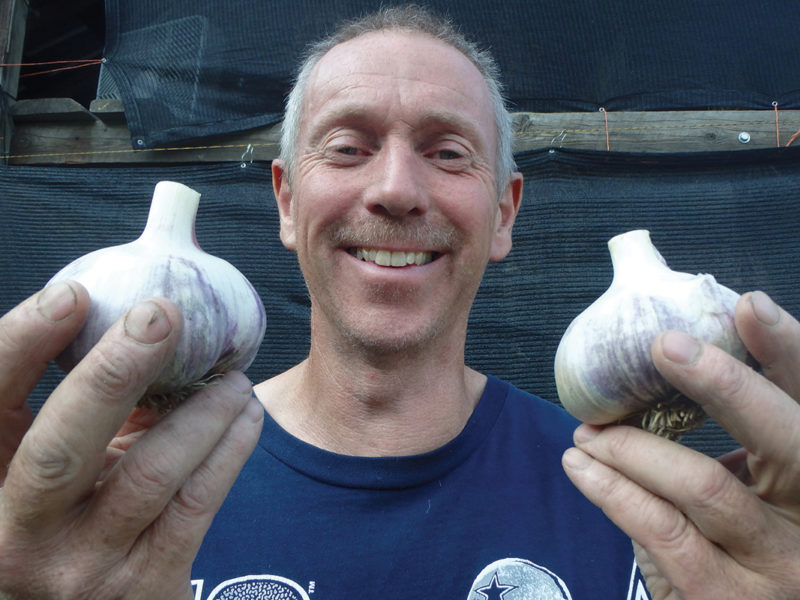
Ian Richardson has been growing garlic at Rocky Ridge Farm in Mara since 2000. Wet weather in June, before harvest, made it challenging to cure this year’s crop. PHOTO / SUBMITTED

November 1, 2020 byMyrna Stark Leader

KELOWNA – BC garlic growers are harvesting about four times as much garlic as they did a decade ago, but a cool spring and wet weather just before harvest challenged some growers this year.

“It was a very stressful year for many of my growers,” says Jim Capellini of Rasa Creek Farm in Lumby. He’s grown garlic since 2009. He markets seed garlic purchased from about a dozen other growers who sell directly to him.

Capellini planted about 4,000 cloves last fall for harvest this summer.

“I lost about 30% of my crop because it was too wet. Bulbs began to develop mold while still in the ground prior to harvest,” he explains.

Two of the organic growers who supply him with seed fared even worse than he did, losing their crops to botrytis.

“Both farms were certified organic, and so my access to certified bulb was seriously restricted,” he says.

Botrytis spores can travel with seed stock to new fields, introducing the fungus to an otherwise clean crop when conditions are right. Organic growers have few options for controlling the fungus, so neither Capellini nor his growers felt comfortable reserving a portion of this year’s crop for seed sales.

Ian Richardson, who’s been growing garlic since 1988 and has operated Rocky Ridge Farm in Mara since 2000, planted about 20,000 cloves on half an acre this year. While he didn’t see significant losses, the weather made it tough to cure the crop.

“Our growing season was okay, just okay,” he says. “We lost some garlic as it was too wet, especially right before harvest time, which is when you want garlic to be drying out in the ground. In a normal year, you quit watering about two weeks before you harvest. This year it rained almost right up to harvest.”

Abdul Majid of BC Garlic Growers Inc. in Abbotsford also faced challenges curing his crop. He farms 48 varieties, for a total of approximately 150,000 plants. The quality was excellent, but didn’t come without effort.

“We had a fantastic crop,” he says. “The least amount of crop loss, and crop quality was great and sizes were amazing. … But rain once a week wasn’t good for drying and curing these large heads.”

Doug Saba of Curly Willow Organic Farms in Grindrod lost about a quarter of his crop, or more than 900 bulbs, to botrytis. His Russian Red was more affected than his Yugoslavian garlic.

Fortunately, he was able to salvage enough good cloves to replant this fall, hoping that the healthy cloves will give next year’s crop a measure of resistance to the fungus.

To try and ward off fungus issues with his next crop, Saba will use less mulch around his plants. He may also look for an organic product to treat them in the spring. Knowing that this years crop had botrytis, he chose not to sell it as seed garlic.

Kelowna grower fared well

Even with a cooler spring, some growers in Kelowna saw good crops.

Now in their third year of garlic production, Michael and Jane Johnston of Avoca Farms and Vineyards had their best crop ever.

They used garlic as a way to boost cash flow while developing their aronia berry operation. They seeded 165,000 cloves in the ground on about 2.5 acres, and another 30,000 in pots.

Jane says 75% of the cloves produced heads of garlic varying in size. They were happy with the outcome, attributing their success to their sandy soil and greater experience.

A notable challenge this year was voles. While garlic is supposed to deter the rodents, the vole population seemed higher this year. The tiny varmints not only made runs through the field but moved bulbs, increasing the risk of disease spreading around the planting.

She says their potted garlic turned out even better due to the controlled growing environment. Michael’s familiarity with potted growing in Ireland, where the method is more common, prompted them to give it a try in Canada.

“It took a year of trial and error to get the fertilizer, watering and management of it in place,” she says, “but, overall, we were very successful for what many have told us was a challenging year.”

Monde Janzen of Janzen Garlic Acres Inc. in Kelowna was pleased with the results of her own 5,000 plants following a poor crop in 2019.

Janzen relocated from her operation from Abbotsford to Kelowna two years ago. Although she had success with the crop in Abbotsford, she’s spent the last two years adjusting to local growing conditions in the Okanagan.

“We got good quantities but I learned that we’ll stick with hard-neck garlic and work next year to increase the garlic’s size,” she explains.

Janzen sees opportunities for local garlic and plans to plant 30,000 to 35,000 cloves this fall, using a garlic splitter to separate them from the heads. The splitter reduces labour costs.

The ambition and innovation of growers like Janzen and the Johnstons give Capellini confidence in the future of the sector. He’s been working to grow it since planting his first 107 cloves of Russian Red, German Red and Yugoslavian garlic in 2009. He expanded to 40,000 bulbs annually and planned to grow even larger, but scaled back to focus on growing the industry through workshops and seed sales.

Capellini believes there’s a hole in the marketplace that could be filled with locally produced garlic.

According to international trade data, Canada imported 45.6 million pounds of garlic worth $60.5 million last year. China accounted for more than 80% of imports, followed by the US and Spain.

“We’re still importing 85% of what we need for fresh garlic in Canada,” says Capellini. “The demand is there, if people can produce it.”

Related Posts

You may be interested in these posts from the same category.

Previous Post: « New barn promises better egg production
Next Post: ALC appointments made »

Copyright © 2026 Country Life in BC · All Rights Reserved