• Menu
  • Skip to primary navigation
  • Skip to main content
  • Skip to primary sidebar

Country Life In BC Logo

The agricultural news source in British Columbia since 1915

  • Headlines
  • Calendar
  • Subscribe
  • Advertise
  • About
  • Archives
  • Contact
  • Search
  • Cart
  • Checkout
  • Headlines
  • Calendar
  • Subscribe
  • Advertise
  • About
  • Archives
  • Contact
  • Search
  • Cart
  • Checkout

Primary Sidebar

Current Issue:

AUGUST 2026
Vol. 112 Issue 8

Subscribe Now!

Sign up for free weekly FARM NEWS UPDATES

Loading form…

Your information will not be
shared or sold ever

Follow us on Facebook

Comments Box SVG iconsUsed for the like, share, comment, and reaction icons

1 day ago

The committee of MLAs charged with setting priorities for the next provincial budget is recommending regular, annual funding for water storage infrastructure associated with food production, including for engineering inspections, maintenance and upgrades. The recommendation builds on the BC Cattlemen's Association's recommendation of an annual allocation of $5 million for water storage infrastructure related to food production, noting that it could also support resilience in the face of climate-related events. While the province has allocated $120 million for agricultural water infrastructure, agriculture minister Lana Popham told Country Life in BC this week that other ministries and the federal government will need to be involved in funding future p#BCAgts#BCAgCAg

#BCAg
... See MoreSee Less

The committee of MLAs charged with setting priorities for the next provincial budget is recommending regular, annual funding for water storage infrastructure associated with food production, including for engineering inspections, maintenance and upgrades. The recommendation builds on the BC Cattlemens Associations recommendation of an annual allocation of $5 million for water storage infrastructure related to food production, noting that it could also support resilience in the face of climate-related events. While the province has allocated $120 million for agricultural water infrastructure, agriculture minister Lana Popham told Country Life in BC this week that other ministries and the federal government will need to be involved in funding future projects.

#BCAg

#BCAg
View Comments
  • Likes: 22
  • Shares: 5
  • Comments: 3

Comment on Facebook

A typical small-to-medium farming operation featuring a house, main barn, and machine shed generally has around 8,000 to 12,000 square feet of total roof surface. The Okanagan Valley is one of the driest regions in Canada, averaging roughly 300 millimetres (11.8 inches) of annual precipitation. Storing a full year's collected rainwater from those roofs yields roughly 262,500 litres. In the three regional districts that make up the Okanagan valley proper (North Okanagan, Central Okanagan, and Okanagan-Similkameen), the 2021 Statistics Canada Census of Agriculture records roughly 3,100 total farms. Multiply that number by 262,500 litres of harvested rainwater equals 813.75 million litres of water saved per year. Capturing that volume of water across every farm roof in the region would significantly ease peak summer pumping pressure on local groundwater aquifers and Okanagan Lake.

Fantastic!! We will work hard to be involved and do what we can as well as a collective group on the Salmon River!

Absolutely! Long over due and very welcomed. Let's make this happen.

1 day ago

... See MoreSee Less

View Comments
  • Likes: 2
  • Shares: 0
  • Comments: 0

Comment on Facebook

2 days ago

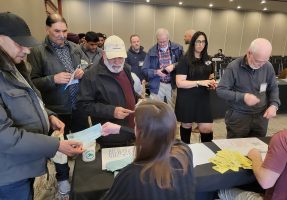
About 40 community members gathered at Silver Creek Community Hall near Salmon Arm last Thursday to discuss ways to improve water availability for both farms and spawning salmon. While the province has since rescinded a fish protection order for the watershed that shut down irrigation, future risks to water access remain top of mind. "We are here because water matters to each of us," says rancher and organizer Trudy Schweb. Farmland Riparian Interface Stewardship Program manager Lee Hesketh outlined the potential for upland water storage while Rob Dinwoodie highlighted cost-shared funding opportunities through the Environmental Farm Plan program for riparian assessments, irrigation efficiency upgrades and other water-related projects available to producers. Photo credit | Facebook/Trudy Schweb

#BCAg
... See MoreSee Less

About 40 community members gathered at Silver Creek Community Hall near Salmon Arm last Thursday to discuss ways to improve water availability for both farms and spawning salmon. While the province has since rescinded a fish protection order for the watershed that shut down irrigation, future risks to water access remain top of mind. We are here because water matters to each of us, says rancher and organizer Trudy Schweb. Farmland Riparian Interface Stewardship Program manager Lee Hesketh outlined the potential for upland water storage while Rob Dinwoodie highlighted cost-shared funding opportunities through the Environmental Farm Plan program for riparian assessments, irrigation efficiency upgrades and other water-related projects available to producers. Photo credit | Facebook/Trudy Schweb

#BCAg
View Comments
  • Likes: 36
  • Shares: 4
  • Comments: 4

Comment on Facebook

Salmon River Watershed Roundtable should be looked into again.

Well done my girl,the voice of Silver Creek ranchers and more

Thanks for covering this🌟

2 days ago

The BC Fruit Growers Association is urging Greater Vernon Water and the Regional District of North Okanagan to halt water shut-offs hitting 2,100+ acres of Okanagan orchards mid-season. With losses potentially topping $250 million, fruit growers say decisions of this scale demand a coordinated plan with farmers and the province — not one-sided cuts. They’re not the only producers affected by this year’s dry conditions.

#BCAg
... See MoreSee Less

Cash Flows

www.countrylifeinbc.com

VERNON – Water restrictions intensified across the southern Interior in late July, with record low stream flows clouding the cash outlook for ranches and orchards. Fourteen agricultural water users...
View Comments
  • Likes: 5
  • Shares: 3
  • Comments: 1

Comment on Facebook

Food should ALWAYS come first. Allow the farmers their water. My grandad watered the apples by flume from the mountain. Let’s get on with AG and get out of the way!

3 days ago

The BC Fruit Growers Association has joined Apples Canada, a new national voice for provincial apple organizations in BC, Ontario, Quebec, New Brunswick and Nova Scotia. Charles Stevens of Ontario chairs the new group, an evolution of the apple working group within Fruit & Vegetable Growers Canada (FVGC), the new group will tackle production, sustainability, research and policy issues as well as advocate for market access in partnership with FVGC. It follows the creation of the Greenhouse Produce Alliance of Canada earlier this year, which replaced the former greenhouse vegetable working group. The berry and field vegetable sectors will continue to maintain working groups with FVGC, while the long-estblished Canadian Potato Council serves the interests of potato growers under the FVGC umbrella.

#BCAg
... See MoreSee Less

The BC Fruit Growers Association has joined Apples Canada, a new national voice for provincial apple organizations in BC, Ontario, Quebec, New Brunswick and Nova Scotia. Charles Stevens of Ontario chairs the new group, an evolution of the apple working group within Fruit & Vegetable Growers Canada (FVGC), the new group will tackle production, sustainability, research and policy issues as well as advocate for market access in partnership with FVGC. It follows the creation of the Greenhouse Produce Alliance of Canada earlier this year, which replaced the former greenhouse vegetable working group. The berry and field vegetable sectors will continue to maintain working groups with FVGC, while the long-estblished Canadian Potato Council serves the interests of potato growers under the FVGC umbrella.

#BCAg
View Comments
  • Likes: 4
  • Shares: 0
  • Comments: 0

Comment on Facebook

Subscribe | Advertise

The agricultural news source in British Columbia since 1915
  • Email
  • Facebook

Apple crop down, quality up

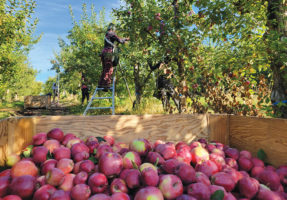
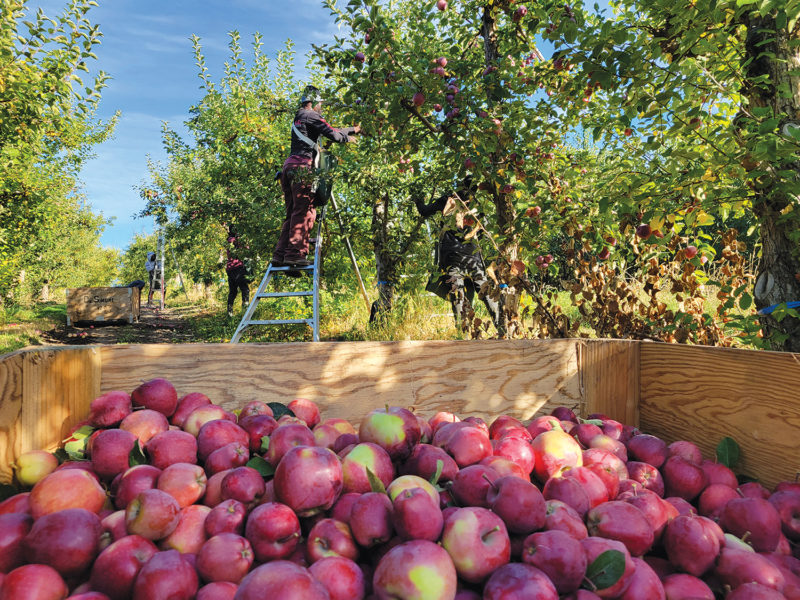
BC apple growers have shot down an initiative that would establish an apple marketing commission in BC. Photo | Myrna Stark Leader

September 27, 2023 byKate Ayers

BC’s apple harvest is in full swing, and early estimates indicate a slightly smaller crop but high-quality fruit.

Overall production is expected to be down about 10% this year, thanks in part to a 5% decline in acreage as well as weather.

The growing season in the Interior started about two weeks later than usual and cold weather in November and December 2022 impacted trees, says BC Fruit Growers Association general manager Glen Lucas. Some orchards in Keremeos suffered hail damage midway through the season.

High spring temperatures affected yields in some varieties, too.

“The warm spring, I feel like that is one of the reasons we have low tonnage,” says Mani Gill of Gill Family Orchards in Kelowna. “It was way too warm at 30°C that a lot of the blooms just dried up and the fruit didn’t get pollinated properly.”

Gill grows Gala, Ambrosia, Spartan, Granny Smith, Honey Crisp and Red Delicious varieties.

BCFGA initially anticipated a normal harvest this year, which is the case for some growers. Yield seems to depend on the area, with some producers dealing with significantly lower production, while others are in their normal ranges.

“It’s quite variable between varieties, between locations in the valley, within orchards,” Lucas says, noting that even individual trees have chequered production. “It’s quite a variable year.”

At Gill’s operation, yields vary block by block.

“The Granny crop looks good, overall, everything looks good,” he says. “The Ambrosia is probably the one that got hit the hardest. The tonnage looks like it’s lower than previous years.”

Some farmers in Vernon have suffered complete losses on their Ambrosia trees, he adds.

However, Lucas predicts an “outstanding” year for colour, and he has not heard of any quality issues due to low light, pests or disease.

“Quality is great,” Gill confirms. “We’ve had awesome weather in September – nice warm days and cool nights, so that’s helped a lot with the colour and sugars in the apples.”

Last year, the province harvested a total of 83,143 tons of fresh apples, the smallest crop of the past decade.

All content on this website is copyrighted, and cannot be republished or reproduced without permission.
Related Posts

You may be interested in these posts from the same category.

Cash Flows

Vernon growers address drought

Sun-Rype moves concern growers

Federal budget kills Living Labs

Cherry bonanza no jubilee

Arts leads BCFGA forward

Tesche leaving BCFGA

United front for fruit growers

Apple growers discuss marketing commission

BC Fruit Growers list test orchard

New fruit co-op discussed

Peach report bullish on future opportunities

Previous Post: « Prepare your orchard for extreme weather with a cooling system
Next Post: Crop failure wins wineries concessions »

© 2026 COUNTRY LIFE IN BC - ALL RIGHTS RESERVED