• Menu
  • Skip to primary navigation
  • Skip to main content
  • Skip to primary sidebar

Country Life In BC Logo

The agricultural news source in British Columbia since 1915

  • Headlines
  • Calendar
  • Subscribe
  • Advertise
  • About
  • Archives
  • Contact
  • Search
  • Headlines
  • Calendar
  • Subscribe
  • Advertise
  • About
  • Archives
  • Contact
  • Search

Primary Sidebar

Originally published:

September 2017
Vol. 103 Issue 9

Subscribe Now!

Sign up for free weekly FARM NEWS UPDATES

Select list(s) to subscribe to


By submitting this form, you are consenting to receive marketing emails from: Country Life in BC. You can revoke your consent to receive emails at any time by using the SafeUnsubscribe® link, found at the bottom of every email. Emails are serviced by Constant Contact
Your information will not be
shared or sold ever

Stories In This Edition

Bleak

Rising from the ashes

Foreign ownership on radar

Local knowledge & premise ID earn creditibility

Political overhaul targets major issues

Back to the future

Back Forty: Support can’t come soon enough

Viewpoint: Smartphones dial up new green revolution

Govt orders review of contaminated acquifer

Ag waste regs coming

Perfect attendance

BC-Washington collaborate on water mgmt

BC leads in organic consumption

Bracing for second flight of armyworm

Budget funding starts flowoing for genomics work

The “S” Team

Ag ministers sign new funding framework

Supply management takes hit

Delta land swap yields benefits

Consolidation strengthens ALR exclusion bid

Salt Spring facility gets big boost from local donor

Corn rootworm infesting FV crops

Kelowna farmers’ market gives new location a try

Compensetion sought for Clinton backburn

Fall promises volatility in cattle markets

Cattle feeders face certain uncertainties

Shave Shower Shampoo

Strong showing for Hereford Bonanza

Grain research helps address shifting conditions

FV, N OK dairies win at Chilliwack

Research: Breeding cows to beat the heat

Kootenay program aims to revive extension expertise

Beet trials target “seed sovereignty”

New hop debuts

Washington lab holds opportunities for grain growers

Sheep dog trials make comeback

Bear kills cause grief for Island sheep producers

Get it in writing

Celebrating 100 years: Eaglet FI

Managing risks, seizing opportunities

Naturally rich soil, low inputs support Kelowna garden

In celebration of thse who buy local

Woodshed: Ashley exercises power of persuasion

Jude’s Kitchen: Back-to-it Bites

More Headlines

Follow us on Facebook

Comments Box SVG iconsUsed for the like, share, comment, and reaction icons

6 days ago

... See MoreSee Less

View Comments
  • Likes: 4
  • Shares: 0
  • Comments: 0

Comment on Facebook

7 days ago

On the last day of the BC Organic Conference, Thursday, Molly Thurston of Pearl Agricultural Consulting helped growers learn how to manage bugs such as codling moth, wireworm, and rootworm in organic growing systems. Her talk alongside Renee Prasad included hands-on activities in which participants checked out various traps and examined pests under microscopes. Be sure to look for more upcoming ag events on our online calendar at www.countrylifeinbc.com/calendar/

#BCAg
... See MoreSee Less

On the last day of the BC Organic Conference, Thursday, Molly Thurston of Pearl Agricultural Consulting helped growers learn how to manage bugs such as codling moth, wireworm, and rootworm in organic growing systems. Her talk alongside Renee Prasad included hands-on activities in which participants checked out various traps and examined pests under microscopes. Be sure to look for more upcoming ag events on our online calendar at www.countrylifeinbc.com/calendar/

#BCAg
View Comments
  • Likes: 15
  • Shares: 0
  • Comments: 0

Comment on Facebook

1 week ago

Well-known organic farmer and podcaster Jordan Marr gets interviewed by Country Life in BC’s own columnist and potato mavin Anna Helmer during the opening session of the BC Organic Conference at Harrison Hot Springs yesterday. Sessions run today (Wednesday) and Thursday and include organic and regenerative growing practices and expanding and advocating for the organic sector, all under the background of the newly launched Organic BC banner.

#BCAg
... See MoreSee Less

Well-known organic farmer and podcaster Jordan Marr gets interviewed by Country Life in BC’s own columnist and potato mavin Anna Helmer during the opening session of the BC Organic Conference at Harrison Hot Springs yesterday. Sessions run today (Wednesday) and Thursday and include organic and regenerative growing practices and expanding and advocating for the organic sector, all under the background of the newly launched Organic BC banner.

#BCAg
View Comments
  • Likes: 37
  • Shares: 2
  • Comments: 1

Comment on Facebook

Interested in finding out more about this

3 weeks ago

Today, we remember those who sacrificed their lives or their well-being for our freedom. Lest we forget. ... See MoreSee Less

Today, we remember those who sacrificed their lives or their well-being for our freedom. Lest we forget.
View Comments
  • Likes: 8
  • Shares: 0
  • Comments: 0

Comment on Facebook

1 month ago

FarmFolk CItyFolk is hosting its biennial BC Seed Gathering in Harrison Hot Springs November 27 and 28. Farmers, gardeners and seed advocates are invited to learn more about seed through topics like growing perennial vegetables for seed, advances in seed breeding for crop resilience, seed production as a whole and much more. David Catzel, BC Seed Security program manager with FF/CF will talk about how the Citizen Seed Trail program is helping advance seed development in BC. Expect newcomers, experts and seed-curious individuals to talk about how seed saving is a necessity for food security. ... See MoreSee Less

Link thumbnail

BC Seed Gathering - FarmFolk CityFolk

farmfolkcityfolk.ca

Save the date for our upcoming 2023 BC Seed Gathering happening this November 3rd and 4th at the Richmond Kwantlen Polytechnic University campus.
View Comments
  • Likes: 1
  • Shares: 0
  • Comments: 0

Comment on Facebook

Subscribe | Advertise

The agricultural news source in British Columbia since 1915
  • Email
  • Facebook

Beet trials target “seed sovereignty”

September 1, 2017 byPeter Mitham

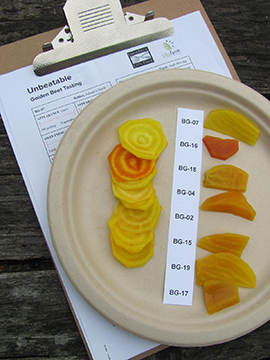
VANCOUVER – Visitors to the UBC Farm market on July 22 received a taste of the latest selections in the BC Seed Trials, a province-wide program that hopes to lay the foundation for the production of seed suited to the province’s different growing regions.

While the curiosity and qualms of many visitors were audible around the kiosk where samples were being doled out, the diversity of opinion was exactly what co-ordinator Chris Thoreau wanted. The more people who participated in the taste test, the better the range of feedback he would have regarding consumer experience of the root vegetable that can be served pickled, roasted, chipped or – as unlikely as it sounds – in ice cream.

“The tasting events are a great way for us to engage the public in research that can easily just remain in the field with only the researcher seeing the results,” Thoreau said. “I had the chance to ask several people why they were attending the event and it was interesting to hear how many people said they simply just love beets! We were also able to observe how tasting participants engaged with each other as they tasted and discussed the beets.”

The varieties on trial were all gold-coloured, some with pronounced striping. They included traditional varieties such as Burpee’s Golden to newer selections including Badger Torch. All were open-seeded, because the focus of the BC Seed Security program is to identify varieties that give growers greater control over production. Seed from the varieties is intended to be saved, ideally weaning growers from dependence on corporate seed purveyors.

Right now, most seed-saving is done by small companies supplying backyard gardeners. Commercial growers tend to source seed from the large commercial seed producers offering affordable, reliable, disease-free seed.

“You can’t tell the quality of the seed till you’ve grown your crop,” Thoreau said. This means commercial growers tend to stick with mass-produced seed they can trust, often from outside their own region.

All told, 212 scorecards were received, up from 150 last year. The cards asked participants to rank raw and cooked samples of the eight varieties on trial according to four traits: appearance, sweetness, earthiness and metallic characters or bitterness. Collation and analysis of the information will take place over the summer, and the results are posted periodically at [www.bcseedtrials.ca/trials-results/].

Beet-infused dishes

In addition to the formal taste test, chef Rob Cleland of the Ash Street Bistro in Vancouver served up a sparkling beet-infused beverage, beet tortellini and beet ice cream dusted with ginger-beet sprinkles. The dishes were designed to show market visitors just what was possible with beets beyond pickles.

Planting at UBC took place May 8 and the roots were harvested July 13.

Besides the plot at UBC Farm, the trial varieties were planted at farms on Gabriola Island, Saanich, Ladysmith, Prince George and Quesnel. All varieties are numbered, and the numbers are specific to each farm, ensuring that growers are blind to what they’re growing.

This year’s seed trials included carrots as well as 33 varieties of leeks. Last year, kale and spinach were tested alongside beets. Kale and other brassicae have been the most successful crops to date in the seed trials, showing a particular zest for BC conditions.

The selections are planted three times over at each location to rule out variations in local site conditions.

Thoreau showed visitors the UBC Seed Hub, a planting of several species designed to illustrate how seed production could be part of a working farm. Typically a challenging endeavour, Thoreau said many growers also find seed production alluring.

“People are really drawn to seed production,” he said. “Once they get it into their blood, they can’t get rid of it.”

While seed production is big business in Washington state, Thoreau would like to increase opportunities for BC growers. Ideally, he would like to see BC pursue seed sovereignty with the same enthusiasm directed towards food sovereignty.

His own zeal isn’t in question: flies are pollinators of carrots and rather than source maggots from the US, Thoreau placed hunks of raw meat in the isolation structure built to protect seed-yielding carrot plants from potential cross-pollination by their cousin, Queen Anne’s Lace. The meat gave rise to a far larger fly population than he ever expected.

But if fly production is easy, seed production for commercial vegetable producers is not. Selecting viable seeds for the local climate is the first step; ramping up production is quite another. The sheer scale of production required to produce millions of tiny seeds for growers requires hundreds of acres, not the fractions currently used for the trial program.

“I think it’s a little more than people expected,” he conceded.

This means commercial growers will be dependent on the big supply companies for the foreseeable future.

Nevertheless, organic growers like Lydia Ryall of Cropthorne Farm in Delta sees value in the trials.

She sources her seed commercially, simply because sources of BC-tailored seed are non-existent. She hasn’t had the choice to date but having seed suited to local conditions has its advantages.

“Sometimes our seed is grown in one specific place in the world or one specific farm and if there are issues, then some years we don’t have access to a certain variety,” Ryall said. “So, if there’s more places that are growing some of these mainstay varieties that market farms use, then that’s a positive.”
Related Posts

You may be interested in these posts from the same category.

Greenhouse, nursery specialist named

Beefsteak tomatoes get smoked

BC Veg names officers

Previous Post: « Compensation sought for Clinton backburn debacle
Next Post: Buggy season »

Copyright © 2025 Country Life in BC · All Rights Reserved