• Menu
  • Skip to primary navigation
  • Skip to main content
  • Skip to primary sidebar

Country Life In BC Logo

The agricultural news source in British Columbia since 1915

  • Headlines
  • Calendar
  • Subscribe
  • Advertise
  • About
  • Archives
  • Contact
  • Search
  • Headlines
  • Calendar
  • Subscribe
  • Advertise
  • About
  • Archives
  • Contact
  • Search

Primary Sidebar

Current Issue:

JANUARY 2026
Vol. 112 Issue 1

Subscribe Now!

Sign up for free weekly FARM NEWS UPDATES

Select list(s) to subscribe to


By submitting this form, you are consenting to receive marketing emails from: Country Life in BC. You can revoke your consent to receive emails at any time by using the SafeUnsubscribe® link, found at the bottom of every email. Emails are serviced by Constant Contact
Your information will not be
shared or sold ever

Follow us on Facebook

Comments Box SVG iconsUsed for the like, share, comment, and reaction icons

10 hours ago

BC's minimum piece rates for 15 hand-harvested crops increased 2.6% on December 31. Crops include peaches, apricots, brussels sprouts, daffodils, mushrooms, apples, beans, blueberries, cherries, grapes, pears, peas, prune plums, raspberries and strawberries. Farm-worker piece rates in BC were increased by 11.5% in January 2019 and 6.9% in December 2024. BC’s current minimum wage sits at $17.85 per hour.

#BCAg
... See MoreSee Less

BCs minimum piece rates for 15 hand-harvested crops increased 2.6% on December 31. Crops include peaches, apricots, brussels sprouts, daffodils, mushrooms, apples, beans, blueberries, cherries, grapes, pears, peas, prune plums, raspberries and strawberries. Farm-worker piece rates in BC were increased by 11.5% in January 2019 and 6.9% in December 2024. BC’s current minimum wage sits at $17.85 per hour. 

#BCAg
View Comments
  • Likes: 6
  • Shares: 0
  • Comments: 2

Comment on Facebook

I'm not sure what they're telling us. Did peace rates have to increase so that Farm workers could make minimum wage?

They deserve it, but the general public will be whining about increased prices in the stores. Will need to make more information average to the g.p.

2 days ago

... See MoreSee Less

View Comments
  • Likes: 9
  • Shares: 0
  • Comments: 0

Comment on Facebook

1 week ago

... See MoreSee Less

View Comments
  • Likes: 7
  • Shares: 0
  • Comments: 0

Comment on Facebook

3 weeks ago

Water volumes from the Nooksack River are at levels similar to 1990 and 2021, but the province says flows should peak at 10pm tonight. The shorter duration, as well as conditions in other watercourses within the watershed and performance of flood protection infrastructure should avoid a catastrophe on the scale of 2021. However, several landslides mean road closures have once again effectively isolated the Lower Mainland from the rest of the province.

#BCag
... See MoreSee Less

Water volumes from the Nooksack River are at levels similar to 1990 and 2021, but the province says flows should peak at 10pm tonight. The shorter duration, as well as conditions in other watercourses within the watershed and performance of flood protection infrastructure should avoid a catastrophe on the scale of 2021. However, several landslides mean road closures have once again effectively isolated the Lower Mainland from the rest of the province.

#BCAg
View Comments
  • Likes: 9
  • Shares: 3
  • Comments: 1

Comment on Facebook

Family living in Sumas WA say it's very much like '21. They have the same amount of water in their house as last time.

1 month ago

... See MoreSee Less

View Comments
  • Likes: 4
  • Shares: 0
  • Comments: 0

Comment on Facebook

Subscribe | Advertise

The agricultural news source in British Columbia since 1915
  • Email
  • Facebook

Cherry virus survey proposed

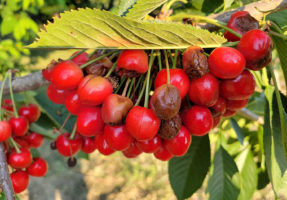
Bing Cherries with Little Cherry Virus 2. Photo credit Dr. Andrea Bixby Brosi.

May 5, 2021 byJudie Steeves

A new industry-led task force hopes to survey cherry growers this summer to ensure a disease that devastated BC’s cherry industry decades ago doesn’t return.

Kootenay growers first reported little cherry disease in 1933. By 1946, almost every tree in the region was infected by the virus that causes the disease, which results in under-sized fruit with little flavour. It remained that way until the early 1980s when all cherry trees and wild hosts in the Creston Valley were removed and growers replanted their orchards with virus-free trees.

The disease turned up in the Okanagan in 1969. Regular surveys were done throughout the Okanagan beginning in 1970 and infected trees were removed. But funding for the program was cut in 2003.

Mike Sanders, a retired agrologist who worked with the BC agriculture ministry in the early 1970s, says that has left the industry without a handle on the situation.

“We don’t have a clue what the situation is today. That’s scary,” he says. “We don’t know if there has been any spread since then.”

Little Cherry Disease and two similar afflictions have cost Washington growers $80 million in crop losses, tree removal and replanting over the past eight years.

With that in mind, the research and extension committee of the BC Cherry Association has established a 13-member task force chaired by Sanders to address the disease in BC. The task force includes representation from industry and government and is seeking funding to survey orchards in areas identified as ‘of concern’ in previous surveys.

To give the survey a head start, the task force is asking growers to scout for symptoms prior to harvest and mark suspect trees. Should the province provide funding, a formal survey will launch this summer.
Related Posts

You may be interested in these posts from the same category.

Staccato cherry rights defended

Cherries replant funding opens

BC Cherry holds AGM

Cherry growers weigh trade complaint

Cherry promotion promising

Cherry harvest firming up

New rules for pesticide applications

Orchard sector pilots new job-matching website

Fruit growers face hard choices

Fruit growers seek workers

Cherry Blossom

Frost nips cherry growers

Cherry growers continue to focus on export markets

Previous Post: « Grape pomace upcycled
Next Post: AITC funding in limbo »

Copyright © 2026 Country Life in BC · All Rights Reserved