• Menu
  • Skip to primary navigation
  • Skip to main content
  • Skip to primary sidebar

Country Life In BC Logo

The agricultural news source in British Columbia since 1915

  • Headlines
  • Calendar
  • Subscribe
  • Advertise
  • About
  • Archives
  • Contact
  • Search
  • Headlines
  • Calendar
  • Subscribe
  • Advertise
  • About
  • Archives
  • Contact
  • Search

Primary Sidebar

Originally published:

MAY 2020
Vol. 106 Issue 5

Subscribe Now!

Sign up for free weekly FARM NEWS UPDATES

Loading form…

Your information will not be
shared or sold ever

Stories In This Edition

Rapid response

Worker health crisis

Spring melt floods Cariboo

Foreign Labour an essential service for fruit growers

Editorial: Watershed moments

Back Forty: COVID-19 will be a reality check for many

Viewpoint: Register now, question later to keep water rights

COVID-19 has varied impact on poultry sector

Social distancing

Honey producers keep focus on research

Beekeepers stung about import issues

Sidebar: Advocating for technology transfer

Farmland values facing headwinds

IAFBC defers major decisions

BCAC focuses on public trust with lower budget

AgSafe governance set for a shake-up

COVID-19 leads to oversupply of dairy

BC Fairs positive as large events banned

Peace growers facing multiple challenges

Co-op considers four-way fix at crossroads

Surprise audits to double

Co-op focuses on cutting costs, increasing sales

Volatility from plant shutdowns could hit BC

Island farmers renew request for local abattoir

Meat processing capacity stable despite closures

Direct marketing saves producers’ bacon

Small producers ride the online sales wave

Farm equipment dealers keep sale smoving

Strawberry growers pin survival on levies

Sidebar: Blueberry and raspberry AGMs postponed

Raspberry growers target fresh market, quality

Apple soda breaks ground in saturated market

Chilliwack family cracks open direct sales

EFB-resistant trees not out of the woods

Distillery shows resilience as it adapts to market

Home gardeners overwhelm seed companies

Sidebar: Commercial seed supply affected

Research: Viruses pursue unique strategies to evolve

Moisture sensors are not created equal

Woodshed: Kenneth gives new meaning to social isoluation

Farmers’ markets go online as channels shift

Farm Story: Pandemic forces a hard pivot to stay in the game

Cheesemaker adapts to coronavirus restrictions

Jude’s Kitchen: Stay-healty food in uneasy times

More Headlines

Follow us on Facebook

Comments Box SVG iconsUsed for the like, share, comment, and reaction icons

6 days ago

A BC Forest Practices Board investigation has found overgrazing has damaged grasslands in the Coutlee Range Unit near Merritt — and the range-use plan meant to prevent it was unenforceable. With complaints about overgrazing on the rise and grasslands covering just 1% of BC's land mass, the findings raise fresh questions about how the province manages one of its most vulnerable — and valuable — food-producing ecosyste#BCAg#BCAg ... See MoreSee Less

Link thumbnail

Board finds overgrazing rules unenforceable unmeasurable

www.countrylifeinbc.com

MERRITT – A BC Forest Practices Board investigation has found instances of non-compliance related to overgrazing have damaged open grasslands in the Mine pasture, part of the Coutlee Range Unit near...
View Comments
  • Likes: 6
  • Shares: 6
  • Comments: 6

Comment on Facebook

Several ranchers in recent years have gone into temporary non use on that range , so that means the grass should grow. But drought conditions/lack of rain and snow don’t allow that to happen . Dried up springs , creeks waterholes in various pastures add to over grazing where there is water , as livestock and everything else stay close to the water source . So even though less cattle are on it , over grazing appears. There is a large volume of horses on it 365 days/year which is wrong ! They pull grass right out of the ground when it’s just trying to grow ,, opens the door for weeds to grow in. That don’t help it. Aging infrastructure ( fences) laying on the ground, pipe line building , ( lack of commitment to fence maintenance) amongst all users contributes also to over grazing. Recreational atv users leaving gates open between pastures allows livestock to go back or ahead in pastures also expidites over grazing. Logging ( bcts) has no problem laying out cut locks on both sides of a fence , then it gets smashed down during logging and they don’t take responsibility to stand it back up or clean the cattle gaurds out when they are done , that happened 4 years ago on pasture 5 up there . I bet it is still not fixed . There are lots of contributing factors to the problem.

Tragedy of the commons.

I looked through the report. I saw nothing about the effects of noxious weeds on productive grasslands. This particular area is vulnerable because of the Ministry’a efforts to diversify the use of the Grasslands.

This pasture is under tremendous pressure not only from cattle but from irresponsible local residents who treat it as a landfill dumping all manner of household debris here. And don't even get me started on the mud bogging and camping in sensitive riparian areas. The feral horses are in this pasture 365 days a year just hammering it. Would sure be nice to see some enforcement action on people who are intentionally ripping up the grasslands and riparian areas. Cattle could be a valuable resource for rebuilding soils and native grasses in this area with the help of electric fencing and/or e-collars. The humans will be harder to manage.

The Forest and Range Practices Act was written by lawyers for global forest licencee shareholders. Results-based = unenforceable.

Also, can we talk about the impact of a pipeline being built through the middle of this field for multiple years?

View more comments

1 week ago

East Kootenay rancher Randy Reay is digging a new well after two natural water sources dried up on his Crown tenures. A new Living Lakes Canada assessment found 15% of mapped aquifers in the region are high-priority for monitoring, yet 80% of those go unmonitored. With over 48% of BC's provincial observation wells reporting below-normal groundwater levels, ranchers and researchers are sounding the alarm on water security. The story is in our March edition, and we've posted it to our website thi#BCAgk.

#BCAg
... See MoreSee Less

Link thumbnail

Water woes: groundwater under pressure across BC

www.countrylifeinbc.com

JAFFRAY – As a young boy growing up in the Kootenay-Boundary region, Randy Reay never expected to run out of water. But this year, in mid-February, his fields are bare. There is no snow halfway up t...
View Comments
  • Likes: 8
  • Shares: 7
  • Comments: 1

Comment on Facebook

Jaffrey is in the east Kootenays not kooteney boundary

2 weeks ago

BC farmers are bracing for prolonged higher input costs as war in the Middle East drives up fuel and fertilizer prices. Nitrogen fertilizer costs were already climbing before the Iran conflict began, with prices still roughly 60% above pre-pandemic levels. Farm Credit Canada warns that unlike 2022, strong commodity prices may not offset rising costs this time. Local suppliers expect supply challenges and further price increases ahead.

#BCAg
... See MoreSee Less

Link thumbnail

Fertilizer prices on the rise

www.countrylifeinbc.com

War in the Middle East has delivered a generational shock to energy prices, meaning BC farmers can expect a prolonged period of higher costs not just for fuel but also for fertilizer.
View Comments
  • Likes: 2
  • Shares: 1
  • Comments: 0

Comment on Facebook

2 weeks ago

... See MoreSee Less

View Comments
  • Likes: 1
  • Shares: 0
  • Comments: 0

Comment on Facebook

2 weeks ago

Cameron Stockdale is the new executive director of provincial farm safety organization AgSafeBC. Find out more in this week's Farm News Update from Country Life in B#BCAg#BCAg ... See MoreSee Less

Link thumbnail

New leadership at AgSafe BC

www.countrylifeinbc.com

Cameron Stockdale is the new executive director of provincial farm safety organization AgSafeBC, succeeding Wendy Bennett. Bennett left AgSafeBC in September 2025, following 12 years with the…
View Comments
  • Likes: 5
  • Shares: 1
  • Comments: 0

Comment on Facebook

Subscribe | Advertise

The agricultural news source in British Columbia since 1915
  • Email
  • Facebook

Chilliwack family cracks open direct sales

The Egg Shack expands to roadside sales

May 1, 2020 byJackie Pearase

CHILLIWACK – A foray into farmgate egg sales using an automated, cashless vending machine is proving advantageous for Brightside Poultry in Chilliwack.

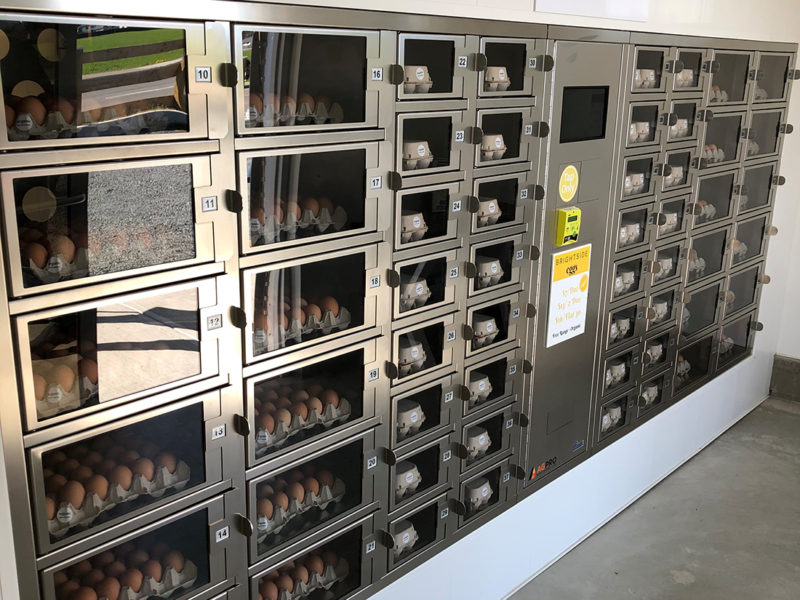
Richard and Jacqueline Boer have the first farm in North America to use the egg vending machine, made by Roesler Vending in Germany.

Launched last September, the option to buy local, organic free-range eggs by tap, debit or credit from a machine has increased in popularity since the COVID-19 pandemic ushered in social distancing and no-touch transactions.

“The virus has been good to our on-farm vending business. I think we’re one of the few types of businesses that are able to say that,” notes Jacqueline Boer. “We were selling only about 1% from the farm gate but right now we’re up to about 15%.”

She says that on March 15, as panic buying set in after BC began restricting public gatherings, they sold 50% of the eggs in their barn.

Brightside is located on Evans Road, and the Boers always wanted to capitalize on the large volume of traffic that passes by their third-generation farm.

“We’ve always wanted to market what we’re producing from the farm gate,” Boer says. “We chose not to go the dairy route because we don’t want to process dairy. But because there’s so much less processing involved with eggs, this is our chance to get our feet wet in retailing.”

In addition to eggs, the farm sustains a dairy operation started in the 1950s and the Boers added broilers in 2013 after winning the new entrant broiler quota lottery.

The couple purchased a layer quota in 2016, added 4,000 laying hens to the farm in 2017 and currently have a flock of about 7,500 birds. A new barn constructed in 2019 has room for up to 16,000 birds.

In November 2018, they went to EuroTier, a trade show for livestock producers in Hanover, Germany, to purchase equipment for the new barn. They looked at several types of vending machines, widely used for hot and cold products in Europe, and ended up purchasing one.

The machine can be configured to accommodate different-sized items. The Boers sell dozens, double-dozens and flats from The Egg Shack, located in the new barn that is purposely cooled for the eggs.

Boer says they did not intend on selling products other than eggs from the vending machine but that may change if consumer demand for local food continues after the pandemic and grows.

“Our perspective has changed through this COVID thing; we may look at some other options down the road. It wasn’t really our intent when we set up,” she says. “There’s a renewed level of public trust with farmers right now. Two months ago, the public didn’t trust us and now, all of a sudden, we’re a pillar in the community, providing fresh local food.”

The machine was a significant investment and the Boers applied for and received partial funding from the Canadian Agricultural Partnership through the Investment Agriculture Foundation of BC.
Related Posts

You may be interested in these posts from the same category.

AI response in spotlight

Ministers discuss avian influenza

COVID-19 response reviewed

Poultry gatherings banned

Second high-path AI case

BC Chicken picks Siemens

Federal election call

COVID influences food demand

Record temps kill poultry

Livestock producers count losses

Farmers market returns

Sector events start growing

Previous Post: « Distillery shows resilience as it adapts to market
Next Post: Island farmers renew request for local abattoir »

Copyright © 2026 Country Life in BC · All Rights Reserved