
• Menu
  • Skip to primary navigation
  • Skip to main content
  • Skip to primary sidebar

Country Life In BC Logo

The agricultural news source in British Columbia since 1915

  • Headlines
  • Calendar
  • Subscribe
  • Advertise
  • About
  • Archives
  • Contact
  • Search
  • Headlines
  • Calendar
  • Subscribe
  • Advertise
  • About
  • Archives
  • Contact
  • Search

Primary Sidebar

Originally published:

JULY 2019
Vol. 105 Issue 7

Subscribe Now!

Sign up for free weekly FARM NEWS UPDATES

Select list(s) to subscribe to


By submitting this form, you are consenting to receive marketing emails from: Country Life in BC. You can revoke your consent to receive emails at any time by using the SafeUnsubscribe® link, found at the bottom of every email. Emails are serviced by Constant Contact
Your information will not be
shared or sold ever

Stories In This Edition

Breakfast on the Farm

Province blinks on ALR

Berry grower hit with fines

BC hop industry matures despite challenges

Smaller than small

Back 40: The ups (and downs) of sustainable agriculture

Viewpoint: Debate over cannabis underscores challenges

Dry weather ushers in provincewide drought

Giant bee-killing hornet identified in Vancouver

Weather ideal for early start to strawberries

Fresh BC strawberries …

FIRB sides with K&M on annualized production

Pricing remains on ongoing issue for poultry sector

Tree fruit competitiveness funds start to flow

Farmers institute members discuss ALR changes

Dairy association seeks general manager

Sitting down on the job

Online platform gives food a second chance

Armyworm comes back for a second helping

Cannabis genes key to long-term success

Twenty years of ambassadors reunite

Policy shifts top ranchers’ list of concerns

Winner! Winner!

Clifton Ranch aims for better beef, habitat

Sidebar: Ranch operations

Treaties create uncertainty for range users

Market Musings: Summertime slowdown

Do you know a horse …

Grazing targets fire prevention, suppression

Kestrel nestbox project will help control starlings

Sterile moth program heads south of the border

Young farmers served a heaving helping of surf ‘n turf

Research: Welfare, reproduction a complex relationship

Variety trials showcase fresh options

Sweet potato has promise for BC growers

Headway made on organic SWD controls

My turn!

The fine art of raising commercial poultry

Winfield couple banks on organic growth

Woodshed: Plans hatch while Kenneth plays golf

Breakfast on the Farm has lessons for everyone

Jude’s Kitchen: Healthy choices

More Headlines

Follow us on Facebook

Comments Box SVG iconsUsed for the like, share, comment, and reaction icons

24 hours ago

Four 4-H members were walking the Islands Ag Show Friday sharing leftover flower lollipops to exhibitors. The colourful pops were prizes for those who guessed answers based on the 4-H project boards on display at the show. Left to right, Talia Prenger, Kate Barter, Ella Prenger and Emma Barter of Parksville and Qualicum thought making lollipops into flowers "was really cute," says Kate. The Islands Ag Show wraps up today at 2 pm at the Cowichan Exhibition Centre. Stop by our booth and say hi to Ronda, Bob and Ann!

#BCAg
... See MoreSee Less

Four 4-H members were walking the Islands Ag Show Friday sharing leftover flower lollipops to exhibitors. The colourful pops were prizes for those who guessed answers based on the 4-H project boards on display at the show. Left to right, Talia Prenger, Kate Barter, Ella Prenger and Emma Barter of Parksville and Qualicum thought making lollipops into flowers was really cute, says Kate. The Islands Ag Show wraps up today at 2 pm at the Cowichan Exhibition Centre. Stop by our booth and say hi to Ronda, Bob and Ann! 

#BCAg
View Comments
  • Likes: 21
  • Shares: 4
  • Comments: 0

Comment on Facebook

3 weeks ago

The Canadian Food Inspection Agency is preparing to implement changes to its livestock traceability rules that will include mandatory computer reporting within seven days on movement of animals for veterinary appointments, community pastures, exhibitions, carcass and on-farm disposal and the births and deaths of every animal on your farm. Writer Tom Walker first brought these changes to the attention of our readers back in June 2023. We've posted his story to our website:

www.countrylifeinbc.com/cfia-proposes-traceability-updat#BCAg#BCag
... See MoreSee Less

The Canadian Food Inspection Agency is preparing to implement changes to its livestock traceability rules that will include mandatory computer reporting within seven days on movement of animals for veterinary appointments, community pastures, exhibitions, carcass and on-farm disposal and the births and deaths of every animal on your farm. Writer Tom Walker first brought these changes to the attention of our readers back in June 2023. Weve posted his story to our website: 

https://www.countrylifeinbc.com/cfia-proposes-traceability-updates/

#BCag
View Comments
  • Likes: 11
  • Shares: 21
  • Comments: 15

Comment on Facebook

I love hpw the cow in the picture hasn't even got a RFID tag in it but I digress. We can not read the link, it says "we are not permitted to read drafts". Please post again with the correct link.

Dairy farmers having been doing this several years. The app we use has become quite simple to use

Including equine?

Premise ID was slowly rolled through the country, voluntary then mandatory. Transparency and 'Consultation' has been light. Those who tried to bring this for discussion a couple years ago, because of forseen overreach, were quite often labeled conspiracy theorists and that it wasnt meant to be so heavily regulated and controlled. Gardens and seeds will be next. "Invasive species" reporting, check out the plants medicinal properties. Read the BC intentions papers. The premise ID that already heavy regulated commodities have claims to be treated different in the intentions papers on page 8. www2.gov.bc.ca/assets/gov/farming-natural-resources-and-industry/agriculture-and-seafood/food-saf...

Says i am "not allowed to preview draft".

Also concerning is the part on compliance...they can 'stumble onto' any farm and if you're not complying there are consequences.

When the CFIA stumbles into the wrong place compliance will be met with civil engagement

Says I can't preview draft

This is government overreach - Do Not Comply!

Do not comply

Fu

As if the price of beef isn't bad enough for consumers,,,,,be prepared to be gouged some more now

Ridiculous!!

Let's hold up on the beef exports tell we can get our own house in order... we need to deregulated, cheapen up the supply chain back into a 5 buck a pound rage so the good people canada can eat healthy food.. fuck your bean diets, that's retarded

This, along with the majority of new legislation pertaining to any type of farm, is a blatant squeeze on any sort of small, alternative agricultural venture. I am a massive believer in working together and sharing resources and costs and solutions - do not get me wrong - but this and the water registration among others, is an overreach (at most generous) and an absolute killer to smaller, local initiatives that LITERALLY save lives during extreme events. There is ONE ROAD into and out of my community. We don’t need or want some sort of backlogged government response when shit goes sideways. We want the ability AND SUPPORT to provide for our communities without penalty when things go badly. We want to produce sustainability for our communities. We live here, we work here, we want to STAY HERE. Stop making it harder.

View more comments

4 weeks ago

BC's minimum piece rates for 15 hand-harvested crops increased 2.6% on December 31. Crops include peaches, apricots, brussels sprouts, daffodils, mushrooms, apples, beans, blueberries, cherries, grapes, pears, peas, prune plums, raspberries and strawberries. Farm-worker piece rates in BC were increased by 11.5% in January 2019 and 6.9% in December 2024. BC’s current minimum wage sits at $17.85 per hour.

#BCAg
... See MoreSee Less

BCs minimum piece rates for 15 hand-harvested crops increased 2.6% on December 31. Crops include peaches, apricots, brussels sprouts, daffodils, mushrooms, apples, beans, blueberries, cherries, grapes, pears, peas, prune plums, raspberries and strawberries. Farm-worker piece rates in BC were increased by 11.5% in January 2019 and 6.9% in December 2024. BC’s current minimum wage sits at $17.85 per hour. 

#BCAg
View Comments
  • Likes: 9
  • Shares: 0
  • Comments: 2

Comment on Facebook

I'm not sure what they're telling us. Did peace rates have to increase so that Farm workers could make minimum wage?

They deserve it, but the general public will be whining about increased prices in the stores. Will need to make more information average to the g.p.

1 month ago

... See MoreSee Less

View Comments
  • Likes: 14
  • Shares: 0
  • Comments: 1

Comment on Facebook

105 Mile Ranch

1 month ago

... See MoreSee Less

View Comments
  • Likes: 7
  • Shares: 0
  • Comments: 0

Comment on Facebook

Subscribe | Advertise

The agricultural news source in British Columbia since 1915
  • Email
  • Facebook

Clifton Ranch aims for better beef, habitat

Care for habitat is integral to herd management

June 30, 2019 byTom Walker

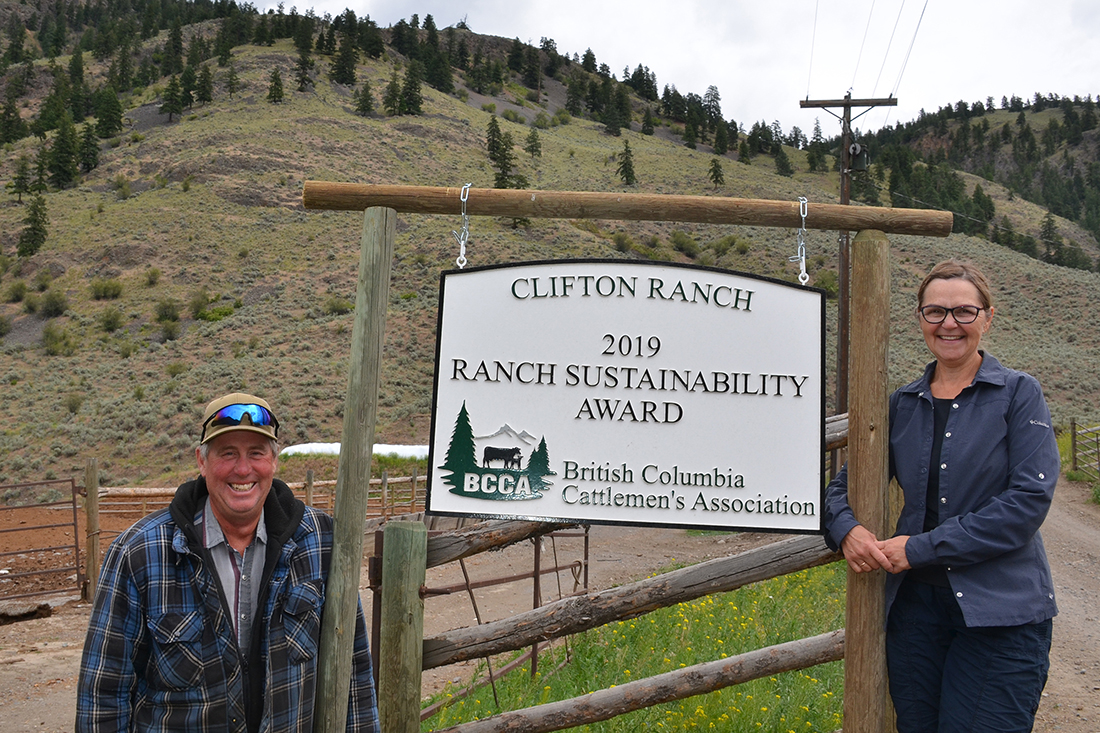
KEREMEOS—The Clifton family was extremely pleased to receive the 2019 Ranch Sustainability Award from the BC Cattlemen’s Association, but the initiatives designed to improve habitat on the family’s ranch weren’t done for attention.

“We didn’t start out to do this with the idea of winning an award,” says Wade Clifton, who undertook the projects with his brother Brad, who died in February. “We did it so that we could better manage the grass for our herd and grow more pounds of beef.”

It’s a tough place to manage grass. Clifton Ranch sits by Olalla on Hwy. 3A at the north entrance to the Similkameen valley. Its range is east over White Lake into Okanagan Falls and west through to Princeton and takes in some of the hottest and driest grasslands in the province.

“On the slopes next to White Lake, it can regularly reach 45 [degrees] Celsius,” says Clifton. Rainfall averages around 12 inches a year.

A key part of the sustainability equation for the Cliftons is economics.

“A project had to make economic sense before we developed it,” says Clifton.

An investment in a water system for example, will support the development of better grazing for the cattle and it will also enhance the restoration of a riparian area.

But one objective doesn’t outweigh the other. What’s good for the cattle is also good for the habitat.

Range cattle will gather where there’s water.

“When we had them drinking out of Horn Lake, the riparian area was heavily impacted by all the traffic, but the hillsides were quite scoured as well,” notes Clifton.

Initially, the cattle would overgraze the bottom grass closest to the lake.

“They would eventually move up the mountain for better grass, but then they would track back down to drink and they wore paths into the soil that would start to erode the hillsides,” he explains.

Brad Clifton’s solution was to install a 1,700-foot, high-elevation spring-sourced water line connecting nine water troughs located across the hillside. This led to multiple benefits.

“The first thing it did was to lure the cattle out of the bottom riparian area up to where there was better grass so that they ate better,” says Clifton.

The multiple troughs spread the cattle over a broader area, leading to less impact on the grass. The cattle began grazing across the slope rather than up and down the hillside, reducing impacts on the land. The riparian area saw less traffic, so it had a chance to recover, too.

In the long run, the cattle eat better, gain weight and put more dollars into the Cliftons’ pockets.

Overall, the Cliftons have 100 water developments. Some are gravity-fed systems, others are as simple as a collection trough on a small spring.

Any riparian fencing has a wildlife-friendly design. The top and bottom strands are plain wire with the middle three stands barbed.

“When deer go over it they are not going to catch a barb on their coat causing an injury and possibly ripping the fence,” explains Clifton. “It’s easier on the animals and we spend less time fixing fences.”

Clifton shows another range area that is also supported by a trough system and points out the unfenced creek bottom.

“When the cattle have access to water up in the hills, they don’t regularly come down to the creek,” he points out. “We don’t have to fence them out of the riparian area because they are only there for a couple of days to eat the grass and then they move up the hill and don’t come back.”

That dry Similkameen grassland is also home to 31 species at risk. As Ottawa identified and developed plans for the protection of these species on federal grazing lands, discussions with ranchers centered on the presence of cattle.

“They said if they remove the cattle we are going to help the species at risk,” Clifton recalls. “And I asked, is it going to help them?”

Challenging the conventional wisdom was mighty scary at first, but the Cliftons explained how the cattle were a key part of the grasslands ecosystem. Each individual species requires a diverse habitat and removing the cattle would significantly alter that diversity.

“Cattle have been grazing on that land for over 100 years,” notes Clifton. “The species that live there do so because the habitat supports them, and cattle are a significant part of that habitat.”

The family has won recognition for its work with the Nature Trust of BC in developing a range management plan that incorporates cattle to restore grasslands around White Lake. The White Lake Biodiversity Ranch is now a showcase property in the Nature Trust’s portfolio.

“They are 100% on-side with how we are managing,” says Clifton.

The Cliftons had bought half of White Lake Ranch, which is the middle of their range area, and Nature Trust had bought the other half hoping to restore areas which were overgrazed.

Clifton says the plan initially called for fencing off the grasslands to keep cattle out but it wasn’t working. That’s when they approached the Cliftons about a partnership.

“We asked them to consider what the cattle might do to help restore the grass,” says Clifton. “We showed them how, when grass is grazed at the right time, it stimulates a strong regrowth. We pointed out the weeds that the cattle would eat and we explained how closely we monitor and time our grazing.”

Indeed, timing is a key to the Clifton’s grazing plan.

“We watch our grasslands really closely to time our turn-out,” he says. “We don’t look at the calendar, we look at the grass to know when it is ready.”

In the most sensitive areas around White Lake, the cattle are on for just two weeks, sometimes with a three-year gap.

“This is a 50-year process,” notes Clifton. “When the grasslands are depleted in this hot, dry, environment, it takes a long time to recover.”

The restoration is starting to show success. Clifton points to a control area that is fenced off and has not had cattle grazing. That pasture has poor forage growth with weeds choking out the grass. Across the road, a grazed field has taller, healthier grass and fewer weeds.

The non-grazed area might eventually recover, says Clifton.

“The weeds might reach a point after a number of years where they crash, and the grass has a chance to come back,” he says. “But it is a lot of waiting for an unknown outcome.”

Due to the unique ecosystem and the location, there are multiple agencies that have interests in the grasslands of the South Okanagan and Similkameen. It is obvious from spending time with Clifton that his low-key, yet highly informed manner would come to be respected among the various interest groups and government agencies he deals with.

For the family, being recognized with the sustainability award creates opportunities to share their story of how cattle can support an ecosystem rather than damage it.

“What I am hoping more than anything is that it shows that cattlemen are actually doing the right thing to maintain our grasslands,” says Clifton. “I hope we can train people to u
Related Posts

You may be interested in these posts from the same category.

Clifton Ranch sustainability recognized

Previous Post: « International blueberry growers meet in Richmond
Next Post: FIRB sides with K&M on annualized production »

Copyright © 2026 Country Life in BC · All Rights Reserved