
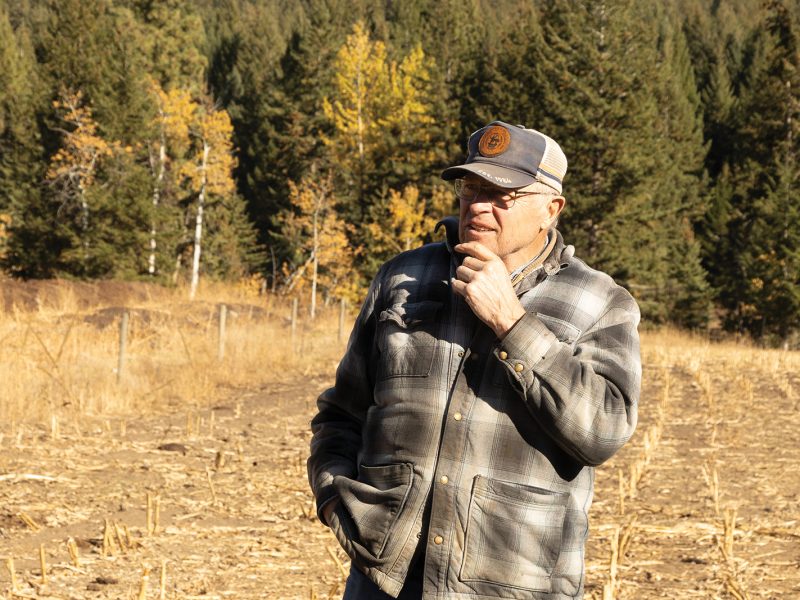
HEFFLEY CREEK – Growing corn has proven beneficial in regenerating the soil at Devick’s Ranch in Heffley Creek but not in extended grazing.
Paul Devick and his son Alex have been experimenting with corn and multiple cover crops for three years as part of the BC Living Lab program to develop best management practices to address climate change challenges. The five-year federal-provincial project supports research to investigate greenhouse gas emissions, carbon sequestration, soil health and species diversity, while considering land management as well as the economic and social aspects of the practices.
The Devicks hosted a field day on October 15 to showcase their work on two separate fields. Visitors included program member partners from the BC Cattlemen’s Association, BC Forage Council and students from Thompson River University’s regenerative agriculture program, along with BC Living Lab researchers.
“We got involved with Living Labs because we always like to experiment and try new things and find it exciting,” says Paul Devick. “The biggest draw for us was growing corn and whether it could grow in our climate and our elevation. It worked well for us; we got good yields. The idea of corn grazing was also an interest of ours; we wanted to try it but because of the size of our operation and the amount of cropland, it didn’t work for us.”
Winter grazing can be costly to cattle operations and is subject to major fluctuations from climate change-driven weather events such as drought, fire and flooding, according to the BC Forage Council. Corn as a standing crop for fall-winter grazing is a beneficial management practice (BMP) in the BC Living Lab program. Other BMPs include winter barley and fall rye for extended fall or spring grazing, and bale grazing.
The Devicks started their Living Lab project three years ago by growing corn and multi-crops such as radishes, turnips, clover and triticale on a 22.5-acre field. Researchers took initial soil samples from the site, which included a cleared section of forest and open grassland, to get a baseline on soil quality and health as well as organic carbon. The south end of the site was then divided into four pieces, with corn at the north end.
In the first year, the entire site was grazed by 250 head of cattle who were turned into a new section each week. The cows were fed hay in the morning before being turned into the corn, but despite this, Devick says it didn’t fully work for them: they experienced cow deaths from acidosis – or grain overload – as well as loss of yield.
“They’d go in there and pig out like crazy on the first day. It might be that our cows aren’t used to eating corn, too – like, ‘Ooh here’s a candy shop, let’s go,’” he says. “When we turned them in there, we made sure they were full, too; we were feeding them hay at the same time. We still had a huge amount of waste. There were corn stocks and most of this is stubble the cattle have stomped down. We even found cobs on the ground the cattle didn’t use. It was disheartening.”
Ranches in Quesnel and Grand Forks have found success in winter grazing on corn and relay cover crops, keeping their cows grazing for over a month, says Mike Witt, a professional agrologist working with the Devicks. The Devicks only had enough grazing for a week – and for just a portion of their herd, which includes 950 cow-calf pairs and yearlings.
“It just didn’t quite work for their operation,” says Witt. “It’s important to know what each operation’s constraints are, as well as their goals. They were too land-constrained to grow enough corn to graze the entire herd. … [Ideally] we would have more access to land and stretch things out for a couple of weeks to make the routine a little bit better.”
As a “living” lab, the program is continually evolving as producers establish data points for regional variability and test different combinations of cover crops to see what works best. The Devicks haven’t decided what to plant on that field next year although they say their corn-grazing days are over.
Yet they intend to continue growing corn for silage on another 35-acre depleted alfalfa field, mainly because it has high yield and has proven to be effective at improving soil health.
Corn was already grown on the second field, tilled for two passes, and will now be planted with fall rye for grazing in the spring. Alex Devick says they will likely do one more round of corn before turning the field back to alfalfa.
“We will continue on with the corn for breaking a field that’s depleted, or aged out, to get it back to a natural state,” he says. “This seems to be a great way to get it back to high-producing fields. We have minimal acres here so that’s why we need to have maximum production. It just loosens the soil and aerates it and becomes very fertile ground. It’s improving the soil from all the stubble, creating organic mass and spreading it all around. It creates a nice seedbed and that’s what alfalfa loves.”
Paul Devick adds they will also consider growing tall fescue after hearing about its benefits from Shabtai Bittman, a research scientist with Agriculture and Agri-Food Canada. Bittman suggested tall fescue is more drought-resistant and persistent than orchard grass, providing a slightly higher yield and better regrowth.
The Devicks continue to try new things: they unveiled their new seeding tool – a drone that can seed 100 pounds per flight.
“It’s a real time-saver, fuel-saver. It’s always fun to try something new and work on these types of things,” Paul Devick says. “It’s all part of experimenting. We learnt something today about the fescue, so we’ll try it. We’re looking for improvements all the time.”
All content on this website is copyrighted, and cannot be republished or reproduced without permission.

 Province lacks reconciliation roadmap: ranchers