
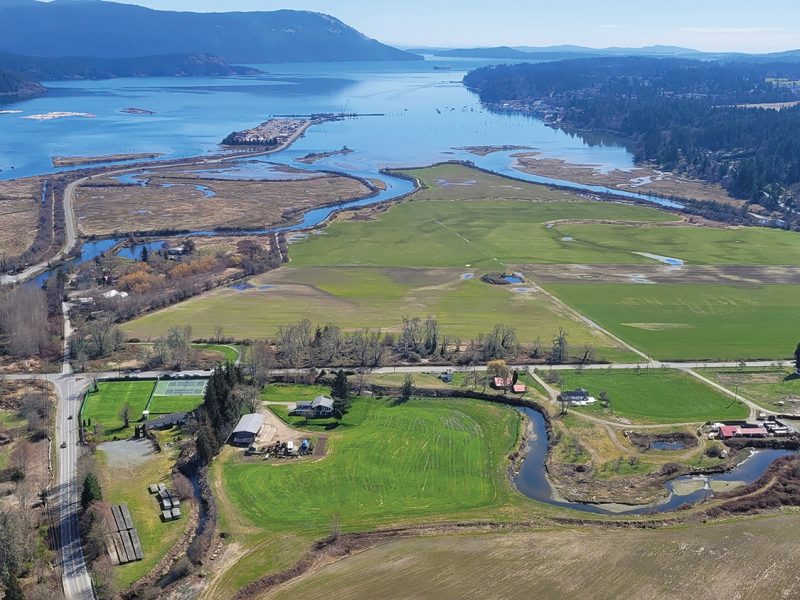
DUNCAN – The province’s emphasis on food security is being undercut by competing interests that, in the most recent case, threaten to literally swamp a productive farm in the Cowichan Valley.
A watershed planning agreement the province signed in May with the Cowichan Tribes will see Cowichan Bay’s historic Dinsdale Farm become a marsh. The property is located within the Agricultural Land Reserve but the province’s reconciliation efforts with First Nations trumps its protected status.
“It’s a shame. For me, it gets to the point of being emotional,” says long-term tenure holder and owner of Sunny Vale Farm Ltd. Gerald Poelman. “It’s a big part of my life and to see it just get destroyed, it leaves a bitter taste in my mouth about agriculture in this province.”
Poelman has farmed the 100-acre property for at least 28 years under a long-term lease from the Nature Trust of BC and Ducks Unlimited Canada, which have owned it since 1990. The hay and corn he grows in its rich soils supply his dairy herd and other local livestock operations.
Now, the Nature Trust and six partners are embarking on a project heralded as Vancouver Island’s largest estuary restoration effort. The two-year, $3 million project will see the restoration of 70 hectares of natural estuarine marshlands, which will flood out the Dinsdale property.
Poelman was made aware of the project in fall 2021 when he was approached regarding a new lease.
“They sort of bullied me into signing a new lease with a lure of two years of free rent,” Poelman says. “That’s the carrot they were dangling in front of me.”
Poelman renewed his lease on the property last summer, hoping the project wouldn’t come to fruition. He believed farmers and trail users alike would oppose such a drastic change to the land.
Unfortunately, area residents weren’t given the chance to voice their concerns, Poelman says.
“How does this just all happen without any public knowledge or consultation?” he asks.
On June 6, the Nature Trust made public plans that call for the “removal of over two kilometres of dikes at the Dinsdale farm and Koksilah marsh, the creation of intertidal channels and salt marsh habitat, the restoration of marine riparian and flood fringe forests, and the reconnection of areas that have been historically cut off from tidal influence.”
It says the project aims to “restore vitally important estuary habitat and enhance estuary resilience against rising sea-levels” and rejuvenate habitat crucial to key fish and wildlife species.
Nature Trust of BC program manager Thomas Reid says community engagement has been ongoing for a “few years now” but the scope of the project nevertheless caught the community off-guard.
“Neighbours are completely unaware of this project – no public inquiry or public meeting explaining what they’re doing,” Poelman says. “Our local [Cowichan Valley Regional District] is just basically tight-lipped. They seem to have all agreed on this project. Same as the minister of ag.”
In a statement to Country Life in BC, the ministry said plans for restoration of the estuary date back to 1985. It also claims farmland will be less susceptible to flooding.
“In removing the dikes, a persistent flooding risk for this farmland will also be addressed,” the ministry says. “No land is being removed or lost from the Agricultural Land Reserve – it is being repurposed for ecological restoration and flood mitigation to protect vital habitat for salmon, shellfish and other aquatic wildlife.”
Delta South MLA and BC United agriculture critic Ian Paton opposed the project during a June 14 rally in Duncan. He believes farmland has an important role in supporting local wildlife in its own right.
“These folks want to create a swamp, and let me tell you something – because I have a farm in Delta – the ducks and the geese and the swans, they’ve got no interest in salty, marshy grassland. There’s nothing to eat there,” Delta South MLA and BC United agriculture critic Ian Paton said at a rally in Duncan on June 14. “But I’ll tell you, if you’ve got corn or potatoes or grasslands, that’s where the birds go. So why wouldn’t you allow that 100 acres to stay there. The best thing for ducks, geese and swans is the farm that Gerald is growing his feed on.”
Ironically, Poelman has long collaborated with the Nature Trust of BC, Ducks Unlimited and the local community to ensure responsible use of the Dinsdale property. In fact, Reid defended Poelman’s management of the land in a 2015 Cowichan Stewardship Roundtable report in response to concerns over manure applications.
“The Dinsdale farm property is an active farm and is managed to provide habitat to migratory and wintering waterfowl, avian insectivores, raptors, owls and shorebird species and, to continue to produce high quality food/crops for our local farmer,” Reid said at the time.
Reid also mentioned that Poelman’s management had increased the bird use days, density and overall native flora and fauna diversity in the area and disputed claims that the farm contributed to fecal coliform levels in the estuary.
The farm’s loss means all that wildlife will likely be squeezed onto whatever farmland is left in the area, Poelman says.
This situation is not unique as the province tries to balance competing interests, especially the need to advance reconciliation with First Nations.
In North Saanich, the use of 193 acres at the historic Woodward farm, which Bryce Rashleigh has farmed for over 30 years, is up in the air following its transfer to the Tsartlip First Nation.
“It is their intention now, to apply to have it removed from the ALR and add it to their Tsartlip land,” Rashleigh says. “Then they can do whatever they want with it.”
For now, he can farm it with a year-to-year lease, growing grain and hay. He’s offered to help the First Nation community get more involved in the farming of this land.
Rashleigh would like to see one of the biggest tracts of land in the Saanich Peninsula remain as farmland.
“There’s nothing more than like 50-acre pieces. So, it’s significant. It’s a significant place,” he says. “The land freeze isn’t as rock-solid as we thought. Kind of shocks me that the NDP, who were the heralders of the ALR, that under their watch, this is going down.”
The future of 600 acres of potato fields at Brunswick Point in Delta to which the Tsawwassen First Nation has first rights is also uncertain, Paton says.
“We cannot afford to lose big tracts of land,” he says. “The [government] talks about food security and I said what a pile of crap that is. They can talk food security out of one side of their mouths, but they are quite willing to get rid of beautiful prime pieces of farmland in this province on the other side of their mouths.”
The Agricultural Land Commission and Cowichan Tribes did not respond to requests for comment prior to deadline.
 Province funds feed access