• Menu
  • Skip to primary navigation
  • Skip to main content
  • Skip to primary sidebar

Country Life In BC Logo

The agricultural news source in British Columbia since 1915

  • Headlines
  • Calendar
  • Subscribe
  • Advertise
  • About
  • Archives
  • Contact
  • Search
  • Headlines
  • Calendar
  • Subscribe
  • Advertise
  • About
  • Archives
  • Contact
  • Search

Primary Sidebar

Originally published:

FEBRUARY 2022
Vol. 108 Issue 2

Subscribe Now!

Sign up for free weekly FARM NEWS UPDATES

Select list(s) to subscribe to


By submitting this form, you are consenting to receive marketing emails from: Country Life in BC. You can revoke your consent to receive emails at any time by using the SafeUnsubscribe® link, found at the bottom of every email. Emails are serviced by Constant Contact
Your information will not be
shared or sold ever

Stories In This Edition

Grain prices hit chicken growers

Farmers helping farmers

Groundwater deadline firm

IAFBC takes over environmental programs

Editorial: Spring shadows

Back 40: Old tractors pull loads of memories

Viewpoint: Animal agriculture is in the crosshairs

Dairy farmers assured recovery funding on its way

BC SPCA hits pause

Soaring fertilizer prices add to cost pressures

Higher milk prices, costs raise stakes at retail

Growers face recertification challenges

Ag Briefs: Omicron forces rescheduling of ag shows

Ag Briefs: Sumas Prairie farmers sue government

Ag Briefs: BC Tree sells another property

Weather deals another blow to berry growers

Cherry growers assessing winter damage

Grape growers grapple with cold damage

Sidebar: Grape bud hardiness index

Farmers face delays from lab closures

Forage council sets sights on growth

Farmers step up in emergency operations

The birds come first at B Jack

Ranchers waiting for federal fencing funds

Integrated control strategy keeps predators at bay

Sidebar: By the numbers

Peace producers work to expand meat processing

BC goats to benefit from genetics investment

Robson Valley family realizes its dreams

Creamery builds a taste for local connections

Research: Scientists learn how plants respond to heat stress

Blueberry growers on the hunt for pollination options

Viewpoint: Diversity, equity, inclusion is an ongoing process

Farm Story: Positive results arent always sensational

Sweet

Woodshed: Clay makes his intentions known to Ashley

FCC gives 4-H clubs a financial boost

Jude’s Kitchen: For your sweetie

More Headlines

Follow us on Facebook

Comments Box SVG iconsUsed for the like, share, comment, and reaction icons

6 days ago

... See MoreSee Less

View Comments
  • Likes: 4
  • Shares: 0
  • Comments: 0

Comment on Facebook

6 days ago

On the last day of the BC Organic Conference, Thursday, Molly Thurston of Pearl Agricultural Consulting helped growers learn how to manage bugs such as codling moth, wireworm, and rootworm in organic growing systems. Her talk alongside Renee Prasad included hands-on activities in which participants checked out various traps and examined pests under microscopes. Be sure to look for more upcoming ag events on our online calendar at www.countrylifeinbc.com/calendar/

#BCAg
... See MoreSee Less

On the last day of the BC Organic Conference, Thursday, Molly Thurston of Pearl Agricultural Consulting helped growers learn how to manage bugs such as codling moth, wireworm, and rootworm in organic growing systems. Her talk alongside Renee Prasad included hands-on activities in which participants checked out various traps and examined pests under microscopes. Be sure to look for more upcoming ag events on our online calendar at www.countrylifeinbc.com/calendar/

#BCAg
View Comments
  • Likes: 15
  • Shares: 0
  • Comments: 0

Comment on Facebook

1 week ago

Well-known organic farmer and podcaster Jordan Marr gets interviewed by Country Life in BC’s own columnist and potato mavin Anna Helmer during the opening session of the BC Organic Conference at Harrison Hot Springs yesterday. Sessions run today (Wednesday) and Thursday and include organic and regenerative growing practices and expanding and advocating for the organic sector, all under the background of the newly launched Organic BC banner.

#BCAg
... See MoreSee Less

Well-known organic farmer and podcaster Jordan Marr gets interviewed by Country Life in BC’s own columnist and potato mavin Anna Helmer during the opening session of the BC Organic Conference at Harrison Hot Springs yesterday. Sessions run today (Wednesday) and Thursday and include organic and regenerative growing practices and expanding and advocating for the organic sector, all under the background of the newly launched Organic BC banner.

#BCAg
View Comments
  • Likes: 37
  • Shares: 2
  • Comments: 1

Comment on Facebook

Interested in finding out more about this

3 weeks ago

Today, we remember those who sacrificed their lives or their well-being for our freedom. Lest we forget. ... See MoreSee Less

Today, we remember those who sacrificed their lives or their well-being for our freedom. Lest we forget.
View Comments
  • Likes: 8
  • Shares: 0
  • Comments: 0

Comment on Facebook

1 month ago

FarmFolk CItyFolk is hosting its biennial BC Seed Gathering in Harrison Hot Springs November 27 and 28. Farmers, gardeners and seed advocates are invited to learn more about seed through topics like growing perennial vegetables for seed, advances in seed breeding for crop resilience, seed production as a whole and much more. David Catzel, BC Seed Security program manager with FF/CF will talk about how the Citizen Seed Trail program is helping advance seed development in BC. Expect newcomers, experts and seed-curious individuals to talk about how seed saving is a necessity for food security. ... See MoreSee Less

Link thumbnail

BC Seed Gathering - FarmFolk CityFolk

farmfolkcityfolk.ca

Save the date for our upcoming 2023 BC Seed Gathering happening this November 3rd and 4th at the Richmond Kwantlen Polytechnic University campus.
View Comments
  • Likes: 1
  • Shares: 0
  • Comments: 0

Comment on Facebook

Subscribe | Advertise

The agricultural news source in British Columbia since 1915
  • Email
  • Facebook

Farmers step up in emergency operations

EOC, firefighting experience help industry

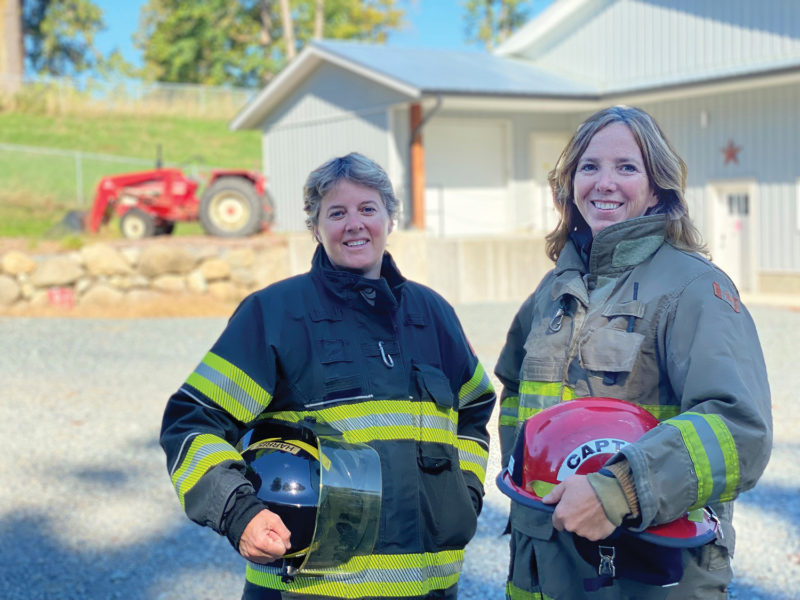
When flooding hit Sumas Prairie after heavy rains in November, Abbotsford poultry farmers and experienced firefighters Krista Harris, left, and her wife, Cathy Van-Martin, jumped into action to help with the emergency response. Their story starts on page 19. SUBMITTED

February 1, 2022 byKate Ayers

ABBOTSFORD – First-generation poultry farmers Krista Harris and Cathy Van-Martin ask fellow egg producers many questions about production and welfare to ensure they have their chickens in a row. They take time to make business decisions with their business partners Barry and Jessica Kragh.

But in addition to managing B Jack Farms, an organic free-range commercial egg operation, Krista is a full-time firefighter in Abbotsford. Her wife Cathy recently retired from firefighting after a 27-year career.

When flooding hit Sumas Prairie last November, the couple didn’t waste time asking questions.

Harris responded to emergency calls the night of November 17 during a second effort to evacuate remaining residents on Sumas Prairie.

“My crew was going door-to-door in the middle of the night to assist with delivering the evacuation order,” she says.

When she wasn’t at work, she offered support as an emergency operations centre rep for the poultry sector to plan routing to move water, feed, birds and eggs.

As an emergency and disaster response specialist, Van-Martin pulled many 16-hour days as a voluntary ECO director during the flooding.

She had been part of previous Eons on the government side of things, helping with COVID-19 responses in the City of Burnaby and during the wildfire season in the Clinton area. These skills came in handy on behalf of industry.

“Representing industry was different,” says Van-Martin. “Being on the other side and being a little bit excluded from the information channels was a challenge. Anytime there’s a disaster, it’s common that communication breaks down between multiple levels of government and multiple ministries of government. We did sort of see that happen as we moved into the second week of the response.”

However, thanks to the BC Poultry Association’s at-the-ready emergency operations centre, reps were able to get to work right away. The association had built out an ECO following the last two avian influenza outbreaks and had systems in place.

“Because we have this standing ECO, we activated before some of the government and ministries did,” says Van-Martin. “We had a lot of success early on, right out of the gate – accessing the flood and evacuation zones and getting necessary supplies to producers.”

Water was a priority as many producers lost access to city water for several days. ECO members were able to start shuttling water between farms that had wells and those that did not.

“All the people we had involved already were just a phone call or email away,” says Van-Martin. “This distribution list we already have made it really easy for us to get up and running fast. That made a huge difference for us to be able to protect and take care of a lot of the birds that we have down there.”

The five poultry boards in BC responsible for turkeys, hatching eggs, chickens, eggs and broiler breeders collaborated during the response phase.

“The agility of industry is really awesome,” says Van-Martin. “We didn’t necessarily know each other professionally a lot before, but everyone just worked seamlessly together to take care of all the impacted people down in the zone.”

Part of Van-Martin’s day-to-day tasks was to create action plans and report to the Abbotsford ECO. She would in turn receive briefings from the agriculture branch director. But information on response, operations and decision-making was elusive.

“I assigned our deputy director of planning, which happens to be Harris, to try and gain information from Environment Canada and any other sources she could get because I wasn’t able to ever get the actual situation reports that were generated by the Abbotsford ECO,” says Van-Martin.

While information was shared within municipalities, regions and the province, those trying to plan on the ground were not part of the conversation. That complicated the development of action plans.

“It was a challenge not having all the information and it became more complicated as more layers of government became involved in the response,” says Van-Martin. “Decisions were being made and it’s a top-down structure. By the time we were informed of the decision, we didn’t have any input into the decision-making process. We weren’t able to point out ways the decision could be altered to be more of a win-win for government and industry.”

Van-Martin and other ECO members look forward to making more connections with government officials and decision-makers in future as well as involving more stakeholders in training and exercises.

Fortunately, B Jack Farms sits on a hill overlooking Matsuri Prairie and was largely unscathed by the flooding. But the couple know many farmers who were forced to evacuate. Some remain off their properties while others lack heating.

“It was an extremely challenging and stressful time, and it was disastrous for some farmers who we received mentorship from,” says Harris. “Our hearts went out to them and the animals that were affected. It was devastating.”

During the series of intense atmospheric rivers that rolled across the region, feed companies were also part of the ECO and showed flexibility and resilience.

“Feed was a significant concern from the get-go. Feed is what keeps these birds alive, and it became a top priority,” says Harris. “There were challenges but all the suppliers in BC and Alberta collaborated. … All the companies worked together to be creative and diligently worked to make sure any farm that needed feed was able to get what they needed.”

B Jack Farms is also fortunate in that the family sources organic feed from a local mill, which proved to be especially useful amidst a slew of road closures.

“Our feed company was consistent, and they communicated with us daily,” Harris says. “We were lucky to not have any disruptions.”

Through the extreme winter weather in late December and early January, Harris and her family focused on the positives and tried to make the most of a rare white Christmas in the Lower Mainland.

“The biggest challenge is keeping snow cleared and making sure trucks can get in for feed and eggs. I don’t know how much more the world can throw at us, but it’s hard to complain after what some people have been through this year,” says Harris. “We all have our health, and the birds don’t care what it’s like outside. They just expect us to take care of them.”

During the most demanding times, the family find refuge in the barn.

“When life is stressful, chaotic, busy, annoying or limiting, with everything we’ve been through the last couple years, you go in the barn every single day at the same time. It’s so consistent,” says Harris. “It’s routine and pattern. You go out there and it gives you purpose. You interact with the birds, and it just balances you out. That’s something all of us enjoy. Sometimes you just need to go to the barn.”
 

Related Posts

You may be interested in these posts from the same category.

Abbotsford approves flood mitigation option

Abbotsford flood mitigation options

Insurance under scrutiny

Previous Post: « BC SPCA seizes cattle
Next Post: Peace producers work to expand meat processing capacity »

Copyright © 2025 Country Life in BC · All Rights Reserved