• Menu
  • Skip to primary navigation
  • Skip to main content
  • Skip to primary sidebar

Country Life In BC Logo

The agricultural news source in British Columbia since 1915

  • Headlines
  • Calendar
  • Subscribe
  • Advertise
  • About
  • Archives
  • Contact
  • Search
  • Headlines
  • Calendar
  • Subscribe
  • Advertise
  • About
  • Archives
  • Contact
  • Search

Primary Sidebar

Originally published:

SEPTEMBER 2021
Vol. 107 Issue 9

Subscribe Now!

Sign up for free weekly FARM NEWS UPDATES

Loading form…

Your information will not be
shared or sold ever

Stories In This Edition

Wildfire response improves

Bad timing for election call

Hay there!

Food sales still reeling from the pandemic

Editorial: Restart, regenerate

Back 40: Anti-vax rhetoric is far worse than the cure

Viewpoint: Organic practices key to our collective well-being

Producers face unannounced welfare checks

Livestock feel the heat as forage dries up

Farmers take issue with water restrictions

Ag Briefs: Grape growers optimistic as harvest approaches

Ag Briefs: Greenhouse nursery specialist named

Feed BC connects producers with opportunities

Sidebar: Nutrition program continues

Growers welcome grocer code of conduct

Chicken growers address heat stress

Greenhouse growers undertake strategic plan

Turning manure into renewable energy

Sidebar: Biogas gets a boost with changes to regulations

Blueberry growers welcome higher berry prices

Ranchers, farmers on the wildfire frontlines

Sidebar: Water and fans keep cattle cool

Province halts livestock watering reg update

BC farm sales sets new monthly record

Mental wellness resources meet a growing need

Sidebar: Mental health resources

Saving the farm business hinges on planning

Hot potatoes

Farmers produce crops, and loads of plastic

Barnston Island farmers face uncertain future

Market garden rises from battle of the weeds

Sidebar: Oostenbrink’s tips for no-till vegetables

Research: Bumblebee declines not as dire as study states

A non-family succession plan that worked

Living plants are revolutionizing herb sales

Food hub readies for fall opening

Farm Story: Good help at the right time

Small-scale abattoir in the works for Island

Breeding better tasting beets

Woodshed Chronicles: Plans unfold for the ride of a lifetime

Young entrepreneur weaves new use for twine

Jude’s Kitchen: Simpler eats for a new, normal September

More Headlines

Follow us on Facebook

Comments Box SVG iconsUsed for the like, share, comment, and reaction icons

6 days ago

A BC Forest Practices Board investigation has found overgrazing has damaged grasslands in the Coutlee Range Unit near Merritt — and the range-use plan meant to prevent it was unenforceable. With complaints about overgrazing on the rise and grasslands covering just 1% of BC's land mass, the findings raise fresh questions about how the province manages one of its most vulnerable — and valuable — food-producing ecosyste#BCAg#BCAg ... See MoreSee Less

Link thumbnail

Board finds overgrazing rules unenforceable unmeasurable

www.countrylifeinbc.com

MERRITT – A BC Forest Practices Board investigation has found instances of non-compliance related to overgrazing have damaged open grasslands in the Mine pasture, part of the Coutlee Range Unit near...
View Comments
  • Likes: 6
  • Shares: 6
  • Comments: 6

Comment on Facebook

Several ranchers in recent years have gone into temporary non use on that range , so that means the grass should grow. But drought conditions/lack of rain and snow don’t allow that to happen . Dried up springs , creeks waterholes in various pastures add to over grazing where there is water , as livestock and everything else stay close to the water source . So even though less cattle are on it , over grazing appears. There is a large volume of horses on it 365 days/year which is wrong ! They pull grass right out of the ground when it’s just trying to grow ,, opens the door for weeds to grow in. That don’t help it. Aging infrastructure ( fences) laying on the ground, pipe line building , ( lack of commitment to fence maintenance) amongst all users contributes also to over grazing. Recreational atv users leaving gates open between pastures allows livestock to go back or ahead in pastures also expidites over grazing. Logging ( bcts) has no problem laying out cut locks on both sides of a fence , then it gets smashed down during logging and they don’t take responsibility to stand it back up or clean the cattle gaurds out when they are done , that happened 4 years ago on pasture 5 up there . I bet it is still not fixed . There are lots of contributing factors to the problem.

Tragedy of the commons.

I looked through the report. I saw nothing about the effects of noxious weeds on productive grasslands. This particular area is vulnerable because of the Ministry’a efforts to diversify the use of the Grasslands.

This pasture is under tremendous pressure not only from cattle but from irresponsible local residents who treat it as a landfill dumping all manner of household debris here. And don't even get me started on the mud bogging and camping in sensitive riparian areas. The feral horses are in this pasture 365 days a year just hammering it. Would sure be nice to see some enforcement action on people who are intentionally ripping up the grasslands and riparian areas. Cattle could be a valuable resource for rebuilding soils and native grasses in this area with the help of electric fencing and/or e-collars. The humans will be harder to manage.

The Forest and Range Practices Act was written by lawyers for global forest licencee shareholders. Results-based = unenforceable.

Also, can we talk about the impact of a pipeline being built through the middle of this field for multiple years?

View more comments

1 week ago

East Kootenay rancher Randy Reay is digging a new well after two natural water sources dried up on his Crown tenures. A new Living Lakes Canada assessment found 15% of mapped aquifers in the region are high-priority for monitoring, yet 80% of those go unmonitored. With over 48% of BC's provincial observation wells reporting below-normal groundwater levels, ranchers and researchers are sounding the alarm on water security. The story is in our March edition, and we've posted it to our website thi#BCAgk.

#BCAg
... See MoreSee Less

Link thumbnail

Water woes: groundwater under pressure across BC

www.countrylifeinbc.com

JAFFRAY – As a young boy growing up in the Kootenay-Boundary region, Randy Reay never expected to run out of water. But this year, in mid-February, his fields are bare. There is no snow halfway up t...
View Comments
  • Likes: 8
  • Shares: 7
  • Comments: 1

Comment on Facebook

Jaffrey is in the east Kootenays not kooteney boundary

2 weeks ago

BC farmers are bracing for prolonged higher input costs as war in the Middle East drives up fuel and fertilizer prices. Nitrogen fertilizer costs were already climbing before the Iran conflict began, with prices still roughly 60% above pre-pandemic levels. Farm Credit Canada warns that unlike 2022, strong commodity prices may not offset rising costs this time. Local suppliers expect supply challenges and further price increases ahead.

#BCAg
... See MoreSee Less

Link thumbnail

Fertilizer prices on the rise

www.countrylifeinbc.com

War in the Middle East has delivered a generational shock to energy prices, meaning BC farmers can expect a prolonged period of higher costs not just for fuel but also for fertilizer.
View Comments
  • Likes: 2
  • Shares: 1
  • Comments: 0

Comment on Facebook

2 weeks ago

... See MoreSee Less

View Comments
  • Likes: 1
  • Shares: 0
  • Comments: 0

Comment on Facebook

2 weeks ago

Cameron Stockdale is the new executive director of provincial farm safety organization AgSafeBC. Find out more in this week's Farm News Update from Country Life in B#BCAg#BCAg ... See MoreSee Less

Link thumbnail

New leadership at AgSafe BC

www.countrylifeinbc.com

Cameron Stockdale is the new executive director of provincial farm safety organization AgSafeBC, succeeding Wendy Bennett. Bennett left AgSafeBC in September 2025, following 12 years with the…
View Comments
  • Likes: 5
  • Shares: 1
  • Comments: 0

Comment on Facebook

Subscribe | Advertise

The agricultural news source in British Columbia since 1915
  • Email
  • Facebook

Feed BC connects producers with opportunities

Local food access expands across province

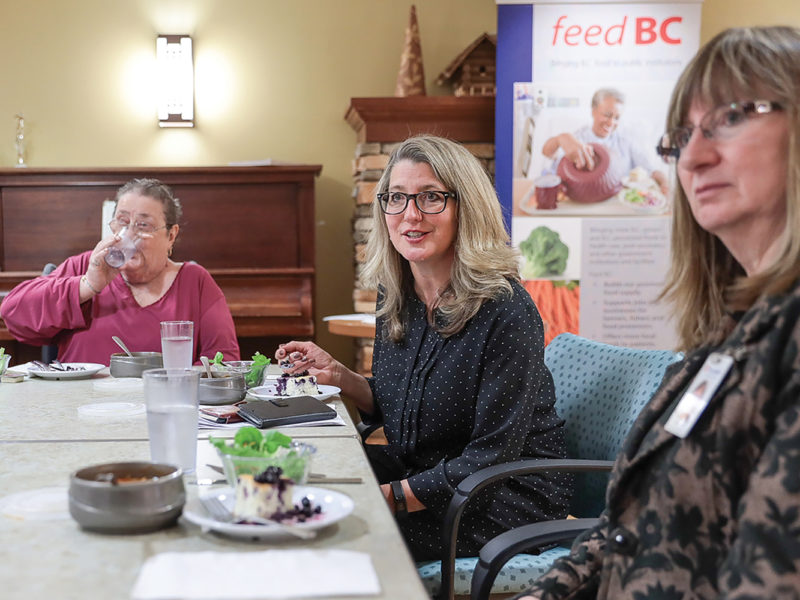
BC Minister of Agriculture, Food and Fisheries Lana Popham says the province’s Feed BC program is set to add more food hubs, hospitals and schools to its list of participants. BCMAFF

September 1, 2021 byKate Ayers

VICTORIA – The government’s Feed BC program is gaining momentum as more food hubs come online and post-secondary partners express interest in offering more local products to students.

“We have a dozen food hubs that are underway right now,” says BC Minister of Agriculture, Food and Fisheries Lana Popham. “With the increased budget that we have this year, we’ll be able to do two or three more for this cycle.”

In addition, she says “around 25” public post-secondary institutions have either signed on with FeedBC or are interested in participating in the initiative.

“We have the goal of making sure at least 30% of the food in these institutions is grown or processed in the province,” she said.

However, after tracking consumption data of institutions over the last two and half years, the government is preparing to move the goal post.

University of Northern BC food services director Yazan Kanaan says the university upheld its commitment of 30% local food even during the pandemic. It managed to achieve 35.7% local purchases in the first semester and 40% in the second during the 2020/2021 school year. While UNBC has surpassed the set 30%, Kanaan cautioned that increasing the benchmark may not be the best move until all universities are set up to achieve at least the minimum. Collecting and tracking purchasing and consumption data can be challenging, Kanaan says, especially when universities work with third-party distribution companies such as Sysco.

Feed BC also works with regional health authorities that operate 170 hospitals and residential care facilities.

To properly implement Feed BC, all partners must monitor food purchases to ensure targets are met and commit to sourcing from local producers, Popham notes.

“Our role is to help facilitate conversations between primary producers and those institutions that are trying to make a shift and then everyone in between,” she says.

“This policy brings stability into domestic markets and allows us to … figure out what is needed in institutional buying. The domestic market is the foundation of the house. It takes a while and it is hard to shift a whole food system, but we are seeing a boost in momentum.”

When the Interior Health Authority began purchasing 600,000 BC eggs per year, egg producers noticed the benefit right away, Popham says.

“It shows that a small shift in where you are purchasing from and thinking about BC producers makes an incredible difference in farmers’ bottom lines,” she says.

S&G Farms Ltd. in Oliver currently works with Sysco through the Feed BC program to provide Interior Health with more BC products.

“I think it is really important to buy local products,” says S&G Farms owner Inderjit Sandhu. He and his family grow 50 acres of fresh vegetables for wholesale and retail.

In 2019, the second year of Feed BC, local food purchases by BC health authorities were $3.5 million higher than the year prior “and that is just the beginning,” Popham says.

Island Health patients and the Lower Mainland health authorities joined Feed BC’s healthcare partnership at the end of July.

On the Island, Galey Farms in Saanich and Michell Farms in Saanichton provide fresh produce to Island Health, which also works with local food suppliers including Islands West Produce and B&C Foods.

In the Provincial Health Services Authority, the BC Forensic Psychiatric Hospital in Coquitlam has partnered with Okanagan Select, an Indigenous fishery owned and operated by the Syilx. The group provides sockeye and Chinook for patients. Vancouver Coastal Health and Providence Health Care work with Highline Mushrooms in the Lower Mainland and Monte Cristo Bakery in Delta.

As per the minister’s mandate letter last November, the province also looks to expand the FeedBC program into elementary and secondary schools.

“The Ministry of Agriculture, Food and Fisheries is working towards Feed BC being introduced in the public K-12 school system in the future and we are working closely with the Ministry of Education on the timing,” says the ministry’s public affairs officer Dave Townsend.


BC Minister of Agriculture, Food and Fisheries Lana Popham says the province’s Feed BC program is set to add more food hubs, hospitals and schools to its list of participants. BCMAFF


Related Posts

You may be interested in these posts from the same category.

BC Tree Fruits relaunch

ALC rejects Cowichan dike removal

Indigenous agriculture faces regulatory reality

Task force members announced

Ag leaders honoured at gala

ALC members appointed

Popham back as ag minister

Province to fund school meals

Producers look beyond 2021’s floods

Farm status requires proof

Province funds market purchases

Province opens ALR to agritech development

Previous Post: « Province announces wildfire recovery funds
Next Post: Wildfire state of emergency ends »

Copyright © 2026 Country Life in BC · All Rights Reserved