• Menu
  • Skip to primary navigation
  • Skip to main content
  • Skip to primary sidebar

Country Life In BC Logo

The agricultural news source in British Columbia since 1915

  • Headlines
  • Calendar
  • Subscribe
  • Advertise
  • About
  • Archives
  • Contact
  • Search
  • Headlines
  • Calendar
  • Subscribe
  • Advertise
  • About
  • Archives
  • Contact
  • Search

Primary Sidebar

Originally published:

SEPTEMBER 2025
Vol. 111 Issue 8

Subscribe Now!

Sign up for free weekly FARM NEWS UPDATES

Select list(s) to subscribe to


By submitting this form, you are consenting to receive marketing emails from: Country Life in BC. You can revoke your consent to receive emails at any time by using the SafeUnsubscribe® link, found at the bottom of every email. Emails are serviced by Constant Contact
Your information will not be
shared or sold ever

Stories In This Edition

Core issues remain

Big bouquet

Chinese tariffs dampen canola hopes

Task force charts sustainable future for BC wine

Editorial: Small steps, not misteps

Back 40: Summer memories have a smoky scent

Viewpoint: Better AI means better decision-making

Council calls for review of farm classificaiton rules

UBC dairy centre launches online data hub

Ag Briefs: Groundwater backlog a top priority for premier

Ag Briefs: New executive director for blueberries

Ag Briefs: BCTF members face $17 million question

Province boosts funding for avian flu defences

Indigenous agriculture faces regulatory reality

First Nations farmers benefit from ag grants

Tight supplies keep beef prices hoofing north

Sidebar: Consumers resilient to higher prices

Award recognizes holistic ranch management

Researchers study effects of prescribed fire

Better fire management encourages natural growth

Potato trials give growers a first glimpse of harvest

Small-scale grower takes on big challenge

Creston farmers join the garlic gold rush

Berry growers on lookout for rose stem girdler

Farm Story: It’s the end of the road for potatoes

Weed walk gets up close with invasive plants

Woodshed: Junkyard Frank takes the bait and takes action

New life ahead for iconic Langley dairy farm

Jude’s Kitchen: Farewell summer; welcome autumn

More Headlines

Follow us on Facebook

Comments Box SVG iconsUsed for the like, share, comment, and reaction icons

2 weeks ago

FarmFolk CItyFolk is hosting its biennial BC Seed Gathering in Harrison Hot Springs November 27 and 28. Farmers, gardeners and seed advocates are invited to learn more about seed through topics like growing perennial vegetables for seed, advances in seed breeding for crop resilience, seed production as a whole and much more. David Catzel, BC Seed Security program manager with FF/CF will talk about how the Citizen Seed Trail program is helping advance seed development in BC. Expect newcomers, experts and seed-curious individuals to talk about how seed saving is a necessity for food security. ... See MoreSee Less

Link thumbnail

BC Seed Gathering - FarmFolk CityFolk

farmfolkcityfolk.ca

Save the date for our upcoming 2023 BC Seed Gathering happening this November 3rd and 4th at the Richmond Kwantlen Polytechnic University campus.
View Comments
  • Likes: 1
  • Shares: 0
  • Comments: 0

Comment on Facebook

4 weeks ago

BC has reported its first case of highly pathogenic avian influenza (HPAI) in the eighth wave of the disease since 2021. Canadian Food Inspection Agency officials confirmed October 13 that a premises in Abbotsford tested positive for the disease, the first infected premise in BC during this fall's migration. The farm is the 240th premises infected in BC since the current national outbreak began four years ago with a detection in Newfoundla#BCAg#BCAg ... See MoreSee Less

BC has reported its first case of highly pathogenic avian influenza (HPAI) in the eighth wave of the disease since 2021. Canadian Food Inspection Agency officials confirmed October 13 that a premises in Abbotsford tested positive for the disease, the first infected premise in BC during this falls migration. The farm is the 240th premises infected in BC since the current national outbreak began four years ago with a detection in Newfoundland.

#BCAg
View Comments
  • Likes: 50
  • Shares: 195
  • Comments: 444

Comment on Facebook

But the ostrich’s have the cure ….

I don't believe anything the CfIA says, like saying ostriches are chickens so that's why everything has to get culled.

Who in BC has reported this, not a word in the news. Why are you spreading fear propaganda? If you cannot add a source do not post this crap! It appears your page knows absolutely nothing about COUNTRY LIFE IN BC OR ELSEWHERE!

Just put one-way arrows on the floor of the chicken coop, keep them 6ft apart from each other and stock up on toiletpaper for them. 😉

Source? I can't find anything to corroborate this story.

Perhaps if they had allowed the ostrich to be tested and discovered how they developed antibodies we could quit culling our food supplies. Yes I know ostrich are not chickens

This only made the news to confuse those interested in the ostrich farm, relax, has nothing to do with the ostriches

How convenient that carney has a pocket in this 🤔

The ostriches eggs can save your flock

Weird how it only affects birds we eat. Kinda like how no homeless people got convid.

How convenient. Now it's off to the ostrich farm, right?

Have you went chicken catching for 8 hours all night 36000 birds

My advice take your chickens and run!

Have none of you guys ever seen the hundreds of birds falling from the sky? Ya me nether

Brainwashing if you ask me

just like on people- that mask looks like its doing a lot of nothing on that rooster!

Is it as deadly as monkey pox?? 🐵

Quick kill all the food! Perhaps we should study the ostriches...

Ostriches not chicken and not reproduced for human consumption

The condom is too small for the CO?K

I don't know how you do it, but invest in egg futures RIGHT NOW. The price will be skyrocketing.

So is it the first or the 240th?

240th. So how many birds culled is that now? The stamping out policy is working so well, isn’t it? Maybe cramming millions of stressed birds, receiving no sunlight, into facilities, all within a few kilometres apart (talk about having all your eggs in one basket) is not the brightest idea. Maybe we should scrap the Quito system, allow regular folks to have more than 100 birds and supply their neighbourhoods with meat and eggs. Maybe we should raise more robust birds with better immune systems. Maybe we shouldn’t give birds sunlight, less crowded conditions, and give them a full 24 hours to lay an egg, instead of artificially giving them shorter days, trying to squeeze more eggs out of them. Maybe, without the quota system, instead of a few mega farms, egg producers would again dot the entire province.

Lol are they going to blaim the ostriches

You mean to tell us all, THE CULL isn’t working, maybe, just maybe we should try something just a bit more humanly and have maybe a slight hint of scientific evidence!!!

View more comments

1 month ago

Here we go again!

With no immediate end in sight for the Canada Post strike, we have uploaded the October edition of Country Life in BC to our website. While it's not the preferred way to view the paper for most of our subscribers, we're grateful to have a digital option to share with them during the strike. The October paper is printed and will be mailed soon as CP gets back to work! In the meantime, enjoy!

... See MoreSee Less

Link thumbnail

CLBC October 2025

news.countrylifeinbc.com

CLBC October 2025
View Comments
  • Likes: 7
  • Shares: 4
  • Comments: 2

Comment on Facebook

The 1 person in Canada who contracted avian flu speaks to Rebel.news

STOP SPREADING LIES ABOUT AVIAN FLU NO BIRD GETS THIS

1 month ago

... See MoreSee Less

View Comments
  • Likes: 8
  • Shares: 0
  • Comments: 0

Comment on Facebook

1 month ago

... See MoreSee Less

View Comments
  • Likes: 6
  • Shares: 0
  • Comments: 0

Comment on Facebook

Subscribe | Advertise

The agricultural news source in British Columbia since 1915
  • Email
  • Facebook

Indigenous agriculture faces regulatory reality

Province funds sector but hedges on regulation

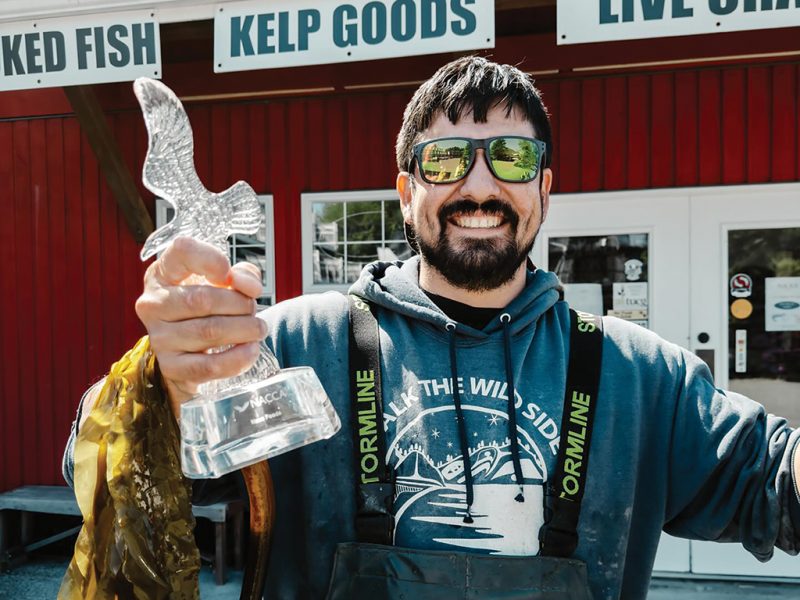
Stevie Dennis, owner of Naas Foods and member of the Vancouver Island Ahousaht Nation, received Indigenous Food Security and Sovereignty Fund grants to support his kelp farming operation in Clayoquot Sound, which is set to become BC's largest single-tenure kelp farm. Photo | Facebook/Naas Foods

September 3, 2025 byRiley Donovan

VICTORIA – Provincial efforts to promote Indigenous food sovereignty face growing questions over how Indigenous production will fit within existing structures to protect farmland and ensure orderly marketing.

In July 2023, the province announced $30 million in funding to enhance Indigenous food sovereignty. The Indigenous Food Security and Sovereignty (IFS) Fund has been disbursed through grants administered by the New Relationship Trust (NRT) non-profit.

Naas Foods – owned by Stevie Dennis, who is a member of the Vancouver Island Ahousaht Nation – received funding through the IFS to support installation of a kelp farm in Clayoquot Sound that is intended to become the largest single-tenure operation of its kind in BC. Naas sells products like kelp flakes and seasoning online, as well as through a storefront in Tofino.

While some IFS funding has gone towards ventures like Naas Foods that build the market capacity of Indigenous agriculture and integrate the sector into the BC economy, maintaining self-reliance by growing a local food supply for community members has been the main focus.

The Chawathil First Nation in the Fraser Valley is using IFS funds to set up a commercial kitchen with industrial equipment to serve members and provide for community events, as well as a greenhouse to grow produce locally and decrease “reliance on external food systems”.

The Tsawwassen First Nation in the Lower Mainland is also investing in a greenhouse it hopes will safeguard community food sovereignty. Food grown in the greenhouse is distributed to Tsawwassen members, including to elders and youth centres.

BC Agriculture Minister Lana Popham says IFS funding has gone towards over 200 Indigenous projects, “including smokehouse construction, food processing, crop production and community greenhouses.”

“The program has helped revitalize traditional food systems, strengthen local food security and create economic opportunities, particularly in rural and remote communities,” she says.

Some Indigenous food sovereignty efforts are mired in controversy, however.

Popham has voiced support for an initiative that will see farmland at the mouth of the Koksilah River on Vancouver Island flooded as part of the Cowichan Estuary Restoration Project.

In addition to citing concerns about future sea level rise fuelled by climate change, proponents say the plan to restore salt marsh habitat by removing dikes will help “revitalize Indigenous food systems.”

Delta South MLA Ian Paton, BC Conservative agriculture critic, has been a staunch opponent of the project.

“There’s 150 acres of prime farmland that was being farmed by local dairy farmers for feed for cattle, and for whatever reason Nature Trust and Ducks Unlimited want to breach the dike and flood the entire 150 acres with ocean water,” he says.

Paton says he’s a strong proponent of Indigenous agriculture projects, but questions how flooding a large stretch of productive farmland would help First Nations.

“If the Cowichan Band wants to do some farming there, great – but they probably only need five acres or 10 acres. Great, get going and have your agricultural program, but why do you want to flood the rest of it?” he asks.

Paton argues that we already know what the results of flooding this stretch of land will be, because a similar project was tried before.

“They did an experiment with part of that farmland years ago; there’s 40 acres that they already exposed to the ocean. There’s nothing growing there, there’s no life … wildlife such as ducks, geese, swans and raptors, they survive off of what farmers are growing – not a piece of restored estuary of dead seagrass,” he says.

While not commenting on the Cowichan Estuary Project specifically, Joan Sawicki, a former BC politician who worked with the Agricultural Land Reserve in its formative years in the 1970s, believes the ALR can both protect farmland and accommodate Indigenous food systems.

She has expressed support for including Indigenous food production in the ALR.

“In our culture, we tend to think of agriculture as crops that we plant,” she told Country Life in BC in March 2023 on the occasion of the ALR’s 50th anniversary. “But if part of our concept of meeting the challenge of reconciliation is ourselves expanding the concept of food … to embrace the other ways that the land produces food for humans, I think that’s a good thing.”

Questions also surround how Indigenous agriculture will be regulated in the context of BC’s government-to-government framework for Indigenous relations.

A key issue is whether Indigenous agricultural operations will fall under the purview of BC’s marketing boards and commissions.

One such example is the Glen Vowell Band in northwestern BC, which has doubled vegetable production after receiving a $130,632 Economic Infrastructure grant from the Northern Development Initiative Trust for an expanded hydroponic operation.

With the BC Vegetable Marketing Commission set to expand its mandate to the entire province on January 1, it is unclear whether Glen Vowell and similar operations will be included in the commission’s scope.

Asked whether Indigenous agricultural operations will fall under the purview of marketing boards, the BC Farm Industry Review Board (BCFIRB), which supervises BC’s eight agricultural regulatory boards and commissions, referred Country Life in BC to its 2024-27 strategic plan.

The Indigenous Reconciliation section of the plan pledges to “continue to expand our understanding of Indigenous economic interests in BC’s regulated agriculture commodities” and to “consider how BCFIRB‘s supervisory role in regulated marketing can assist in addressing those interests.”

What the broad goals outlined in this plan mean for BC’s Indigenous agricultural sector is unclear.

BCFIRB referred questions to the province’s marketing boards and commissions for further comment.

BC Milk Marketing Board general manager Robert Delage says his board has not received any guidance from the BC government on whether a hypothetical Indigenous dairy operation would fall under his board’s purview.

“I’m not aware of any information provided by the BC government on this matter to BC Milk. Certainly nothing within the past eight years that I’ve been in this role,” he says.

A statement from the BC Ministry of Agriculture and Food suggested Indigenous agricultural operations should work with BC’s marketing boards and commissions, but provided no further detail.

“Indigenous farming operations and First Nations planning on producing and selling regulated commodities should work with the respective marketing boards and commissions regarding regulations and requirements,” the ministry states.

Paton promotes Indigenous agricultural operations and wants to see them grow but says they should be subject to the marketing boards and commissions once they reach the relevant production thresholds.

“Everybody needs to be on an equal playing field. I’d be happy to see First Nations get into growing huge conventional crops of potatoes, vegetables or even dairy farming, but they should have to live by the rules that everybody else lives by as well. You have to be regulated, and you have to own quota,” he says.


Related Posts

You may be interested in these posts from the same category.

BC Tree Fruits relaunch

Cowichan title decision creates uncertainty

ALC rejects Cowichan dike removal

Task force members announced

Ag leaders honoured at gala

ALC members appointed

Popham back as ag minister

Gala honours agricultural leaders

BCAC lobbying event positive

Province consults on agritech

Homemade food rules are too restrictive

Province doubles vet seats

Previous Post: « Southern Interior irrigators shut down
Next Post: Berry growers on lookout for rose stem girdler »

Copyright © 2025 Country Life in BC · All Rights Reserved