
• Menu
  • Skip to primary navigation
  • Skip to main content
  • Skip to primary sidebar

Country Life In BC Logo

The agricultural news source in British Columbia since 1915

  • Headlines
  • Calendar
  • Subscribe
  • Advertise
  • About
  • Archives
  • Contact
  • Search
  • Headlines
  • Calendar
  • Subscribe
  • Advertise
  • About
  • Archives
  • Contact
  • Search

Primary Sidebar

Originally published:

NOVEMBER 2022
Vol. 108 Issue 11

Subscribe Now!

Sign up for free weekly FARM NEWS UPDATES

Loading form…

Your information will not be
shared or sold ever

Stories In This Edition

Final inspection

Dry Season

Country Life in BC wins awards

Duncan feed mill sounds supply chain alarm

The great pumpkin

Editorial: The price of peace

Back 40: Pumpkins make great conversation starters

Viewpoint: The roots of the ALR point a way to its future

Producers look beyond 2021’s flood

No quick fix

Ag Briefs: Plant centre breaks ground

Ag Briefs: 4-H LEADer recognized

Ag Briefs: New child worker rules

Movement of poultry banned to curb AI threat

Sentencing of animal activists disappoints industry

Weather makes for easier harvest in Peace

Western dairy groups target processors

Funding supports First Nations’ food security

Replant report targets industry over orchards

New national soil study underway

Honey producers target growth with new study

Sweet reward

Hazelnut industry continues to thrive

Producers push for social welfare in organic standards

Sidebar: Compliance rate high

Garlic grower cuts the mustard – and pests

Extended fall improves outcome at corn trial

Forest planning pilot includes range values

Diversification keeps families on the farm

Farm Story: Rethinking the sales strategy could improve profits

Automation boosts market garden’s efficiency

Fallow deer rattle Mayne Island farmers

Best of the best

Winery stakes its hopes on sur echalas planting

Woodshed: “One sweet deal” too hard for Kenneth to resist

Rising input costs create challenges for direct sales

Sidebar: Provincial farmer-chef event returns

Jude’s Kitchen: Comfort comes from the oven

More Headlines

Follow us on Facebook

Comments Box SVG iconsUsed for the like, share, comment, and reaction icons

2 hours ago

The Township of Langley Farm and Ranch Exhibition Society is hosting a public open house this evening to gather input on plans to transform the historic Belmont Farm into an agricultural exhibition, education and heritage hub. Farmers, ranchers, and community members are invited to share their feedback. The open house is at the George Preston Rec Centre, 6-8 pm.

Township of Langley Farm and Ranch Exhibition Society
#BCAg
... See MoreSee Less

The Township of Langley Farm and Ranch Exhibition Society is hosting a public open house this evening to gather input on plans to transform the historic Belmont Farm into an agricultural exhibition, education and heritage hub. Farmers, ranchers, and community members are invited to share their feedback. The open house is at the George Preston Rec Centre, 6-8 pm. 

Township of Langley Farm and Ranch Exhibition Society 
#BCAg
View Comments
  • Likes: 1
  • Shares: 0
  • Comments: 0

Comment on Facebook

5 hours ago

The sold-out Southern Interior Horticulture show continues today. Education sessions range from rodent control to new tree fruit varieties, with the afternoon devoted to improving spraying techniques for orchardists and vineyard managers. When not listening to speakers, producers are checking the trade show.

#BCAg
... See MoreSee Less

The sold-out Southern Interior Horticulture show continues today. Education sessions range from rodent control to new tree fruit varieties, with the afternoon devoted to improving spraying techniques for orchardists and vineyard managers. When not listening to speakers, producers are checking the trade show.

#BCAg
View Comments
  • Likes: 5
  • Shares: 0
  • Comments: 0

Comment on Facebook

7 hours ago

The BC Poultry Association has lowered its avian flu biosecurity threat level from red to yellow, citing declining HPAI risk factors and fewer wild bird infections. Strong biosecurity practices helped BC limit cases this winter to 38 premises, down from 81 last year. For more, see today's Farm News Update from Country Life in #BCAg#BCAg ... See MoreSee Less

Link thumbnail

Poultry biosecurity notches down

www.countrylifeinbc.com

Declining risk factors for highly pathogenic avian influenza (HPAI) have prompted the BC Poultry Association to lower the industry’s biosecurity threat level from red to yellow. The decision…
View Comments
  • Likes: 11
  • Shares: 2
  • Comments: 1

Comment on Facebook

🐥💛

23 hours ago

The application deadline for cost-shared funding through the Buy BC program is coming up on February 20. Up to $2 million through the Buy BC Partnership Program is available annually to BC producers and processors to support local marketing activities that increase consumer awareness of BC agriculture and BC food and beverages. For more information, visit buybcpartnershipprogram.ca/.

Buy BC

#BCAg
... See MoreSee Less

Link thumbnail

Home - Buy BC Partnership Program

buybcpartnershipprogram.ca

Buy BC Partnership Program Increase your visibility with Buy BC The Buy BC Partnership Program is a fundamental component of Buy BC that provides up to $2 million in cost-shared funding annually to lo...
View Comments
  • Likes: 3
  • Shares: 0
  • Comments: 0

Comment on Facebook

1 day ago

The Sik-E-Dakh (Glen Vowell) First Nation's Skeena Fresh hydroponic operation has doubled production capacity thanks to a $130,632 Northern Development Infrastructure Trust grant. Growing lettuce, kale, herbs and more in shipping containers, the operation uses 90% less water than traditional farming while providing 1,200 people with year-round access to fresh, locally grown greens. Their story is in the February edition of Country Life in BC, the agricultural news source for BC’s farmers and ranchers.

Northern Development Initiative Trust
#BCAg
... See MoreSee Less

The Sik-E-Dakh (Glen Vowell) First Nations Skeena Fresh hydroponic operation has doubled production capacity thanks to a $130,632 Northern Development Infrastructure Trust grant. Growing lettuce, kale, herbs and more in shipping containers, the operation uses 90% less water than traditional farming while providing 1,200 people with year-round access to fresh, locally grown greens. Their story is in the February edition of Country Life in BC, the agricultural news source for BC’s farmers and ranchers. 

Northern Development Initiative Trust 
#BCAg
View Comments
  • Likes: 14
  • Shares: 1
  • Comments: 0

Comment on Facebook

Subscribe | Advertise

The agricultural news source in British Columbia since 1915
  • Email
  • Facebook

Garlic grower cuts the mustard – and pests

Biofumigant attributes keep pests and fungi at bay

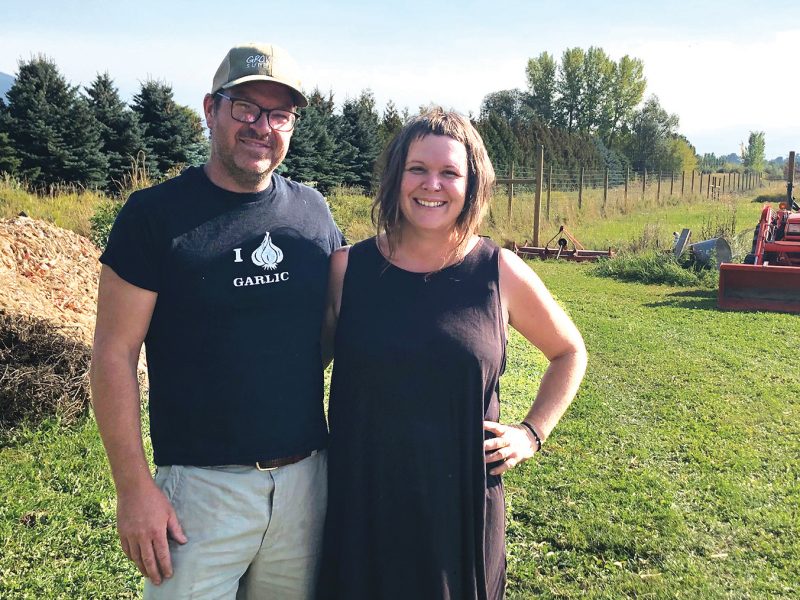
Kip and Michelle Cantrell shared their secret for suppressing soil-borne pests and diseases in garlic with other growers during a field day at their Creston farm. TRACEY FREDRICKSON

November 1, 2022 byTracey Fredrickson

CRESTON – British Columbia is one of Canada’s largest producers of garlic, a crop that is well suited to smaller farms since it does not require a great deal of land to support a profitable business.

Thistle Farm in Creston is an example of what can be achieved on just four acres with this much-in demand vegetable bulb. At a recent field day facilitated by the Kootenay & Boundary Farm Advisors and FarmFolk/CityFolk, farm owners Kip and Michelle Cantrell shared their success using mustard as a cover crop.

Where Thistle Farm differs from other local growers is its use of biofumigation, the suppression of soil-borne pests and diseases using plants that produce chemicals called glucosinolates. When glucosinolates come in contact with water and plant enzymes, they transform into another type of compound which gives mustard its biofumigation power. Mustard can deter many pests while preventing soil erosion and improving soil structure, provided a rigorous protocol is followed.

The Cantrells settled on their four-acre property in 2015 after working on farms across Canada, New Zealand and Australia for 15 years.

“We knew the science behind growing garlic,” says Kip, “but here on the Creston flats, the soil is fertile but fine like silk, and contains little organic matter. We adapted what we knew as we learned about the land, including building up the soil so that it drained better.”

He says they focused on garlic because it can be grown in a small area and sells well. It also doesn’t demand constant attention.

“There are times during the year where the crop requires little management,” he says. “This lets us do other things, such as making value-added products and some off-farm work in the winter.”

One of the farm’s early crops developed fusarium, a fungus that can live a long time in the soil and stops the flow of water and nutrients to the garlic bulb. To address the problem, the couple experimented with radish, oats, peas and buckwheat as cover crops, but had the greatest success with mustard, specifically the Caliente 199 strain which is bred for biofumigation due to its high levels of glucosinolates.

Incorporating mustard is a specific and time-sensitive procedure. It needs to be done before full bloom and before the mustard starts producing seeds, otherwise it can become a weed problem in the next season. Glucosinolate levels also go down quickly once mustard plants start producing seeds.

Initially the farm hired someone with a flail mower to incorporate the mustard into the soil. This year, the Cantrells purchased their own  flail mower.

“The blades are like small hammers attached to a long spinning shaft that rotates at high speed, resulting in extremely finely cut plant material,” Kip explains. “The mustard needs to be mowed and tilled within 15 minutes – we use two tractors to do this – then irrigated as soon as possible. It’s important to wait two weeks after incorporating the mustard before planting the next crop to ensure maximum benefits from the biofumigation process.

“By using biofumigation, we’ve been able to reduce our previous four-year rotation to three which makes our production more viable,” adds Kip. “Mustard requires just nine to 10 pounds per acre while an alternative such as fall rye requires 100 pounds per acre. Now other growers are contacting us for information on garlic growing practices and drying and storage systems.”

Thistle Farm also grows shallots, onions, beets and carrots which are sold at farmers markets in Creston, Cranbrook, Nelson and Trail. They also sell their fresh and value-added products such garlic grinders and garlic scape salt grinders at the farmgate. Its long-term plan is to grow the farm to 10 acres, with fresh garlic remaining the priority.

“You can never grow enough garlic,” says Kip.
Related Posts

You may be interested in these posts from the same category.

Garlic co-op pitched as supply, appetite expands

Previous Post: « BC Turkey names executive director
Next Post: Province funds fruit growers »

Copyright © 2026 Country Life in BC · All Rights Reserved