
• Menu
  • Skip to primary navigation
  • Skip to main content
  • Skip to primary sidebar

Country Life In BC Logo

The agricultural news source in British Columbia since 1915

  • Headlines
  • Calendar
  • Subscribe
  • Advertise
  • About
  • Archives
  • Contact
  • Search
  • Headlines
  • Calendar
  • Subscribe
  • Advertise
  • About
  • Archives
  • Contact
  • Search

Primary Sidebar

Originally published:

JUNE 2022
Vol. 108 Issue 6

Subscribe Now!

Sign up for free weekly FARM NEWS UPDATES

Loading form…

Your information will not be
shared or sold ever

Stories In This Edition

Bird flu in FV

Birds of a feather

BC farm count shrinks

Fast turnaround nabs new grower high praise

Editorial: Growing old quickly

Back 40: War puts perspective on delayed spring in BC

Op-ed: Panel frames a vision for the future of BC ag

Cool spring has delayed crops province-wide

Sidebar: Low termperatures impact fruit

Nicola Valley secures funding for new abattoir

Ranchers feel margin squeeze

IAFBC expands its reach despite challenging year

Good job

Growers must focus on quality to grow market

Task force works to implement UNDRIP goals

Packers say they’ll work together to fix industry

New president aims to motivate farmers institutes

Irrigation shouldn’t be an afterthought

Project provides peace of mind for Oliver growers

Seaweed shows promise as feed additive

Forage field days showcase new tools, concepts

Sidebar: Pest management plot

Women offer ‘cutting-edge’ skills

Irrigation planning critical for hazelnuts

Nip and tuck

Off-season sales boosted by new vending machine

New pest jeopardizes strawberry production

Big expansion plans for Terrace poultry farm

BCAITC celebrates 30 years

Farm Story: There’s always one field that’s “special”

Shape-shifting dahlias drawing in growers

Woodshed Chronicles: Rescue comes for Kenneth

Jude’s Kitchen: Cake to celebrate summer and dads

More Headlines

Follow us on Facebook

Comments Box SVG iconsUsed for the like, share, comment, and reaction icons

6 days ago

A BC Forest Practices Board investigation has found overgrazing has damaged grasslands in the Coutlee Range Unit near Merritt — and the range-use plan meant to prevent it was unenforceable. With complaints about overgrazing on the rise and grasslands covering just 1% of BC's land mass, the findings raise fresh questions about how the province manages one of its most vulnerable — and valuable — food-producing ecosyste#BCAg#BCAg ... See MoreSee Less

Link thumbnail

Board finds overgrazing rules unenforceable unmeasurable

www.countrylifeinbc.com

MERRITT – A BC Forest Practices Board investigation has found instances of non-compliance related to overgrazing have damaged open grasslands in the Mine pasture, part of the Coutlee Range Unit near...
View Comments
  • Likes: 6
  • Shares: 6
  • Comments: 6

Comment on Facebook

Several ranchers in recent years have gone into temporary non use on that range , so that means the grass should grow. But drought conditions/lack of rain and snow don’t allow that to happen . Dried up springs , creeks waterholes in various pastures add to over grazing where there is water , as livestock and everything else stay close to the water source . So even though less cattle are on it , over grazing appears. There is a large volume of horses on it 365 days/year which is wrong ! They pull grass right out of the ground when it’s just trying to grow ,, opens the door for weeds to grow in. That don’t help it. Aging infrastructure ( fences) laying on the ground, pipe line building , ( lack of commitment to fence maintenance) amongst all users contributes also to over grazing. Recreational atv users leaving gates open between pastures allows livestock to go back or ahead in pastures also expidites over grazing. Logging ( bcts) has no problem laying out cut locks on both sides of a fence , then it gets smashed down during logging and they don’t take responsibility to stand it back up or clean the cattle gaurds out when they are done , that happened 4 years ago on pasture 5 up there . I bet it is still not fixed . There are lots of contributing factors to the problem.

Tragedy of the commons.

I looked through the report. I saw nothing about the effects of noxious weeds on productive grasslands. This particular area is vulnerable because of the Ministry’a efforts to diversify the use of the Grasslands.

This pasture is under tremendous pressure not only from cattle but from irresponsible local residents who treat it as a landfill dumping all manner of household debris here. And don't even get me started on the mud bogging and camping in sensitive riparian areas. The feral horses are in this pasture 365 days a year just hammering it. Would sure be nice to see some enforcement action on people who are intentionally ripping up the grasslands and riparian areas. Cattle could be a valuable resource for rebuilding soils and native grasses in this area with the help of electric fencing and/or e-collars. The humans will be harder to manage.

The Forest and Range Practices Act was written by lawyers for global forest licencee shareholders. Results-based = unenforceable.

Also, can we talk about the impact of a pipeline being built through the middle of this field for multiple years?

View more comments

1 week ago

East Kootenay rancher Randy Reay is digging a new well after two natural water sources dried up on his Crown tenures. A new Living Lakes Canada assessment found 15% of mapped aquifers in the region are high-priority for monitoring, yet 80% of those go unmonitored. With over 48% of BC's provincial observation wells reporting below-normal groundwater levels, ranchers and researchers are sounding the alarm on water security. The story is in our March edition, and we've posted it to our website thi#BCAgk.

#BCAg
... See MoreSee Less

Link thumbnail

Water woes: groundwater under pressure across BC

www.countrylifeinbc.com

JAFFRAY – As a young boy growing up in the Kootenay-Boundary region, Randy Reay never expected to run out of water. But this year, in mid-February, his fields are bare. There is no snow halfway up t...
View Comments
  • Likes: 8
  • Shares: 7
  • Comments: 1

Comment on Facebook

Jaffrey is in the east Kootenays not kooteney boundary

2 weeks ago

BC farmers are bracing for prolonged higher input costs as war in the Middle East drives up fuel and fertilizer prices. Nitrogen fertilizer costs were already climbing before the Iran conflict began, with prices still roughly 60% above pre-pandemic levels. Farm Credit Canada warns that unlike 2022, strong commodity prices may not offset rising costs this time. Local suppliers expect supply challenges and further price increases ahead.

#BCAg
... See MoreSee Less

Link thumbnail

Fertilizer prices on the rise

www.countrylifeinbc.com

War in the Middle East has delivered a generational shock to energy prices, meaning BC farmers can expect a prolonged period of higher costs not just for fuel but also for fertilizer.
View Comments
  • Likes: 2
  • Shares: 1
  • Comments: 0

Comment on Facebook

2 weeks ago

... See MoreSee Less

View Comments
  • Likes: 1
  • Shares: 0
  • Comments: 0

Comment on Facebook

2 weeks ago

Cameron Stockdale is the new executive director of provincial farm safety organization AgSafeBC. Find out more in this week's Farm News Update from Country Life in B#BCAg#BCAg ... See MoreSee Less

Link thumbnail

New leadership at AgSafe BC

www.countrylifeinbc.com

Cameron Stockdale is the new executive director of provincial farm safety organization AgSafeBC, succeeding Wendy Bennett. Bennett left AgSafeBC in September 2025, following 12 years with the…
View Comments
  • Likes: 5
  • Shares: 1
  • Comments: 0

Comment on Facebook

Subscribe | Advertise

The agricultural news source in British Columbia since 1915
  • Email
  • Facebook

Irrigation shouldn’t be an afterthought

Plan to start early and run late to maximize crop potential

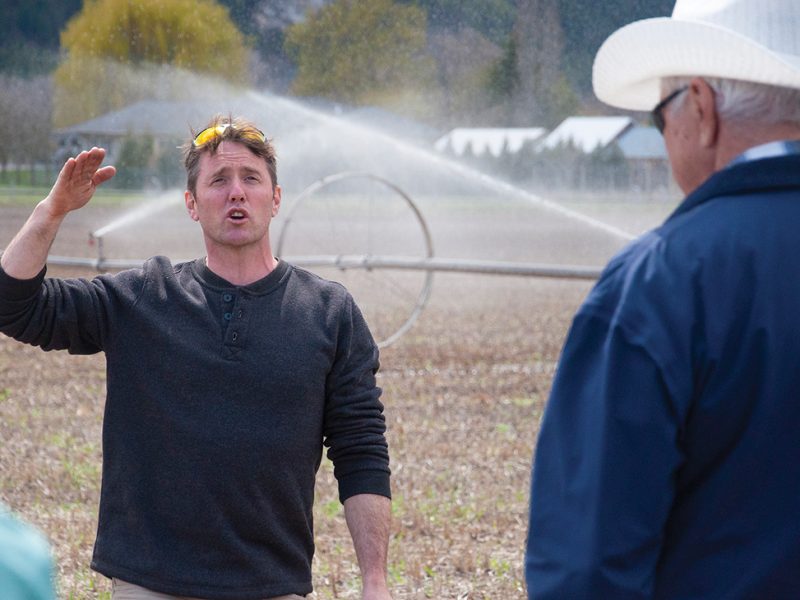
Irrigation designer Andrew Bennett explains the wheel line irrigation system at Mehmal Farms near Grand Forks during a field day hosted by Kootenay and Boundary Farm Advisors. BRIAN LAWRENCE

June 1, 2022 byBrian Lawrence

GRAND FORKS – When cool weather lingers through spring and when it arrives in the fall, irrigation is the furthest thing from the minds of many growers.

That shouldn’t be the case, says irrigation designer Andrew Bennett.

“It’s been a cold April – nobody’s thinking about irrigation,” he says. “[But] start early, and make sure you’re going into winter moist.”

Bennett and Bruce Naka, both irrigation designers and consultants certified by the Irrigation Industry Association of BC, visited Windermere, Skookumchuk, Creston and Grand Forks from April 25-29 as part of a series of field days hosted by Kootenay and Boundary Farm Advisors

They toured a farm each morning to assess its irrigation system, then presented their findings and general advice to the farmers and guests in the afternoon.

“These field days are all about the fundamental principles: Apply the right amount of water at the right time, evenly to all the roots and microbes, and save yourself time while you’re doing it,” says Bennett, who has his own five-acre farm in Rossland. “This way, our crops are stress-free, grow to their greatest potential, and we don’t cause problems like nutrient leaching, soil erosion and working harder than we have to.”

“I enjoy going out and meeting people from the agriculture community, as well as learning their story about their farms and being able to, maybe in a small way, help them to improve their farm through irrigation system improvements,” says Naka, who started working for his father’s irrigation supply business in the mid-1970s.

Century-old licence

Their final stop on April 29 took them to the Mehmal Farm, a family operation east of Grand Forks that dates back to 1914, when Leanna Mehmal’s grandfather had the farm’s water licence transferred into his name.

“We’re the second people to farm the land,” she says.

The Mehmal family has 200 head of cattle and 200 irrigated acres dedicated to corn silage, alfalfa, barley and timothy. Naka and Bennett’s initial presentation and discussion took place on a nearby 16-acre parcel, later moving to their Kettle River intake on the main part of the farm.

The parcel is irrigated by wheel lines, with wheels set 120 feet apart and fed by four-inch pipe. The line, designed prior to the Mehmals operating on that land, has sprinkler heads spaced 38 feet apart instead of the usual 40 feet, possibly planned with the weather in mind — not surprising to the dozen or so onlookers gathered on a blustery day.

“Somebody was really sharp on this one,” says Naka. “If it was done for a reason, it might be because of the wind. … If there’s a strong wind, it impacts the ability of the head to throw.”

“Sprinklers water much more heavily near the head, so spreading them too wide leads to really wet and really dry patches,” says Bennett.

“Head-to-head” overlap creates more even irrigation, a method he also recommended during the April 28 visit to Creston’s Cartwheel Farm, a market garden.

At the outside edge of a wheel line, where there are no overlapping sprinklers, the application rate is lower, but the Mehmal farm’s line has a double head at the end, making up for the lower amount of water.

“‘Nozzle up’ on the ends,” says Naka.

The line did, however, have noticeable leaks, which could represent a loss of four or five gallons per minute, a challenge in a system that is typically 65% efficient. With no other farms running irrigation during the presentation, the line’s pressure was about 70 psi, when it should be in the 40-50 psi range – pressure that’s too high leads to water loss through misting, and pressure too low results in crop damage from heavy drops of water.

As he had at Skookumchuk’s B-E Ranch on April 26, Bennett recommended replacing brass impact sprinklers with plastic rotators, which offer more uniform distribution and have lower maintenance costs. They’re sturdy, too; one of his clients has cows that enjoyed rubbing on the old brass nozzles, but still appreciate plastic.

“They can rub on them all day,” the farmer told Bennett, although “they might not get as good a scratch.”

“The cows might not be as happy,” says Bennett, but “the worst that can happen is they unscrew them.”

On the main part of the farm, just east of the 16-acre parcel, the Mehmals also use irrigation guns, which, as with the wheel lines, are labour-intensive.

“We need technologies to automate water use on oddly-shaped Interior BC fields where centre pivots are impractical,” says Bennett. “Ideas range from basic automatic valves on wheel moves and hand lines to fancy GPS-guided systems.”

Accurate and sufficient watering is particularly important as farmers deal with the effects of climate change. Last year, many crops were already stressed going into the extreme heat that settled over the province at the end of June and into July.

“We’re looking at a hot year,” says Naka. “In the Okanagan [in 2021], we had three or four districts make commercial growers use 20% less water.”

“What we are going to see with climate change is that we need to water more frequently,” says Bennett. “Many people only have four or five days of decent water storage in the soil.”

Government soil surveys are a helpful tool, showing the type of soil – such as sand or loam – in a general area, which directly affects water storage. At each farm, Bennett tested soil at various depths, sifting through 4mm and 2mm screens.

“Anything that can’t go through the screen can’t hold water,” says Bennett. “It can’t count toward water storage.”

Soil moisture sensors work

At Noble Farms, a 14-acre commercial cherry orchard south of Creston visited April 27, trees were already in need of water, with dry soil 18 inches down – a problem that soil moisture sensors could help with.

“You want to, every single day, be adding enough to keep it at the top,” says Bennett.

Owned by retired engineer Dev Singh, the farm uses drip irrigation, which presents its own challenges, but can be 90% efficient under ideal conditions. This system, designed by a previous owner, is manual, which may lead to human error, a challenge they also found at Windermere’s Winderberry Farm on April 25.

“Automation saves time and waters plants better – for every farm, it’s almost always worth the investment,” says Bennett.

Most systems should also have air relief valves at high points, allowing lines to fill quicker and eliminating water hammer.

“As the valve shuts off, the water hammers back,” says Naka. “If you have 100 pounds [of water in the pipe], 244 pounds hammers back. If you have too small a pipe, there will be more breaks.”

The more flexible polyethylene pipe, rather than PVC, can help in that regard, one of the reasons Bennett uses only polyethylene hose with time-saving cam locks, rather than screw-type hose connectors, on his farm.

“Getting water and soil relationships right is fundamental to every farm, so I get charged helping people think about them in ways that are simple, accurate and, most importantly, practical,” says Bennett.

An expert isn’t required to determine a farm or garden’s soil composition and water depth, but the process isn’t a tidy one.

“There are no substitutes for digging holes, getting dirty and making an afternoon of it,” says Bennett.

Related Posts

You may be interested in these posts from the same category.

Previous Post: « DAS expands to Kootenays
Next Post: Good land at risk »

Copyright © 2026 Country Life in BC · All Rights Reserved