• Menu
  • Skip to primary navigation
  • Skip to main content
  • Skip to primary sidebar

Country Life In BC Logo

The agricultural news source in British Columbia since 1915

  • Headlines
  • Calendar
  • Subscribe
  • Advertise
  • About
  • Archives
  • Contact
  • Search
  • Headlines
  • Calendar
  • Subscribe
  • Advertise
  • About
  • Archives
  • Contact
  • Search

Primary Sidebar

Originally published:

DECEMBER 2019
Vol. 105 Issue 12

Subscribe Now!

Sign up for free weekly FARM NEWS UPDATES

Select list(s) to subscribe to


By submitting this form, you are consenting to receive marketing emails from: Country Life in BC. You can revoke your consent to receive emails at any time by using the SafeUnsubscribe® link, found at the bottom of every email. Emails are serviced by Constant Contact
Your information will not be
shared or sold ever

Stories In This Edition

Parties unite on trespass legislation

Protesters rally at Ag Day

Got milk?

Peace faces worst grain harvest in 30+years

Editorial: Light in darkness

Back Forty: The West is packing its bags. Does Ottawa care?

Farmers’ passion for the land is strong

Ranchers voice ALR concerns at public meetings

Chefs, farmers foster new relationships

Sidebar: VFM Direct shuts down

Summerland grower steps up as co-op president

Recommendations from report nearly fully implemented

Food and beverage innovation centre launched

Japanese beetle control an industry priority

Langley farmers launch local farmers’ institute

BC agritech attracting major partners

New dam safety information flows

Bee-utiful

No-till takes centre stage at field day

Students showcase on-farm research projects

Emergency plans top agenda for bison ranchers

Rad

Regulatory issues top concerns for cattlemen

Processing adds value to Cowichan farm

Mentorship network helps new farmers

Research: Gene-editing eliminates horns in dariy bulls

Preserving owl, bat habitat is good for farming

Sidebar: Better bait

Seed app helps producers grow research data

Cannabis class wins high marks at BC fairs

Cannabis growers square off against diseases, pests

Pear-fect

Sidebar: Breaking the mold

Fine-tune feeding for healthier lambs

Farm Story: Performance anxiety knows no boundaries

Island AgSafe consultant changes gears

Woodshed: Intrigue deepens as barn repairs take shape

Century Farm award honours historic milestone

Jude’s Kitchen: So much to celebrate

More Headlines

Follow us on Facebook

Comments Box SVG iconsUsed for the like, share, comment, and reaction icons

6 days ago

... See MoreSee Less

View Comments
  • Likes: 4
  • Shares: 0
  • Comments: 0

Comment on Facebook

7 days ago

On the last day of the BC Organic Conference, Thursday, Molly Thurston of Pearl Agricultural Consulting helped growers learn how to manage bugs such as codling moth, wireworm, and rootworm in organic growing systems. Her talk alongside Renee Prasad included hands-on activities in which participants checked out various traps and examined pests under microscopes. Be sure to look for more upcoming ag events on our online calendar at www.countrylifeinbc.com/calendar/

#BCAg
... See MoreSee Less

On the last day of the BC Organic Conference, Thursday, Molly Thurston of Pearl Agricultural Consulting helped growers learn how to manage bugs such as codling moth, wireworm, and rootworm in organic growing systems. Her talk alongside Renee Prasad included hands-on activities in which participants checked out various traps and examined pests under microscopes. Be sure to look for more upcoming ag events on our online calendar at www.countrylifeinbc.com/calendar/

#BCAg
View Comments
  • Likes: 15
  • Shares: 0
  • Comments: 0

Comment on Facebook

1 week ago

Well-known organic farmer and podcaster Jordan Marr gets interviewed by Country Life in BC’s own columnist and potato mavin Anna Helmer during the opening session of the BC Organic Conference at Harrison Hot Springs yesterday. Sessions run today (Wednesday) and Thursday and include organic and regenerative growing practices and expanding and advocating for the organic sector, all under the background of the newly launched Organic BC banner.

#BCAg
... See MoreSee Less

Well-known organic farmer and podcaster Jordan Marr gets interviewed by Country Life in BC’s own columnist and potato mavin Anna Helmer during the opening session of the BC Organic Conference at Harrison Hot Springs yesterday. Sessions run today (Wednesday) and Thursday and include organic and regenerative growing practices and expanding and advocating for the organic sector, all under the background of the newly launched Organic BC banner.

#BCAg
View Comments
  • Likes: 37
  • Shares: 2
  • Comments: 1

Comment on Facebook

Interested in finding out more about this

3 weeks ago

Today, we remember those who sacrificed their lives or their well-being for our freedom. Lest we forget. ... See MoreSee Less

Today, we remember those who sacrificed their lives or their well-being for our freedom. Lest we forget.
View Comments
  • Likes: 8
  • Shares: 0
  • Comments: 0

Comment on Facebook

1 month ago

FarmFolk CItyFolk is hosting its biennial BC Seed Gathering in Harrison Hot Springs November 27 and 28. Farmers, gardeners and seed advocates are invited to learn more about seed through topics like growing perennial vegetables for seed, advances in seed breeding for crop resilience, seed production as a whole and much more. David Catzel, BC Seed Security program manager with FF/CF will talk about how the Citizen Seed Trail program is helping advance seed development in BC. Expect newcomers, experts and seed-curious individuals to talk about how seed saving is a necessity for food security. ... See MoreSee Less

Link thumbnail

BC Seed Gathering - FarmFolk CityFolk

farmfolkcityfolk.ca

Save the date for our upcoming 2023 BC Seed Gathering happening this November 3rd and 4th at the Richmond Kwantlen Polytechnic University campus.
View Comments
  • Likes: 1
  • Shares: 0
  • Comments: 0

Comment on Facebook

Subscribe | Advertise

The agricultural news source in British Columbia since 1915
  • Email
  • Facebook

No-till takes centre stage at field day

Untilled soils are healthier, have greater biodiversity

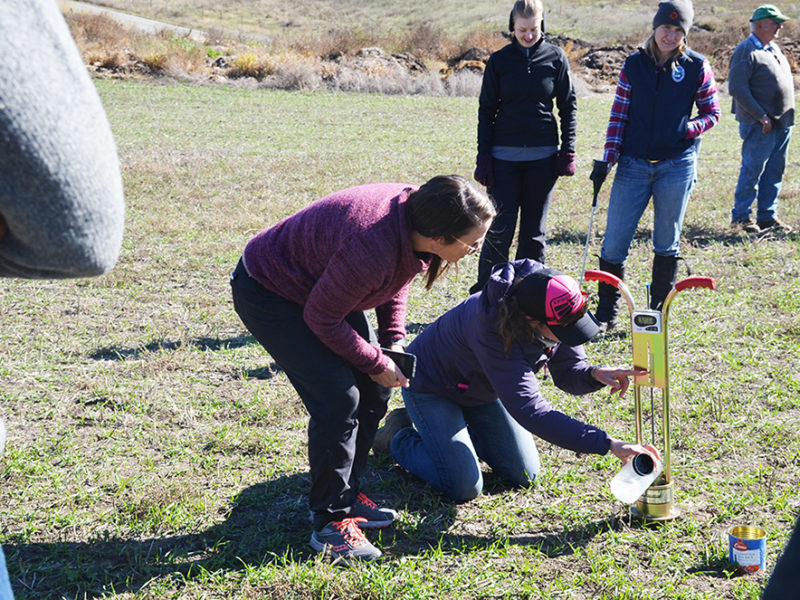
Catherine Tarasoff, left, and Rachael Roussin demonstrate an infiltrometer that measures how long it takes the soil to absorb water. TOM WALKER PHOTO

December 1, 2019 byTom Walker

ROCK CREEK – West Kootenay farmers had a field day in the hills above Rock Creek on September 10.

“We had an opportunity to view both informal and formal field trials that the farmers are developing,” says Rachael Roussin, coordinator of the Kootenay and Boundary Farm Advisors, which organized the event. “But these field days also make a space for conversation among the farmers.”

The first stop was at Doug and Erica Fossen’s cattle ranch. Classic curious farmers, the Fossens are always looking to improve the efficiency of their ranch.

This has made Doug is a fan of zero-till, the practice of seeding each year’s crop through the stubble of last year’s.

Benefits include less compaction and healthier soils because there’s no loss of organic matter or microbes.

“We’ve had spots, like on our calving grounds, where the soil was so compact we couldn’t grow anything,” he explains. “We have been zero-tilling for probably 20 years now, and those areas are not compacted anymore and the soil is getting stronger.”

Less time on the tractor also saves on the gas bill.

“We are always looking for ways to reduce our fuel bill,” he adds.

The Fossens showed a field planted to corn and intercropped with clover. The aim was to have some clover left behind for fall grazing after the corn was cut for silage. The clover was not as successful as he had hoped, however.

“My timing was a bit off, and the seeder I am using is really old,” he says. “But there should be some clover roots to stabilize the hillside soil in the spring and the new growth could give some early grazing.”

He also shared tips on growing and harvesting corn silage and corn grazing.

“I got good yields on my corn, around 7.5 tons of dry matter per acre,” he says. “I had more than I needed for silage so I left two fields for the cows to graze in December.”

He grazed an eight-acre field two years ago and he believes he got the equivalent yield in the field as if he had harvested it.

“I am hoping that each 13-acre field with about 400 cows will last 15 to 17 days,” says Fossen. “So, hopefully, we can get an extra month of grazing past when we would normally have to start feeding.”

But it’s good to have a back-up plan, he says.

“We have enough silage out in the pit to feed if everything goes wrong and it is just an ugly experiment for the neighbours to talk about,” he chuckles.

Radish rescue

Over 100 years of dry-land farming in the Rock Creek sunshine have left the grain and forage fields on Jamie Haynes’ ranch pretty compact. When it does rain, the dense soils are less able to absorb the moisture.

“After talking to the Fossens, I have transitioned to no-till methods to increase organic matter and reduce soil compaction,” explains Haynes.

A grant from the BC Agriculture and Food Climate Action Initiative’s Farm Adaptation Innovator program helped Haynes conduct an on-farm research project to see if he could improve soil function by interplanting tillage radishes while maintaining a satisfactory forage yield.

“We wanted to see if the radishes would help with water infiltration so when it does rain, the water will go in further and last longer,” explains Roussin.

Half a 60-acre field was planted with spring rye, oats and peas, and tillage radish, while the other half had no radish. Roussin coordinated the trial and Catherine Tarasoff, of Thompson Rivers University, and Agrowest Consulting provided support for research design and standardized measurements.

Tarasoff says the radishes served two purposes.

Radishes have long roots that are able to punch through the hardpan layer of soil, she explains. When the roots rot in the fall, they leave a kind of tube in the soil that allows water infiltration as well as adds organic matter.

“We found that [infiltration] where the radishes had been planted was almost twice that of the control area,” says Tarasoff. “But it’s not a silver bullet. That hardpan has taken years to build so it will take a number of plantings of radishes to break it up.”

The yields in both plots were comparable.

“We found that the yields on both the rye, oats and peas alone and the radish mix were very similar,” says Tarasoff.

However, radish planting reduced weed growth.

“The radish plantings had only half as many weeds and a more consistent yield,” she says.

That’s good for the long-term health of the field, Tarsoff points out.

“If the weeds are choked out, they will have less to seed the next year,” she says.

Low risk

On-farm research doesn’t require a lot of risk, Tarasoff notes.

“You can start with an acre just to see if something works,” she says. “And you always need an adjacent plot without the experiment so that you can compare

results.”
Related Posts

You may be interested in these posts from the same category.

Field days give farmers the dirt on soil management

Greenhouse sets example for others to follow

ACARN hosts largest-ever workshop

Previous Post: « Parties unite on trespass legislation
Next Post: BC agritech attracting major partners »

Copyright © 2025 Country Life in BC · All Rights Reserved