• Menu
  • Skip to primary navigation
  • Skip to main content
  • Skip to primary sidebar

Country Life In BC Logo

The agricultural news source in British Columbia since 1915

  • Headlines
  • Calendar
  • Subscribe
  • Advertise
  • About
  • Archives
  • Contact
  • Search
  • Headlines
  • Calendar
  • Subscribe
  • Advertise
  • About
  • Archives
  • Contact
  • Search

Primary Sidebar

Current Issue:

DECEMBER 2025
Vol. 111 Issue 11

Subscribe Now!

Sign up for free weekly FARM NEWS UPDATES

Select list(s) to subscribe to


By submitting this form, you are consenting to receive marketing emails from: Country Life in BC. You can revoke your consent to receive emails at any time by using the SafeUnsubscribe® link, found at the bottom of every email. Emails are serviced by Constant Contact
Your information will not be
shared or sold ever

Follow us on Facebook

Comments Box SVG iconsUsed for the like, share, comment, and reaction icons

6 days ago

... See MoreSee Less

View Comments
  • Likes: 4
  • Shares: 0
  • Comments: 0

Comment on Facebook

7 days ago

On the last day of the BC Organic Conference, Thursday, Molly Thurston of Pearl Agricultural Consulting helped growers learn how to manage bugs such as codling moth, wireworm, and rootworm in organic growing systems. Her talk alongside Renee Prasad included hands-on activities in which participants checked out various traps and examined pests under microscopes. Be sure to look for more upcoming ag events on our online calendar at www.countrylifeinbc.com/calendar/

#BCAg
... See MoreSee Less

On the last day of the BC Organic Conference, Thursday, Molly Thurston of Pearl Agricultural Consulting helped growers learn how to manage bugs such as codling moth, wireworm, and rootworm in organic growing systems. Her talk alongside Renee Prasad included hands-on activities in which participants checked out various traps and examined pests under microscopes. Be sure to look for more upcoming ag events on our online calendar at www.countrylifeinbc.com/calendar/

#BCAg
View Comments
  • Likes: 15
  • Shares: 0
  • Comments: 0

Comment on Facebook

1 week ago

Well-known organic farmer and podcaster Jordan Marr gets interviewed by Country Life in BC’s own columnist and potato mavin Anna Helmer during the opening session of the BC Organic Conference at Harrison Hot Springs yesterday. Sessions run today (Wednesday) and Thursday and include organic and regenerative growing practices and expanding and advocating for the organic sector, all under the background of the newly launched Organic BC banner.

#BCAg
... See MoreSee Less

Well-known organic farmer and podcaster Jordan Marr gets interviewed by Country Life in BC’s own columnist and potato mavin Anna Helmer during the opening session of the BC Organic Conference at Harrison Hot Springs yesterday. Sessions run today (Wednesday) and Thursday and include organic and regenerative growing practices and expanding and advocating for the organic sector, all under the background of the newly launched Organic BC banner.

#BCAg
View Comments
  • Likes: 37
  • Shares: 2
  • Comments: 1

Comment on Facebook

Interested in finding out more about this

3 weeks ago

Today, we remember those who sacrificed their lives or their well-being for our freedom. Lest we forget. ... See MoreSee Less

Today, we remember those who sacrificed their lives or their well-being for our freedom. Lest we forget.
View Comments
  • Likes: 8
  • Shares: 0
  • Comments: 0

Comment on Facebook

1 month ago

FarmFolk CItyFolk is hosting its biennial BC Seed Gathering in Harrison Hot Springs November 27 and 28. Farmers, gardeners and seed advocates are invited to learn more about seed through topics like growing perennial vegetables for seed, advances in seed breeding for crop resilience, seed production as a whole and much more. David Catzel, BC Seed Security program manager with FF/CF will talk about how the Citizen Seed Trail program is helping advance seed development in BC. Expect newcomers, experts and seed-curious individuals to talk about how seed saving is a necessity for food security. ... See MoreSee Less

Link thumbnail

BC Seed Gathering - FarmFolk CityFolk

farmfolkcityfolk.ca

Save the date for our upcoming 2023 BC Seed Gathering happening this November 3rd and 4th at the Richmond Kwantlen Polytechnic University campus.
View Comments
  • Likes: 1
  • Shares: 0
  • Comments: 0

Comment on Facebook

Subscribe | Advertise

The agricultural news source in British Columbia since 1915
  • Email
  • Facebook

Pandemic puts the squeeze on blueberry growers

Reduced workforce threatens fruit quality
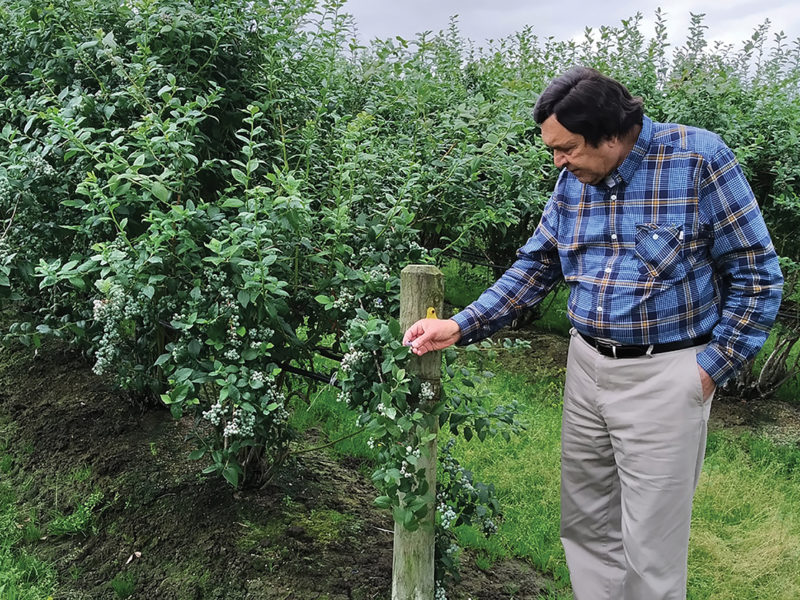
Rajinder Singh Lally says he’s spent more than $50,000 on personal protective equipment to keep his staff safe while harvesting and processing this year’s blueberry crop. It’s a significant expense, especially when a labour shortage could result in a smaller harvest this season. PHOTO / SARBMEET SINGH

August 1, 2020 bySarbmeet Singh

by SARBMEET SINGH
ABBOTSFORD – BC blueberry growers face tighter profit margins this year due to COVID-19.
Public health protocols have created additional costs including the need for personal protective equipment for workers’ safety and a hike in labour costs. Meanwhile, fewer workers in the fields mean fruit could over-ripen, reducing quality and prices.
“We have spent more than $50,000 on the equipment including gloves, masks and hand sanitizer. Additionally, to maintain social distancing during lunch times, we have placed new tents for the workers,” says Rajinder Singh Lally, owner of Lally Farms in Abbotsford, pointing towards the new Plexiglas dividers being installed at his packing house to ensure social distancing between workers.
Lally owns 13 farms totalling 500 acres. Despite his size, he feels the extra costs are likely to reduce his profit margins.
Besides spending money on personal protective equipment – a significant cost in itself – farms are having to hire additional workers to sanitize everything from crates to retail areas.
Kris Maan at Maan Country Farms is also feeling the pinch due to the need for additional staff to maintain a high level of sanitation at the popular agri-tourism venue.
“We have hired workers just for sanitization,” he says. “They keep on sanitizing various things at the farm. We are very cautious about the disease. This has increased our costs.”
Farmers also fear over-ripening of fruit that can’t be harvested as quickly because of the need to maintain social distancing among workers. Picking began this year in early July and will last into September. The farm labour contractors who provide workers need to make more trips to deliver the same number of workers to farms, and there are also specific protocols at the farms themselves.
“We are planning to enroll the workers in picking berries by keeping them at a distance of at least one row. This will, however, cause over-ripening due to slow picking leading to a decline in price,” says Bhupinder Singh, a Punjabi farmer in Langley.
“We need around 200 people to pick berries in our farm,” says Parmjeet Sahota, who farms in Pitt Meadows. “This year we are not getting enough labour and that can result in over-ripening of the fruit because the berries can’t wait to be picked.”
The need to maintain space among workers is compounding troubles associated with a shortage of labour. To tackle the situation, farm owners are offering higher wages for pickers.
“In the past, we used to offer 50 to 60 cents per pound for picking berries for early and mid-season varieties, respectively. This year, we are planning to hike that by up to 10 cents per pound,” says Lally.
On an average, one person can pick around 300 pounds of berries per day, which means Lally will pay around $30 more per day to each worker. As hundreds of workers work at the farm, this will result in hundreds of extra dollars in harvest costs, and a reduction in profit margins. With an average yield of 12,000 pounds an acre, the extra pay could boost costs by up to $1,200 an acre.
Farm owners say many people are reluctant to work due to the Canadian Emergency Response Benefit, which Ottawa has announced will run an additional eight weeks until August 29. CERB pays $500 a week to workers who have lost work due to COVID-19, or about $2,000 a month. Recipients can accept work, but wages are capped at $1,000 before the benefit starts being clawed back. This means farmers would have to pay a full-time worker at least $3,000 a month in order for employment to be competitive with staying at home.
“The aid given by the federal government is also luring the people to not resume work. Monthly aid by the government is another factor contributing to the prevailing shortage of labour,” says Balraj Singh of Abbotsford. “When people can get money by sitting idle at their homes, why will they come to farms?”
But there’s also another reason for the shortage of workers that’s unique to Indo-Canadian farms.
A large number of Indo-Canadians rush to Punjab to visit their homeland in winter, a time when most of the marriages are held in Punjab. They return in April and May. However, due to COVID this year, many of them were not able to return on time as per their schedule.
“I went to India to attend (the) marriage ceremony of my relatives in December last year. I was scheduled to return by April end. However, due to COVID, all the flights were cancelled,” says Gurnam Singh, who worked on berry farms last year but has been unable to return to Canada for this season. “When the Canadian government started repatriating the Canadians, the costly flight tickets was another challenge before me. So, I decided to remain in Punjab for some more time and wait for the tickets to get cheaper.”

Related Posts

You may be interested in these posts from the same category.

COVID-19 response reviewed

BC blueberry crop down 30%

Federal election call

Farmers market returns

Sector events start growing

Wind machines in Surrey face blowback

WorkSafeBC increases inspections

Sunrise Poultry COVID outbreak

Flight ban strands workers

Travel restrictions raise concerns

Foreign worker vaccination prioritized

Strict pandemic plan keeps workers safe

Previous Post: « Farm safety organization revamps
Next Post: Pandemic-related stress increases »

Copyright © 2025 Country Life in BC · All Rights Reserved