• Menu
  • Skip to primary navigation
  • Skip to main content
  • Skip to primary sidebar

Country Life In BC Logo

The agricultural news source in British Columbia since 1915

  • Headlines
  • Calendar
  • Subscribe
  • Advertise
  • About
  • Archives
  • Contact
  • Search
  • Headlines
  • Calendar
  • Subscribe
  • Advertise
  • About
  • Archives
  • Contact
  • Search

Primary Sidebar

Originally published:

APRIL 2022
Vol. 108 Issue 4

Subscribe Now!

Sign up for free weekly FARM NEWS UPDATES

Loading form…

Your information will not be
shared or sold ever

Stories In This Edition

Taking root

No room

Farmland values soar

Orchardist grows international, domestic sales

Editorial: The choices we make

Back 40: Freedom has its boundaries in a civilized world

Viewpoint: Underinsured in a potential disaster zone

BCFGA sheds responsibilities, looks ahead

Province hikes minimum wage, piece rates

Climate Action Initiative disbanded by province

Dusty brown

Letters: Minister is misleading

Chicken growers on watch for avian influenza

Ag Briefs: OrganicBC pursues structural review

Ag Briefs: Online bull sale exceeds expectations

Ag Briefs: Groundwater deadline passes

Turkeys emerge from 2021 in a strong position

Sidebar: Benoit trades turkeys for flowers

Agri-industry project gets green light from ALC

Resilient cherry growers target exports

Labour shortage has abattoirs hogtied

No progress on livestock watering regulations

Soakin’ up the sun

Regenerative agriculture vision outlined

Strong yields and new strategy for cranberries

Tree fruit growers struggle to source plants

Fumigation options

Farm Story: Cull potatoes are about to earn their keep

Pilot program bridges the extension gap

There is a future for BC’s apple industry

A warming world calls for new strategies

Heat dome, cold snaps hit some, miss others

Boiler project cuts costs for Duncan farm

Woodshed Chronicles: A little tough love for Frank and Kenneth

Farm partnership supports local non-profit

BC entrepreneurs meet food waste challenge

It’s time to dust off the barbecue

More Headlines

Follow us on Facebook

Comments Box SVG iconsUsed for the like, share, comment, and reaction icons

6 days ago

A BC Forest Practices Board investigation has found overgrazing has damaged grasslands in the Coutlee Range Unit near Merritt — and the range-use plan meant to prevent it was unenforceable. With complaints about overgrazing on the rise and grasslands covering just 1% of BC's land mass, the findings raise fresh questions about how the province manages one of its most vulnerable — and valuable — food-producing ecosyste#BCAg#BCAg ... See MoreSee Less

Link thumbnail

Board finds overgrazing rules unenforceable unmeasurable

www.countrylifeinbc.com

MERRITT – A BC Forest Practices Board investigation has found instances of non-compliance related to overgrazing have damaged open grasslands in the Mine pasture, part of the Coutlee Range Unit near...
View Comments
  • Likes: 6
  • Shares: 6
  • Comments: 6

Comment on Facebook

Several ranchers in recent years have gone into temporary non use on that range , so that means the grass should grow. But drought conditions/lack of rain and snow don’t allow that to happen . Dried up springs , creeks waterholes in various pastures add to over grazing where there is water , as livestock and everything else stay close to the water source . So even though less cattle are on it , over grazing appears. There is a large volume of horses on it 365 days/year which is wrong ! They pull grass right out of the ground when it’s just trying to grow ,, opens the door for weeds to grow in. That don’t help it. Aging infrastructure ( fences) laying on the ground, pipe line building , ( lack of commitment to fence maintenance) amongst all users contributes also to over grazing. Recreational atv users leaving gates open between pastures allows livestock to go back or ahead in pastures also expidites over grazing. Logging ( bcts) has no problem laying out cut locks on both sides of a fence , then it gets smashed down during logging and they don’t take responsibility to stand it back up or clean the cattle gaurds out when they are done , that happened 4 years ago on pasture 5 up there . I bet it is still not fixed . There are lots of contributing factors to the problem.

Tragedy of the commons.

I looked through the report. I saw nothing about the effects of noxious weeds on productive grasslands. This particular area is vulnerable because of the Ministry’a efforts to diversify the use of the Grasslands.

This pasture is under tremendous pressure not only from cattle but from irresponsible local residents who treat it as a landfill dumping all manner of household debris here. And don't even get me started on the mud bogging and camping in sensitive riparian areas. The feral horses are in this pasture 365 days a year just hammering it. Would sure be nice to see some enforcement action on people who are intentionally ripping up the grasslands and riparian areas. Cattle could be a valuable resource for rebuilding soils and native grasses in this area with the help of electric fencing and/or e-collars. The humans will be harder to manage.

The Forest and Range Practices Act was written by lawyers for global forest licencee shareholders. Results-based = unenforceable.

Also, can we talk about the impact of a pipeline being built through the middle of this field for multiple years?

View more comments

1 week ago

East Kootenay rancher Randy Reay is digging a new well after two natural water sources dried up on his Crown tenures. A new Living Lakes Canada assessment found 15% of mapped aquifers in the region are high-priority for monitoring, yet 80% of those go unmonitored. With over 48% of BC's provincial observation wells reporting below-normal groundwater levels, ranchers and researchers are sounding the alarm on water security. The story is in our March edition, and we've posted it to our website thi#BCAgk.

#BCAg
... See MoreSee Less

Link thumbnail

Water woes: groundwater under pressure across BC

www.countrylifeinbc.com

JAFFRAY – As a young boy growing up in the Kootenay-Boundary region, Randy Reay never expected to run out of water. But this year, in mid-February, his fields are bare. There is no snow halfway up t...
View Comments
  • Likes: 8
  • Shares: 7
  • Comments: 1

Comment on Facebook

Jaffrey is in the east Kootenays not kooteney boundary

2 weeks ago

BC farmers are bracing for prolonged higher input costs as war in the Middle East drives up fuel and fertilizer prices. Nitrogen fertilizer costs were already climbing before the Iran conflict began, with prices still roughly 60% above pre-pandemic levels. Farm Credit Canada warns that unlike 2022, strong commodity prices may not offset rising costs this time. Local suppliers expect supply challenges and further price increases ahead.

#BCAg
... See MoreSee Less

Link thumbnail

Fertilizer prices on the rise

www.countrylifeinbc.com

War in the Middle East has delivered a generational shock to energy prices, meaning BC farmers can expect a prolonged period of higher costs not just for fuel but also for fertilizer.
View Comments
  • Likes: 2
  • Shares: 1
  • Comments: 0

Comment on Facebook

2 weeks ago

... See MoreSee Less

View Comments
  • Likes: 1
  • Shares: 0
  • Comments: 0

Comment on Facebook

2 weeks ago

Cameron Stockdale is the new executive director of provincial farm safety organization AgSafeBC. Find out more in this week's Farm News Update from Country Life in B#BCAg#BCAg ... See MoreSee Less

Link thumbnail

New leadership at AgSafe BC

www.countrylifeinbc.com

Cameron Stockdale is the new executive director of provincial farm safety organization AgSafeBC, succeeding Wendy Bennett. Bennett left AgSafeBC in September 2025, following 12 years with the…
View Comments
  • Likes: 5
  • Shares: 1
  • Comments: 0

Comment on Facebook

Subscribe | Advertise

The agricultural news source in British Columbia since 1915
  • Email
  • Facebook

Pilot program bridges the extension gap for Gulf Island farmers

Soil health provides local insight for Gulf Island farmers

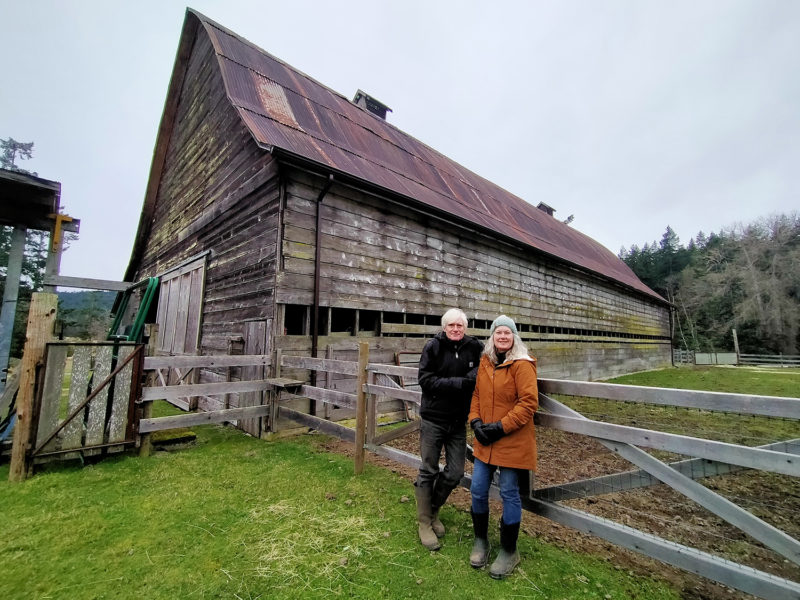
Peter Robinson and Kristine Webber highlighted their efforts in riparian restoration during a tour of their Mayne Island farm. SANDRA TRETICK

April 1, 2022 bySandra Tretick

MAYNE ISLAND – Hedgerow Farm and Deacon Vale Farm on Mayne Island opened their gates on February 26 to welcome a group of 20 experienced, new and prospective farmers from the outer Gulf Islands for the final field day of a six-week introductory course on soil health hosted by the Gulf Islands Food Co-op in partnership with Kwantlen Polytechnic University (KPU).

When farmers are starting out, there’s a lot to learn and online resources can be overwhelming. There’s often little that’s specific to growing conditions in smaller regions such as the Gulf Islands.

Closing that gap was top of mind for co-op president Roz Kempe when she reached out to Kent Mullinix, director of the Institute for Sustainable Food Systems at KPU. She was inspired by the Healthy Soil Initiative out of California and wanted to see if KPU could recreate that on a smaller scale.

“If we could just have some support on the Gulf Islands to understand what soil health actually means,” recalls Kempe. “Not just soil chemistry, but the entire ecosystem of soils and how to improve that. Kent was very enthusiastic.”

Mullinix was interested because no one else in BC was doing anything similar. Together they prepared a proposal and VanCity came through with a $20,000 grant through its Community Partnership Program.

“The local piece is really important,” says Kempe. “It’s not just learning from the United States or from the Lower Mainland or the Fraser Valley where [there’s] so much large-scale farming. It’s different here on the Gulf Islands.”

Hedgerow Farm co-owner Kristine Webber says the program provided much- needed on-farm extension support for farmers like herself. Webber received a degree in agriculture 20 years ago, but it taught her about conventional agriculture. That wasn’t the direction she and her partner Peter Robinson wanted to go when they purchased the farm six years ago.

“We’re doing things differently now,” says Webber. “The science has changed. We’re talking about healthy soil, not what [chemicals] you’re putting on soils.”

Taking a whole-ecosystem approach is what program instructor Amy Norgaard, also a part-time instructor at KPU, was keen to impart to the group.

Through a series of four evening Zoom sessions and four weekend field days – one each on Saturna, Galiano, Pender and Mayne – the group learned the basics of soil science, the role of nutrient management and cover cropping, why soil testing is important and how to take samples. Norgaard also provided links to useful resources, shared videos, brought in guest speakers  and allowed plenty of time for questions and discussion.

Farms around the Gulf Islands are as diverse as the islands themselves and local farmers jumped at the chance to have their soil tested. KPU student Julia Bendtsen, who is completing a graduate certificate in food security, had more volunteers for this aspect of the program than the grant funding could support. Five farms – some established and some bare land – were selected and each received a comprehensive nutrient management plan.

Norgaard says soil health can be attained largely through a combination of cover cropping and composts. But it’s rarely that simple. Soil health is really the result of an iterative process that people need to revisit year after year.

“There’s no silver bullet,” she says. “Start somewhere. Make a small change and see how it performs. I think some people want to have all of their ducks in a row before they initiate a plan. The reality is there’s all these microclimates, all these different soils, all of these different background characteristics that inform how somebody is going to go about managing their soil. There’s no better way to know what’s going to work best on your property than to get that direct feedback by making these incremental changes and fine tuning with your own observations.”

Webber says her biggest takeaway was finding out how much knowledge already existed in the farming community.

“We got to meet experts to talk about soil and nutrient cycling and cover crops and soil health, but we also got to meet other small-scale farmers and learn from them what they’ve tried, what’s been successful and what hasn’t,” says Webber. “I have a lot of people now I can ask for advice and some more friends to grow with.”

Lack of extension

The lack of extension crops up in various regional agriculture plans, including the 2017 Southern Gulf Islands Food and Agriculture Strategy commissioned by the Capital Regional District. The strategy actually led to the creation of the co-op in 2018.

Kempe knew there was a need for the course, which ran as a pilot this year, but she was surprised at the level of interest. They planned for 20 participants, but more than 64 signed up. Coordination across the islands proved challenging, but she credits the co-op’s project coordinator Ben Dunsmuir for his efforts to pull together four field days on four different islands while adhering to COVID-19 protocols.

Kempe hopes the course will serve as inspiration for other communities looking for extension support, but she admits that they just scratched the surface in four Zoom lectures.

“Soil health is so in-depth,” says Kempe. “There’s so much to learn. We could be doing this for years and years and still learn more about soil. It’s a start.”

The BC Ministry of Agriculture and Food hasn’t completely exited the world of extension services, despite what many believe. Under the New Entrant Strategy – part of Grow BC – there’s the BC Land Matching Program and support from new entrant agrologists. Grow BC also enables producer organizations to provide extension and organize events ranging from workshops to on-farm demonstration projects, although small-lot producers in the Gulf Islands may not find these a good fit for their specific needs.

There is also AgriServiceBC, the ministry’s one-stop shop for farmers to connect with a qualified expert for one-on-one help to access the right funding programs, solve technical production problems, grow business or research opportunities.

Some of the participants in the healthy soils course were previously unaware of these supports, but Norgaard addressed that and introduced Emma Holmes, the ministry’s organics specialist.

In retrospect, Norgaard said she wanted the participants to walk away from the program feeling empowered to farm more confidently.

“People almost hesitate to start and I see this lack of confidence,” says Norgaard. “I see that all over the map. Farmers think they’re unique and they don’t have the answers, but they think their neighbour does. I hope these field days have provided some ‘neighbour-to-neighbour’ information sharing that can lower those risks of change and increase confidence in adopting new practices.”
Related Posts

You may be interested in these posts from the same category.

Islands Trust turns 50

KPU genomics lab expands

Genomics lab expands service to local growers

Previous Post: « Abbotsford flood mitigation options
Next Post: Stories bridge the gap between producers, consumers »

Copyright © 2026 Country Life in BC · All Rights Reserved