
CHILLIWACK – Growing local and global demand is fuelling a renewed focus on BC hazelnuts and their potential.
Past replant programs failed to achieve full uptake from hazelnut growers, but a new report from Chris Bodnar, assistant professor of agriculture at the University of the Fraser Valley, may drive more interest from government, investors and growers looking for new options.
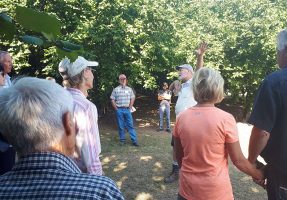
“There is significant potential for growth based on climatic reasons and soil types,” says Bodnar, who addressed about 35 growers during the BC Hazelnut Growers Association (BCHGA) field day at Fraser Valley Hazelnuts in Chilliwack, September 13.
The potential was noted in a November 2024 opportunities assessment report prepared for the BC Ministry of Agriculture and Food to provide growers with alternative crop options in anticipation of future environmental changes. Hazelnuts were one of four promising crops for further research.
The report provided a starting point for Bodnar’s own opportunities assessment report for the sector, which he expects to formally release in October.
“We have [an agriculture] minister in BC who loves hazelnuts,” Bodnar says. “I think that’s something to leverage.”
Popham has overseen multiple rounds of renewal funding for the sector since 2018, but Bodnar says that support could change as government priorities shift. His report aims to leverage her current enthusiasm to drive industry growth.
Bodnar’s overview of the hazelnut industry considers current production, processing capacity, demand, market conditions, crop values, infrastructure, value chain gaps, government support and policy landscape, and strategic opportunities and recommendations. He presented the eight draft recommendations to growers at the field day.
The first is to expand processing capacity and infrastructure, summarized in the report as building “the backbone of cracking, cleaning and packing either through a cooperative processing venture or public-private funding model, to ensure no grower is left without a viable path to market their nuts.”
Other recommendations include: develop harvest and post-harvest solutions; strengthen marketing, branding and consumer education, including creating a BC Hazelnut brand; promote value-added product development; implement a levy to generate funds for industry; pursue strategic partnerships for marketing, research, agrology and other supports; and strategically expand acreage in diverse geographic regions.
Bodnar notes that the Okanagan has been identified as an important potential region for growers shifting away from apples.
“Canadian apples are no longer seen as competitive,” he says. “That would be one of the more obvious places to position the sector for more growth.”
The final recommendation urges enhanced grower support and knowledge transfer to reduce risk and improve the likelihood of grower success. This includes tracking the growth and spread of Eastern Filbert Blight in resistant varieties to ensure risks to industry are mitigated wherever possible.
“Farmer events continue to be a really important part of how the sector might develop,” he says.
New growers Henry and Jan van Someren of Fort Langley are hopeful for increased support for the industry, especially in education. They participate in field days and similar events as often as possible to learn about proper hazelnut care.
“We’re into our third summer,” Henry says of their one-acre orchard. “We try to attend as much as we can ever since we planted.”
Like many growers, the van Somerens find value in hearing they are on the right track with their farming practices. They also value learning new techniques and being part of the tight-knit hazelnut grower community.
“We want to stay connected and learn more about what people are doing,” Henry says. “Because we’re so new, the learning is important to us. To see that we are somewhat on track is encouraging.”
Community is something Mike Sunder, owner of Horti International, spoke about in a fireside chat-style Q&A with BCHGA executive director Sue Grubac.
Sunder’s portion of the field day focused on nutrition and amendments but he went slightly off-script to discuss the importance of coming together in agriculture.
“It’s not a competition,” Sunder says. “Ultimately, we want to work as a community.”
He says when growers come together, they ask each other questions and share knowledge. However, when farmers see other farmers as competitors, they lose out on that sense of community and synergy. This ultimately costs them more than they could ever gain by being an island.
“That community is what makes us better and makes us learn,” he says. “It’s the best way to drive this industry forward.”
Another part of the field day included a hay ride, during which participants were taken to a five-year-old, double-density orchard for a demonstration of tree removal. Every second tree in the orchard will be removed this year to improve the production of the maturing trees left standing.
Adam Russenholt of Inland Enterprises brought his tree mulcher to the farm to demonstrate how quickly and accurately he can remove trees and “mulch them down to whatever size the grower wants.”
The machine he showcased is nimble, able to get to alternate trees quickly without damaging their neighbours. It can handle trunks of six to eight inches in diameter (he has larger equipment to remove larger trees). From the point of touching the trunk with the mulching blade to leaving debris behind on the orchard floor took about 10 seconds.
“I was going slower, too, because there were people around,” Russenholt says.
While suckers may return after the tree is removed, these are easily managed with regular management practices used on the suckers of existing trees.
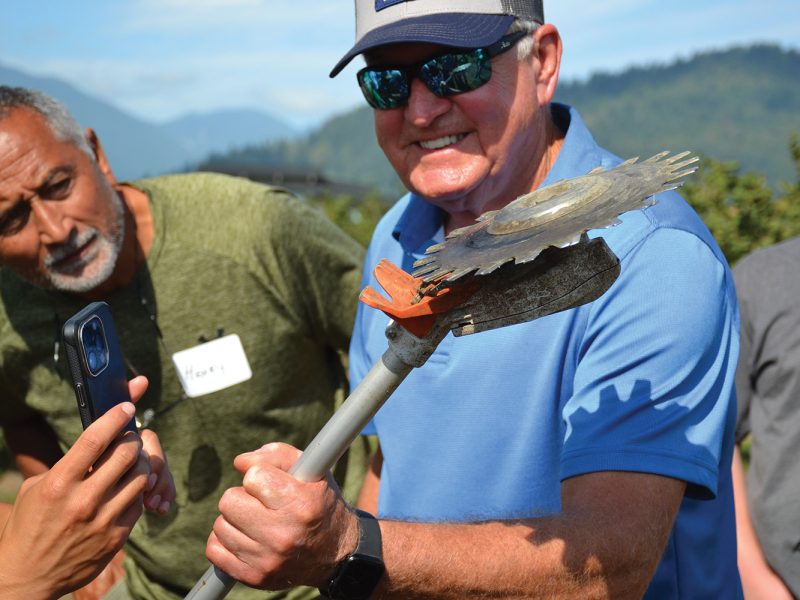
Don Hooge of Fraser Valley Hazelnuts also conducted a demonstration, showing how a special round blade with teeth removes suckers from around trees without damaging roots or trunks.
All content on this website is copyrighted, and cannot be republished or reproduced without permission.
 Sheep commission considered