• Menu
  • Skip to primary navigation
  • Skip to main content
  • Skip to primary sidebar

Country Life In BC Logo

The agricultural news source in British Columbia since 1915

  • Headlines
  • Calendar
  • Subscribe
  • Advertise
  • About
  • Archives
  • Contact
  • Search
  • Headlines
  • Calendar
  • Subscribe
  • Advertise
  • About
  • Archives
  • Contact
  • Search

Primary Sidebar

Originally published:

May 2018
Vol. 104 Issue 5

Subscribe Now!

Sign up for free weekly FARM NEWS UPDATES

Select list(s) to subscribe to


By submitting this form, you are consenting to receive marketing emails from: Country Life in BC. You can revoke your consent to receive emails at any time by using the SafeUnsubscribe® link, found at the bottom of every email. Emails are serviced by Constant Contact
Your information will not be
shared or sold ever

Stories In This Edition

Fraser Valley bee shortage overstated

Still waiting: ag waste regs

Cannabis shift delivers hit to vegetable sector

Peter’s legacy

Editorial: The straight dope

Back Forty: Our best friend deserves greater recognitiontory

Overheard: Farmers should embrace First Nations model

Change is coming, fast and furious

Foundation effective in fueling ag projects

New meat producer association launched

Sidebar: On board

Traceability regs to include animal movement

Report recommends FN approval on tenures

Province urged to regulate farmhouse size

Dairy group highlights industry needs on tour

Ottawa plays hardball with Agassiz leases

IAF showcases innovative ag projects

Neonics in water not from farm operations

Potato growers need to exploit opportunities

Spuds in tubs

Vegetable commission optimistic

Sidebar: Variety update

MacAulay grilled over farm labour issues

Apiarists want pollination income to count

Sidebar: BCHPA launches pollinator health study

Raspberry growers increase board size

Popham meets with berry growers

Hazelnut growers flush with optimism

Ranchers schooled in disaster preparation

Westgen eyes beef semen sales for growth

Big prize money draws big entries

Holstein auction sets new sale benchmark

North 40 bull tops Vanderhoof sale

Reclaiming market share in a global economy

Day-neutrals show promise for strawberry fields

Weather skews results in Peace variety trials

Salal berries have market potential

Vole control in blueberries

Wannabe: When tragedy brings us together

Watchful eye

Woodshed Chronicles: Henderson masterminds an apology

Jude’s Kitchen: Celebrate May with beef on the ‘barbie’

More Headlines

Follow us on Facebook

Comments Box SVG iconsUsed for the like, share, comment, and reaction icons

7 days ago

... See MoreSee Less

View Comments
  • Likes: 4
  • Shares: 0
  • Comments: 0

Comment on Facebook

7 days ago

On the last day of the BC Organic Conference, Thursday, Molly Thurston of Pearl Agricultural Consulting helped growers learn how to manage bugs such as codling moth, wireworm, and rootworm in organic growing systems. Her talk alongside Renee Prasad included hands-on activities in which participants checked out various traps and examined pests under microscopes. Be sure to look for more upcoming ag events on our online calendar at www.countrylifeinbc.com/calendar/

#BCAg
... See MoreSee Less

On the last day of the BC Organic Conference, Thursday, Molly Thurston of Pearl Agricultural Consulting helped growers learn how to manage bugs such as codling moth, wireworm, and rootworm in organic growing systems. Her talk alongside Renee Prasad included hands-on activities in which participants checked out various traps and examined pests under microscopes. Be sure to look for more upcoming ag events on our online calendar at www.countrylifeinbc.com/calendar/

#BCAg
View Comments
  • Likes: 15
  • Shares: 0
  • Comments: 0

Comment on Facebook

1 week ago

Well-known organic farmer and podcaster Jordan Marr gets interviewed by Country Life in BC’s own columnist and potato mavin Anna Helmer during the opening session of the BC Organic Conference at Harrison Hot Springs yesterday. Sessions run today (Wednesday) and Thursday and include organic and regenerative growing practices and expanding and advocating for the organic sector, all under the background of the newly launched Organic BC banner.

#BCAg
... See MoreSee Less

Well-known organic farmer and podcaster Jordan Marr gets interviewed by Country Life in BC’s own columnist and potato mavin Anna Helmer during the opening session of the BC Organic Conference at Harrison Hot Springs yesterday. Sessions run today (Wednesday) and Thursday and include organic and regenerative growing practices and expanding and advocating for the organic sector, all under the background of the newly launched Organic BC banner.

#BCAg
View Comments
  • Likes: 37
  • Shares: 2
  • Comments: 1

Comment on Facebook

Interested in finding out more about this

3 weeks ago

Today, we remember those who sacrificed their lives or their well-being for our freedom. Lest we forget. ... See MoreSee Less

Today, we remember those who sacrificed their lives or their well-being for our freedom. Lest we forget.
View Comments
  • Likes: 8
  • Shares: 0
  • Comments: 0

Comment on Facebook

1 month ago

FarmFolk CItyFolk is hosting its biennial BC Seed Gathering in Harrison Hot Springs November 27 and 28. Farmers, gardeners and seed advocates are invited to learn more about seed through topics like growing perennial vegetables for seed, advances in seed breeding for crop resilience, seed production as a whole and much more. David Catzel, BC Seed Security program manager with FF/CF will talk about how the Citizen Seed Trail program is helping advance seed development in BC. Expect newcomers, experts and seed-curious individuals to talk about how seed saving is a necessity for food security. ... See MoreSee Less

Link thumbnail

BC Seed Gathering - FarmFolk CityFolk

farmfolkcityfolk.ca

Save the date for our upcoming 2023 BC Seed Gathering happening this November 3rd and 4th at the Richmond Kwantlen Polytechnic University campus.
View Comments
  • Likes: 1
  • Shares: 0
  • Comments: 0

Comment on Facebook

Subscribe | Advertise

The agricultural news source in British Columbia since 1915
  • Email
  • Facebook

Salal berries have market potential

May 1, 2018 byMargaret Evans

Sometimes, some of the best health foods are right in front of you – or perhaps swirling in a glass-filled gift from a buddie.

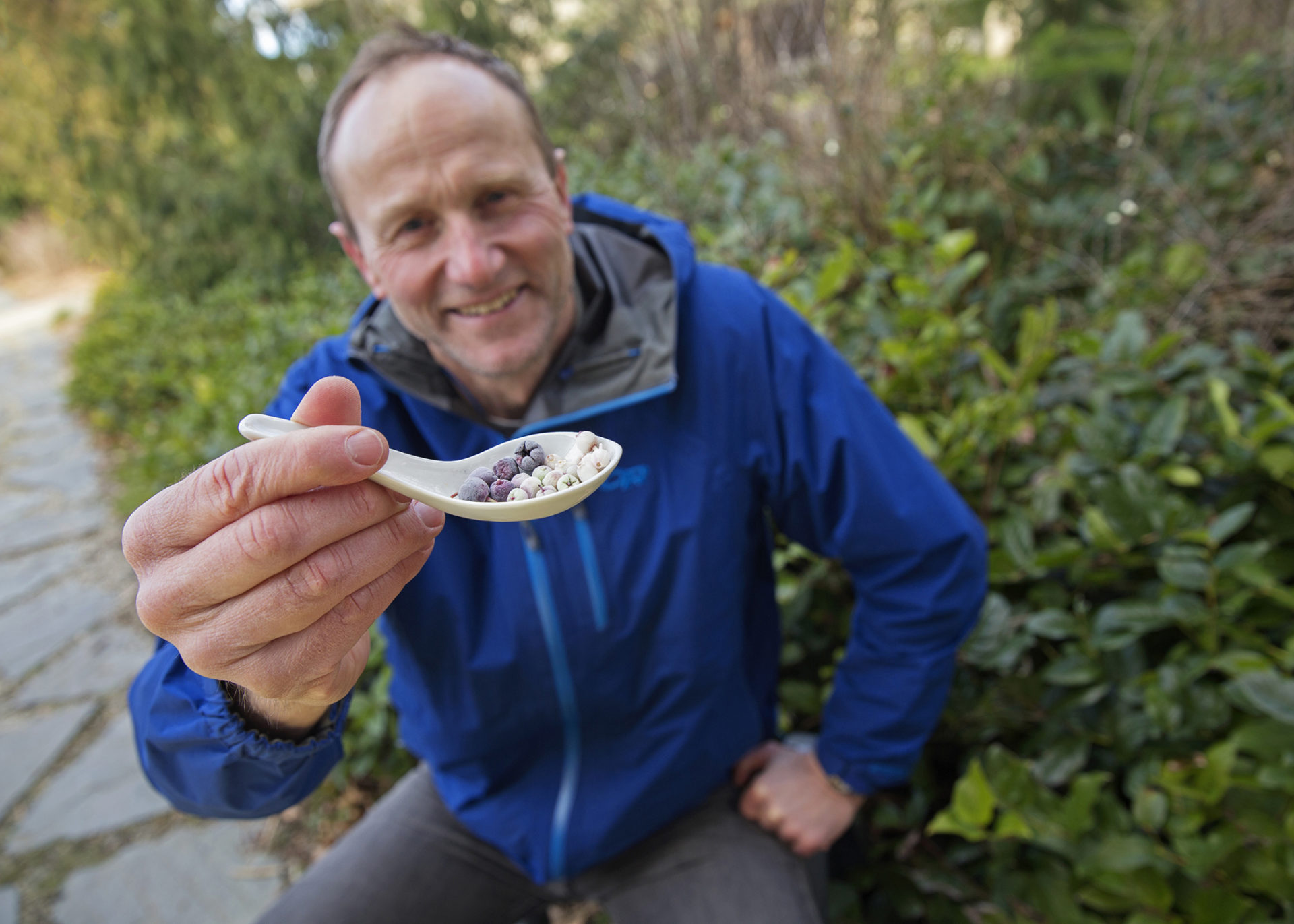
“A friend gave me a bottle of dessert wine that included some salal juice as a present,” says professor Peter Constabel, director of the Centre for Forest Biology, University of Victoria. “I had done previous work on blueberries [and] salal is in the same plant family as blueberry. The fruit had been used extensively by First Nations, so I thought it could be an interesting species to study further.”

As it turned out, it was very interesting. The wild berry of the coastal areas of the Pacific Northwest is rich in health-promoting chemical compounds that include tannins and anthocyanins. The compounds give the berry an edge as an antioxidant superstar with benefits that could perhaps reduce the risks of cancer, cardiovascular and neurodegenerative diseases, as well as boosting anti-inflammatory benefits.

“I was surprised, though not entirely, since salal foliage is known to be high in tannins,” says Constabel. “It’s hard to say which one [when compared to blueberry] is superior. However, our side-by-side lab tests showed that salal has several times more tannin than blueberry and a diet rich in tannin is associated with reduced risk of several diseases, including cardiovascular disease. On the other hand, blueberry is also rich in a variety of compounds.”

In addition, salal berries contain anthocyanins which are the red and purplish pigments found in many fruits including blueberries.

“The anthocyanins may also contribute to the beneficial effects of fruits and berries although I think that tannins are more effective as health-promoting plant chemicals,” he says. “Much depends on how the body absorbs and/or modifies these compounds and this is not always well understood. Salal also has significant levels of a specific tannin similar to that found in cranberry that is helpful against urinary tract infection so that is quite interesting.”

Five years ago, Constabel became the first in the world to show, at the molecular level, how blueberries ripen and produce the antioxidant flavonoids for which they are celebrated. His research team, along with collaborators in Finland and Italy, then focused on salal berries, measuring more than 50 phytochemical compounds during the fruit’s development. They discovered that salal flavonoid concentrations are the highest among common berries with the exception of highbush cranberry, a wild honeysuckle relative. Tannins proved to be up to five times higher than in blueberries while anthocyanins came in about 1.5 times higher.

Northwest native

The purple-black salal berries grow on shrubs native to the Pacific Northwest. The plants have leathery leaves and can grow up to three metres tall. The spring flowers are tiny white bells and the small dark berries are slightly hairy. First Nations people valued them fresh, dipped in oolichan grease, dried into cakes and fruit leather as winter food, or used them to thicken salmon eggs. Today, salal berries can make great jams and preserves.

The obvious next question is whether they can be grown commercially.

“I think locally and in previously forested sites, some people are already growing salal for berries as a non-traditional forest product,” says Constabel. “Quite a few people pick it wild for their own use. It seems to do well as an urban landscape plant, so it’s not difficult to grow. In sunny sites with irrigation, I believe [it] can produce lots of fruit. However, salal doesn’t produce berries all at once but spread over the season, so this makes it more difficult to harvest in a commercial context. The farmed blueberries that we see in BC are all commercial varieties, unlike salal, which is basically a wild shrub. So, agronomic varieties do not really exist at this point.”

But that, of course, could change given the will of berry farmers not to mention the enthusiasm and support of consumers. Constabel says that there has been an amazing response from the public. Many people know the plant as a landscape feature but had no idea of the value of its edible berries.

The research on salal berries was published in the March issue of Phytochemistry, the international journal of plant chemistry, plant biochemistry and molecular biology and the study was funded by the Natural Sciences and Engineering Research Council.

Constabel is planning further studies on salal, focusing on the function of the berry’s tannins as a defense against fungi. Salal are unusual in that they remain on the plant all winter without getting moldy and a hypothesis is that the high concentrations of tannins protect the berries against fungal attacks.
Related Posts

You may be interested in these posts from the same category.

Previous Post: « Labour trouble
Next Post: New meat producer association launched »

Copyright © 2025 Country Life in BC · All Rights Reserved