
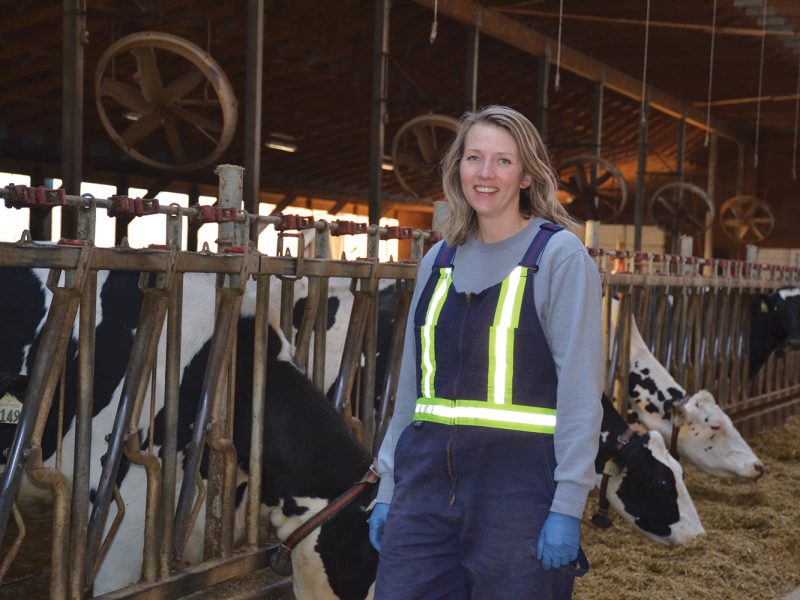
CHILLIWACK – When dairy farmers on the flooded Sumas Prairie started evacuating their herds to buddy farms in November 2021, West River Farm in Rosedale took in eight bottle-fed calves.
“They were freezing cold,” recalls dairy farmer Sarah Sache. “They were in the water, so it took quite a lot of work to keep them alive.”
West River Farm was further from the flooded area, so its involvement in the buddy program was minimal, but still vital to the overall rescue effort. Dairy farmers lost 420 cows with losses totalling upwards of $100 million.
“[It was] definitely an emergency response unlike any other we have conducted in the past,” says Sache, vice-chair of the BC Dairy Association. “We’re working on planning for that more for the future.”
Other industry sectors did not fare as well. Official estimates in the aftermath of the flooding pegged livestock losses at 628,000 chickens and 12,000 hogs.
Johnny Guliker, owner of Trilean Pork, was one of the hog farmers directly impacted by the flooding. He shared his story with the Senate standing committee on agriculture and forestry as part of its investigation into the floods that overwhelmed the Fraser Valley.
“I got pretty well wiped out in this flood,” Guliker told the committee. “When you have a lot of things, animals and people you are trying to rescue, you always seem to do the wrong things.”
He described how they tried everything to save their hogs. They built walls to keep the feed dry. When the first set of dikes failed, they chased the smaller animals to the higher part of the facility. They had few resources left when the second dike broke on the other side of the flats.
“The water just came higher and all of them drowned,” Guliker explained. “Those were futile efforts.”
Guliker was the only producer directly impacted by the flooding who spoke to the Senate committee as it conducted hearings on four days between April and June. Other presenters included the BC Agriculture Council and five producer groups (chicken growers, broiler hatching eggs, blueberries, pork and dairy), First Nations, academics, engineering consultants and federal and municipal officials. All of the transcripts are available online.
On October 27, just as the Fraser Valley was bracing for its first atmospheric river this fall, the Senate released its report, Treading Water: The Impact of and Response to the 2021 British Columbia floods.
The report highlights the causes and impacts of the floods, support measures and lessons learned from the recovery efforts. It makes three recommendations: urging the federal government to work with the BC government and local municipalities to develop a comprehensive Fraser Valley flood plan, providing easy and timely access to natural disaster relief and coordinating with the US government on the management of transboundary waters.
“We heard that 87% of the dykes in Southern Mainland BC were in disrepair and 73% would fail just by water going over the top,” says senate committee chair Rob Black. “There’s significant work to be done. We hope those three recommendations will spur government on.”
Sache says the recommendations are consistent with BC Dairy’s perspective.
“It’s good to see [these] plain language recommendations that will help to put some of these pieces that are much needed for food security into the future into place,” she says. “Obviously, there’s still a lot of work that needs to go into it, but the report acknowledges that this is going to need to be across levels of government to get this done. I think that’s kind of the key takeaway. It’s not one level of government or one group’s situation to deal with. It’s going to be a collaborative, significant process that’s going to need to be ongoing always.”
Developing consensus
Steve Litke, director of water programs with the Fraser Basin Council, agrees.
“There is still a way to go in developing consensus on region-wide flood priorities,” Litke says. “Some guidance may come from a new BC flood strategy, which is now in development and expected next spring.”
Litke says that many communities rely on flood protection dikes as a primary defence, and most of those dikes don’t meet current provincial standards for height or seismic resilience.
“Significant upgrades across the region will be needed for dikes to be effective in a large flood event,” he adds.
Government estimates developed in consultation with industry put the cost of flood-related damages to Fraser Valley farmers at $285 million. Monica Mannerstrӧm, an engineer with Northwest Hydraulic Consultants, further added that damages “would be at least tenfold” should the Fraser River overflow its banks.
The Fraser Basin Council estimates $1 billion of direct impact to the Fraser Valley’s agricultural sector if flooding were similar to the 1894 freshet.
Federal agriculture minister Marie-Claude Bibeau thanked the Senate committee for its study and acknowledged that recent extreme weather events, like the BC floods, have allowed the federal government to learn and improve its processes.
“In collaboration with the provinces, we have made improvements to the business risk management programs and all have supported the idea of incorporating climate risk in the future,” Bibeau says in a statement e-mailed to Country Life in BC. “In addition to the great resilience of producers and their willingness to build back better, what I retain from these disasters is the great collaboration between the affected provinces and the federal government, which allows programs to be deployed quickly.”
Quickly is a subjective term. Many of the producer groups raised concerns about how long it took for payments to flow to producers.
In an interview with Country Life in BC before the Senate report was released, BC agriculture minister Lana Popham acknowledged that a similar flooding event could easily happen again this year.
“We’ve been working with the associations and trying to support them as they shore up their emergency preparedness response plans,” said Popham. “We expect things to happen again. And so we’re trying to help producers prepare.”
She highlighted BC Dairy’s tabletop exercise, and their work on developing an inventory of livestock transport and suggested moving cows to buddy farms or areas of higher ground earlier in an emergency scenario.
In an e-mail , the BC Ministry of Forests noted that the province continues to work alongside First Nations, local governments and other partners to reduce flood risk in the Fraser Valley and that many components toward a comprehensive plan for flood mitigation have been advanced through work on the Lower Mainland Flood Management Strategy.
In March, former premier John Horgan and Washington State governor Jay Inslee announced a transboundary initiative to respond to Nooksack River flooding. Two technical site visits took place in July and September.
As the one-year anniversary of the flood approached, the BC Ministry of Transportation announced the reopening of Hwy 8 to all vehicle traffic, once again connecting Spences Bridge and Merritt, and Mike Farnworth, Minister of Public Safety and Attorney General, announced $1.6 million in Disaster Financial Assistance funding for permanent repairs to the Sumas River main dike. The work was expected to wrap up in November.
With files from Kate Ayers




 Avian influenza spreads