
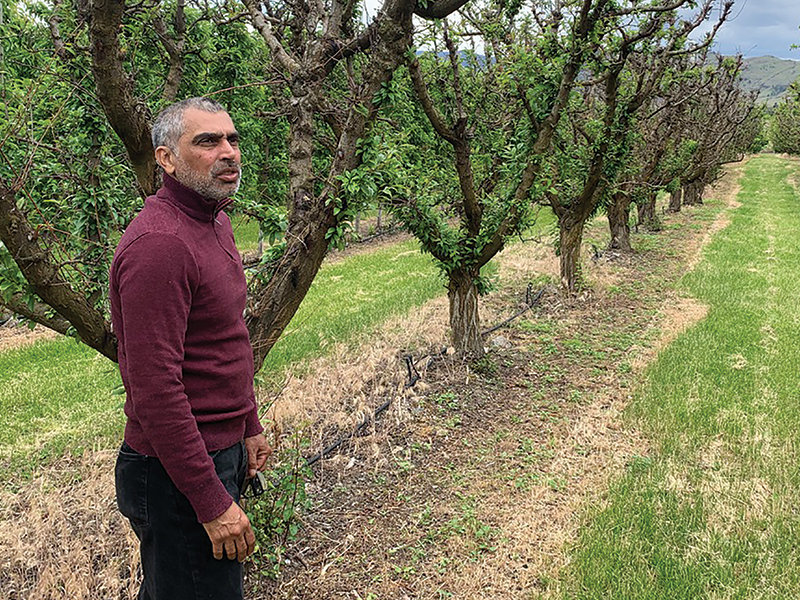
OLIVER – The deep black of dying plum trees stands in stark contrast to the vibrant green of the adjacent cherries in Pinder Dhaliwal’s orchard in Oliver.
Yet on closer inspection, many of the cherry branches have little if any fruit and several branches are dying. The nearby peach trees have no fruit at all and many are struggling to push a full canopy of leaves.
Across the orchard, a row of apple trees appears to be doing fine, but multiple cracks in the bark just above the graft union are an open invitation to pests and pathogens.
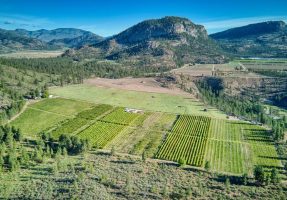
It’s a grim scene, and Dhaliwal’s orchard is but one of hundreds of orchards and vineyards across the Okanagan, Similkameen and Creston valleys blasted by successive years of extreme weather.
The cumulative effects of the 2021 heat dome, back-to-back freeze events and a bloom-killing spring frost this year have been devastating for fruit farmers in BC.
“This has brought the industry to its knees,” says BC Fruit Growers Association president Peter Simonsen.
Dhaliwal’s family have been fruit growers since 1981, and have steadily diversified their business with apples, cherries, plums, peaches and, more recently, grapes.
A farmstand direct-markets the tree fruits, part of a business plan designed to mitigate the risks of farming.
But the effort is no match for Mother Nature.
“Our grape buds froze during the January cold event and we will have no grapes this year,” Dhaliwal says.
Woodpeckers are already finding insects in the plum trees and Dhaliwal says he will need to remove and replant them.
“All our work will go into rehabilitating the other trees and vines to support them to get back to health and hopefully have a reduced crop next year,” he says. “But we just don’t know if the trees will survive through the heat of the summer.”
The existential threat facing the industry has been a long time coming.
Six years ago, the province established the Tree Fruit Industry Competitiveness Fund, a precursor to the Tree Fruit Industry Stabilization Initiative launched in 2021 that resulted in 19 recommendations.
The initiative, led by the province’s former tree fruit and grape specialist Adrian Arts, convened various committees to work through the recommendations. Growers and industry stakeholders took on some initiatives while others fell to the BC Ministry of Agriculture and Food.
With much of the committee work completed, the initiative is winding down.
The province did not make Arts available for this story, despite repeated requests, but the ongoing challenges facing growers underscore the fact the industry is even less stable than it was six years ago, with the number of growers falling dramatically.
“That has a lot to do with what Mother Nature has thrown at us over the last several years in combination with inflation, a huge apple crop in the US last year and the timing of the cherry crops,” says BCFGA general manager Melissa Tesche.
She says much of the committee work focused on data collection, extension, new varieties, labour and cross-commodity communication and collaboration.
“These have all been positive initiatives that support the industry,” she says. “If the last two years had been good crop years, we would be having a different conversation. Unfortunately, extreme weather challenges have continued to pummel crops and almost every grower I have talked to is thinking about getting out of farming.”
The rush for the exits is a question of financial survival.
“The individual grower is no better off; actually, they are worse off than they were three years ago,” Simonsen says.
No money for reinvestment
This has left fewer dollars available for participating in the Perennial Crop Renewal Program the province launched last year.
“It is one of the most generous programs we have ever had,” says Tesche. “But taking advantage of the program requires that growers have funds on hand to reinvest, and you can only reinvest when you have a profit. It’s been a long time since growing fruit was profitable.”
Some growers accessed funds for pull-outs last year and some planting took place this spring, but the program is quite prescriptive on varieties.
The cherry and grape industries have been told to revise the market assessment reports required to secure funds for planting. This means most won’t likely be planting before next spring.
A number of recommendations from the stabilization initiative were never actioned, such as financial support for fruit farmers.
Simonsen says he realizes that government dollars are stretched and that there are many priorities including health care and housing, but he notes that BC funding for agriculture is a lower proportion of the sector’s GDP than for any other province in Canada at just 2.5% last year.
Indeed, a BC Agriculture Council analysis of Statistics Canada data indicates the national average is 11.3%, led by Saskatchewan at 26.5%.
“Just to tie with New Brunswick, which has the next lowest share of government investment, the budget for BC’s Ministry of Agriculture and Food would need to be increased by roughly 45.7% or $59.5 million,” BCAC states. “That would represent an increase from $130.1 million in the 2024-25 budget to $189.6 million in 2025-26.”
Simonsen notes that Washington apple growers, who sell twice as much fruit in Canada as Canadian growers do, received a $2,000 support payment last year and will likely see additional support this year.
“Washington growers were impacted by the same freeze events as those in BC and the governor has declared a state of emergency in Okanogan County just across the border,” he says.
Business risk management programs, which provincial staff regularly encourage farmers to access, get a failing grade from industry.
“The current programs were designed for occasional bad years, not multiple climate disasters in a row,” notes Tesche. “Successive years of loss have resulted in declining reference margins and reduced pay-outs.”
She believes a climate resilience and recovery fund could complement existing programs, a role AgriRecovery funds have not fulfilled.
“AgriRecovery funds have not been triggered for any of the recent climate disasters,” Tesche says. “Not for the heat dome of 2021, nor the back-to-back cold snaps following. It is imperative that growers are able to access adequate financial relief after extreme weather events.”
Cold comfort
Crop insurance has also been cold comfort. The most affordable programs have a deductible of 50%, a loss that must be experienced across all farm sites rather than specific blocks.
This makes it more difficult for growers who mitigate risk with orchards at various locations to secure compensation.
“If one block in Summerland is wiped out by hail, you don’t get to claim that specific loss,” Dhaliwal says.
Dhaliwal’s orchard has a silver lining as the sun glints off a cordon of lush vines at the margins with maturing grape clusters.
“Those are table grapes,” Dhaliwal explains. “At least we will have something to sell in the fruit stand.”
All content on this website is copyrighted, and cannot be republished or reproduced without permission.



 Berry growers on lookout for rose stem girdler