• Menu
  • Skip to primary navigation
  • Skip to main content
  • Skip to primary sidebar

Country Life In BC Logo

The agricultural news source in British Columbia since 1915

  • Headlines
  • Calendar
  • Subscribe
  • Advertise
  • About
  • Archives
  • Contact
  • Search
  • Cart
  • Checkout
  • Headlines
  • Calendar
  • Subscribe
  • Advertise
  • About
  • Archives
  • Contact
  • Search
  • Cart
  • Checkout

Primary Sidebar

Originally published:

SEPTEMBER 2026
Vol. 112 Issue 9

Subscribe Now!

Sign up for free weekly FARM NEWS UPDATES

Loading form…

Your information will not be
shared or sold ever

Stories In This Edition

After the fires

Burn out

Canada-US trade war heats up

Repeated water shutdowns spur calls for action

Editorial: Winds of change

Back 40: Climate crisis trumps fiscal economy concerns

Viewpoint: Regulato needs to find the right balance

Water restrictions collide with wildfire season

Grout leaves ALC as province moves to open ALR

Ag Briefs: New national apple advocacy group formed

Ag Briefs: Paton leaves Conservatives

Letter: Small farms, big impact

Dairy industry pays tribute to David Janssens

Orchardists lose a strong advocate for the sector

FIRB urges review of regulated marketing policy

Wine grape task force reports on first year

BC ranch wins national nod for stewardship

Cattle prices expected to remain stable

When BC’s burning, Range Riders saddle up

Orchard embraces leasing to preserve family legacy

Tour connects local media with food supply

Ugly Potato Day breaks Guiness world record

Small farms in BC gain new loan option

Farm Story: Clutch cable wages war on patience

Cover crops could extend the life of raspberry fields

Viewpoint: Farmers deserve a practical watershed plan

Student pursues dream of farming full-time

Woodshed: Delta’s balloon ride is what memories are made of

Century-old fair draws record attendance

Jude’s Kitchen: Protein-packed power bowls hit the spot

All content on this website is copyrighted, and cannot be republished or reproduced without permission.
More Headlines

Follow us on Facebook

Comments Box SVG iconsUsed for the like, share, comment, and reaction icons

2 days ago

After weeks and weeks of no moisture, there's rain in Kelowna today. While much more moisture is needed over the coming weeks and months to reduce drought conditions and the air smells of wet campfire, the slow, steady rain is very welcome for fruit grower#BCAg#BCAg ... See MoreSee Less

After weeks and weeks of no moisture, theres rain in Kelowna today. While much more moisture is needed over the coming weeks and months to reduce drought conditions and the air smells of wet campfire, the slow, steady rain is very welcome for fruit growers. 

#BCAg
View Comments
  • Likes: 6
  • Shares: 0
  • Comments: 0

Comment on Facebook

3 days ago

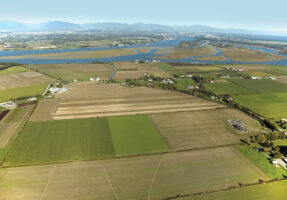
The first Delta Farmland and Wildlife Trust Grassland Set-aside Variety Trial Field Day was held at Delta's family-owned Tecarte Farms, August 27. Co-owner Bill Bates and DFWT executive director Christine Schmalz welcomed more than 35 people to view seven acres planted to different grassland blends specifically chosen to rejuvenate the soil and support the farm's blueberries. For the Bates family, it was time to try something different following the decline of the field's blueberry bushes over the past several years. "We tried everything, and nothing worked," says Bates. The blueberries were removed in May and the grassland crops planted about a week later.

#BCAg
... See MoreSee Less

The first Delta Farmland and Wildlife Trust Grassland Set-aside Variety Trial Field Day was held at Deltas family-owned Tecarte Farms, August 27. Co-owner Bill Bates and DFWT executive director Christine Schmalz welcomed more than 35 people to view seven acres planted to different grassland blends specifically chosen to rejuvenate the soil and support the farms blueberries. For the Bates family, it was time to try something different following the decline of the fields blueberry bushes over the past several years. We tried everything, and nothing worked, says Bates. The blueberries were removed in May and the grassland crops planted about a week later.

#BCAgImage attachmentImage attachment
View Comments
  • Likes: 16
  • Shares: 1
  • Comments: 0

Comment on Facebook

3 days ago

Bessette Creek is the latest watershed hit with a temporary fish protection order this year as the province moves to protect returning Chinook salmon. A total of 131 surface and groundwater users must cease drawing water immediately, with forage producers, greenhouses and nurseries impacted. "Declining flows in Bessette Creek reached record lows in early July 2026 and have remained below the minimum level required to support fish population survival," says the province. Bessette producers have embraced voluntary cutbacks, scheduled irrigation and other measures to reduce water use, and are also waiting on funding to boost water storage infrastructure. They're the second group of producers hit with a provincial order this year. Salmon River irrigators were told to top watering earlier this month following a reprieve to address wildfire risk. Growers in both the Salmon River and Bessette watersheds are urging the province to support new water storage infrastructure in advance of next year.

#BCAg
... See MoreSee Less

Bessette Creek is the latest watershed hit with a temporary fish protection order this year as the province moves to protect returning Chinook salmon. A total of 131 surface and groundwater users must cease drawing water immediately, with forage producers, greenhouses and nurseries impacted. Declining flows in Bessette Creek reached record lows in early July 2026 and have remained below the minimum level required to support fish population survival, says the province. Bessette producers have embraced voluntary cutbacks, scheduled irrigation and other measures to reduce water use, and are also waiting on funding to boost water storage infrastructure. Theyre the second group of producers hit with a provincial order this year. Salmon River irrigators were told to top watering earlier this month following a reprieve to address wildfire risk. Growers in both the Salmon River and Bessette watersheds are urging the province to support new water storage infrastructure in advance of next year.

#BCAg
View Comments
  • Likes: 7
  • Shares: 1
  • Comments: 3

Comment on Facebook

There is a problem... having lived in the salmon river ( silver creek ) area, I remember a fish biologist telling family members that salmon only "survive" in high iron content creeks, they do not "thrive".... salmon river ( silver creek ) is a very high iron content, would stain clothes brown when i would use bleach... So don't expect high salmon numbers off of that creek , even in ideal situations...

I just wish they would take an interest in CHASE CREEK....went bone dry...100% of trout abd other species died...smell was terrible from rotting fish. Understand this has happened many times in the past. Chase Irrigation District totally responsible for this disaster. Now fishermen are complaining about major drop in water levels at Pillar Lake.

They could not mismanage things worse than they have. It's impossible for them to. The fact that farmers that we need for our animals are now suffering the consequences our governments have not protected us from, is absolutely fucking wild.

4 days ago

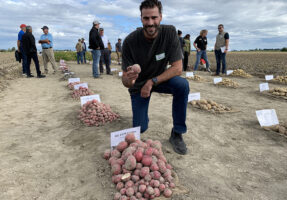
The annual potato variety trial in Delta on August 27 attracted more than 300 people from across Canada, with Bill Zylmans of the BC Potato and Vegetable Growers Association declaring it a gathering of "the extended potato family." With the expansion of BCPVGA's mandate to a host of field vegetable growers, the field day was a chance to network, learn and understand issues across the vegetable sector. BC agriculture minister Lana Popham and Delta South MLA Ian Paton were on hand for the event at Lundstrum Farms on Westham Island, with both applauding efforts to restore bridge access to the island earlier this year to ensure production was unimpeded. Results of the trials will be published in the new year once seasonal data has been collated and analyzed.

#BCAg
... See MoreSee Less

The annual potato variety trial in Delta on August 27 attracted more than 300 people from across Canada, with Bill Zylmans of the BC Potato and Vegetable Growers Association declaring it a gathering of the extended potato family. With the expansion of BCPVGAs mandate to a host of field vegetable growers, the field day was a chance to network, learn and understand issues across the vegetable sector. BC agriculture minister Lana Popham and Delta South MLA Ian Paton were on hand for the event at Lundstrum Farms on Westham Island, with both applauding efforts to restore bridge access to the island earlier this year to ensure production was unimpeded. Results of the trials will be published in the new year once seasonal data has been collated and analyzed.

#BCAg
View Comments
  • Likes: 24
  • Shares: 0
  • Comments: 1

Comment on Facebook

Lana Popham is the hardest working MLA in the province, I don’t agree with the NDP policies, however I do recognize a hard working MLA…thanks for what you do

5 days ago

Faith Folkerts from Woodlands 4-H Club in Langley got $5 per pound for her 150- pound market lamb Sid at the 2026 PNE 4-H Auction on Monday. Sid is a Charolais/Hampshire cross and Faith's second lamb project. Between both live animals and carcasses, the auction featured more than 30 swine, more than 30 lambs, four goats and 25 beef projects. High-selling beef project was Linden Hastie's grand champion. The 1,520-pound steer sold for $12/pound. #BCAgrs!

#BCAg
... See MoreSee Less

Faith Folkerts from Woodlands 4-H Club in Langley got $5 per pound for her 150- pound market lamb Sid at the 2026 PNE 4-H Auction on Monday. Sid is a Charolais/Hampshire cross and Faiths second lamb project. Between both live animals and carcasses, the auction featured more than 30 swine, more than 30 lambs, four goats and 25 beef projects. High-selling beef project was Linden Hasties grand champion. The 1,520-pound steer sold for $12/pound. Yowzers!

#BCAg
View Comments
  • Likes: 57
  • Shares: 1
  • Comments: 4

Comment on Facebook

Thank you to all of the generous Buyer & dedicated organizers for supporting the 4-H sale at the pne. Your time, hard work, and contributions helped make the event a wonderful success. I truly appreciate your support of my fellow 4-H members and I.

Thank you to everyone who supported our youth farmers at this years PNE auction! My kids both had a Market and Carcass animal in the sale and they appreciated all the support.

Thank you to everyone who supported these great youth in agriculture

He looks great!

Subscribe | Advertise

The agricultural news source in British Columbia since 1915
  • Email
  • Facebook

Water restrictions collide with wildfire season

Irrigated land blocked fires advancing into communities

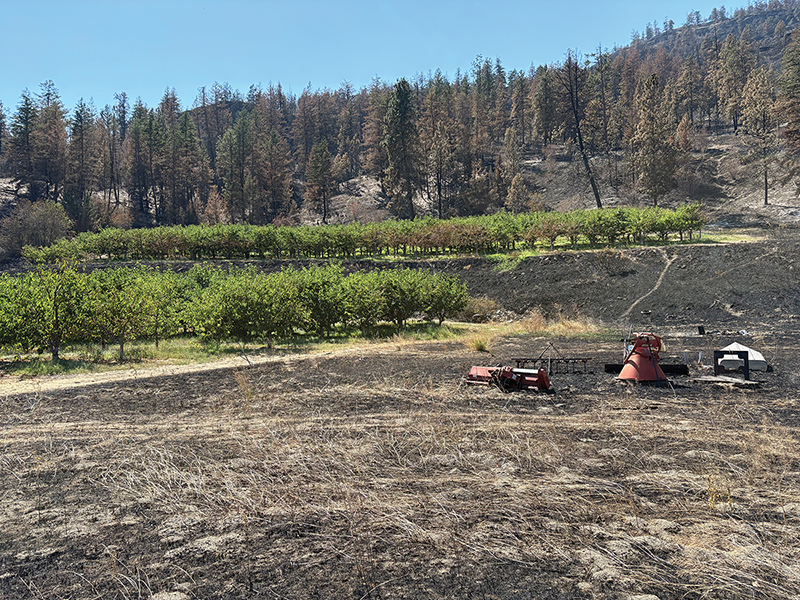
When the Bald Range wildfire roared into Garnet Valley heading for Summerland on August 7, it was no match for the irrigated orchards at Savannah Ridge Cherries, highlighting the importance of secure water supplies for growers. Photo | Jan Carlson

August 31, 2026 byPeter Mitham

SUMMERLAND – Water management is in the spotlight following unprecedented irrigation restrictions and aggressive wildfires across the southern Interior

Summerland grabbed international headlines as the Bald Range wildfire raced from the hamlet of Faulder to the edge of town within hours of ignition on August 7, destroying homes, farms and disrupting power and water treatment plants.

“We lost over $1 million dollars in infrastructure, including all of our cold storage facilities, our packing house, our office – all the amenities our workers who live on site use,” says Erin Carlson of Carcajou Fruit Co. and Savannah Ridge Cherries. “It’s all gone.”

The orchard’s 48 foreign workers had to be evacuated by helicopter, and the fire ultimately cost them their final week of harvest, typically one of the most lucrative of the year.

Yet what remains are the orchards – 12 properties scattered throughout Summerland, which made water available to growers early in the season to ensure trees could get a head start before Stage 3 restrictions took effect following a record low snowpack and spring freshet.

“There’s some damage in some orchards,” Carlson says. “But the orchards created a barrier and stopped the fire from racing into Summerland.”

By ensuring farmers had access to water early on, Summerland ensured the well-being of both crops and the community at large – underscoring the benefits of irrigation beyond its agricultural importance.

“Where things are irrigated and farmed, they were much more resilient and able to slow the fire down,” Carlson says.

This was also the case at Davison Orchards in Vernon, which told growers June 4 to reduce their water use by 70%. Davison Orchards typically irrigates 200 acres planted not just to fruit trees but also small fruits and vegetables.

But when the Bradley Creek fire raced onto Grandview Flats on August 2, it stopped at the property line where irrigation began.

“The reality is that any of these irrigated properties is what is keeping the fire from moving into residential areas,” says Davison Orchards owner Tom Davison. “We provide a green area that’s less likely to burn.”

But the value of irrigation for fire suppression isn’t recognized by Regional District of North Okanagan staff, who continue to shut down growers who max out their allocations from Greater Vernon Water, which supplies agricultural users.

This frustrates Davison, who says there seems to be enough water available for new subdivisions.

“We have 60 acres of farm that does not have an allocation, and we’re continually being told that there’s no more water, but across the road from us there’s a new 300-lot subdivision going in, and they have water,” he says. “That property never had water before, but now that it has homes it has water. So, there is water. It’s just that it’s not for agriculture.”

This has forced Davison and other growers to pick and choose which crops to water.

“We’re continually prioritizing, saying okay, we’ve picked half that crop, we’re going to disc that under now so we can shut the water off there and prioritize young apple trees,” he says.

Zelaney Farms in Coldstream went public at the end of July with the losses it’s facing as it prioritized which crops would get water as it sought to stretch its allocation. More recently, Blackwell Dairy near Kamloops has seen the creeks it depends on for water run dry, raising the prospect of more than $400,000 in additional feed costs for its herd, among other costs.

The full extent of the losses from water restrictions in Vernon won’t be known until the end of the season, but the province’s Production Insurance program had received 155 notices of loss from drought as of August 20. Of these, 50 were from tree fruit growers and 105 from forage producers, who have also been hit hard by dry conditions this year.

Emergency response

BC agriculture minister Lana Popham told Country Life in BC that irrigation and water storage are key pieces of infrastructure, but the province’s immediate priority is supporting growers facing losses.

The province announced $20 million for the Agricultural Water Infrastructure Program earlier this year, boosting program funding to $120 million since 2023, but Popham hedged on whether there would be additional supports.

“Whether we’re going to be able to come forward with another package for irrigation is yet to be seen,” she says. “Those are ones that we would love to be able to prioritize, but right now we’re sitting with this emergency in front of us.”

In the meantime, she says growers can take steps to help themselves, pointing to a “really telling example” amid the Vernon restrictions.

“We have some growers in that area who are on fully drip irrigation systems, and then we’ve got growers who are not,” she says. “The folks with the drip irrigation, they still have water left in their allocations because they’re on drip, whereas the folks using the water guns don’t. That’s a black-and-white example of how we have to move to these more efficient water systems. Given what’s happened this year, I don’t think it’s an argument. It just has to be done.”

Davison is one of the growers who have upped their game, but it still isn’t enough.

“We have a fairly sophisticated irrigation system, and we have everything broken into zones, and soil types and crops, and we use exclusively trickle irrigation except for our sweet corn. We’re pretty efficient,” he says. “Typically, we use about 65% to 70% of our allocation, so essentially what it meant is that we had to use half of what we normally would, and that just wasn’t enough water when we got into the heat of July.”

Half of this year’s crop was undersized, he says, and large peaches were smaller than usual.

He wants to see more concrete action, not just talk.

“We don’t have people who are thinking big; we have people who are saying, ‘No, we can’t do that,’” he says.

A case in point was RDNO’s rejection of a proposal by orchardists David Geen and John Bylands to tap a deep aquifer on an emergency basis to sustain their operations and turn it over to the district at the end of next year. RDNO staff sent it back to the drawing board.

“We have to think big if we’re going to create an atmosphere in the Okanagan that is a wonderful place to live, and raise your families and grow crops and be sustainable,” Davison says.

Carlson agrees.

Summerland orchardists were able to return to their properties promptly thanks to advocacy by the BC Fruit Growers Association, but ongoing government support will be essential to preparing them for the next disaster looming on the horizon. The province’s Tree Fruit Industry Stabilization Project addressed the industry’s business challenges, but the climate threat keeps intensifying.

While late-August thunderstorms offered relief to some areas, sustained rainfall will be needed to replenish streams and aquifers that are currently at historic lows. With a powerful El Niño forecast for this winter, precipitation is likely to be light, and forecasters expect next year to be the world’s hottest ever.

“It’s super dry out there, so we don’t know what’s going to happen next spring. It’s hard to stabilize chaos, and we know that climate change is causing absolute climate chaos,” Carlson says. “If the provincial government seriously wants to do anything, then they’d better start acting on climate change.”

All content on this website is copyrighted, and cannot be republished or reproduced without permission.
Related Posts

You may be interested in these posts from the same category.

Ottawa commits $20M to flood mitigation

ALR processing rules changing

BC Tree Fruits relaunch

ALC rejects Cowichan dike removal

Indigenous agriculture faces regulatory reality

Task force members announced

Ag leaders honoured at gala

ALC members appointed

Popham back as ag minister

Province to fund school meals

Producers look beyond 2021’s floods

Farm status requires proof

Next Post: Peace agriculture faces threat from hydro project »

© 2026 COUNTRY LIFE IN BC - ALL RIGHTS RESERVED