
• Menu
  • Skip to primary navigation
  • Skip to main content
  • Skip to primary sidebar

Country Life In BC Logo

The agricultural news source in British Columbia since 1915

  • Headlines
  • Calendar
  • Subscribe
  • Advertise
  • About
  • Archives
  • Contact
  • Search
  • Headlines
  • Calendar
  • Subscribe
  • Advertise
  • About
  • Archives
  • Contact
  • Search

Primary Sidebar

Originally published:

DECEMBER 2022
Vol. 108 Issue 12

Subscribe Now!

Sign up for free weekly FARM NEWS UPDATES

Loading form…

Your information will not be
shared or sold ever

Stories In This Edition

Ottawa dishes trade funds

I spy

New money for fruit growers

Regenerative ag tops Ag Days successes

Editorial: A winter’s tale

Back 40: Regenesis: the end of farming as we know it

Viewpoint: The challenges of BC ag industry advocacy

Senate report highlights the need for flood plans

More farms test postive for avian influenza

Ag Briefs: BC Turkey names executive director

Ag Briefs: Province rebrands short course

Ag Briefs: Growers Supply expands

Ag Briefs: Cattleliner accident

Economic outlook challenges farm margins

Farmer markets launch economic impact study

WALI delivers labour update to grapegrowers

Beekeepers abuzz about tech transfer program

New apple varieties may improve profits

UFV grows its berry research capacity

Bayer opens new canola seed production site

Island farmers identify challenges at summit

Consumer demand key to local food production

Comox Valley ag plan undergoes overhaul

Salt Spring Abattoir marks 10th anniversary

Ranchers undertake living lab project

Copper deficiency challenges BC bison productivity

Bison ranchers briefed on emergency protocols

SWBC hires a new program manager

Sidebar: How does certification benefit producers?

Better communcation markted wildfire season

Sidebar: Government extends extreme weather support

Retail partnerships add value to small farms’ production

Research: Researchers barcode bacteria to fight farting cattle

Young butchers make their mark

Farm Story: Shot nerves are the price of success this year

Reduced water use doesn’t hurt cherries

Woodshed: Kenneth explores the old Corbett farm

Family farm finds new markets by diversification

Jude’s Kitchen: Festive flatbreads, dips & spreads

More Headlines

Follow us on Facebook

Comments Box SVG iconsUsed for the like, share, comment, and reaction icons

5 days ago

A BC Forest Practices Board investigation has found overgrazing has damaged grasslands in the Coutlee Range Unit near Merritt — and the range-use plan meant to prevent it was unenforceable. With complaints about overgrazing on the rise and grasslands covering just 1% of BC's land mass, the findings raise fresh questions about how the province manages one of its most vulnerable — and valuable — food-producing ecosyste#BCAg#BCAg ... See MoreSee Less

Link thumbnail

Board finds overgrazing rules unenforceable unmeasurable

www.countrylifeinbc.com

MERRITT – A BC Forest Practices Board investigation has found instances of non-compliance related to overgrazing have damaged open grasslands in the Mine pasture, part of the Coutlee Range Unit near...
View Comments
  • Likes: 6
  • Shares: 6
  • Comments: 6

Comment on Facebook

Several ranchers in recent years have gone into temporary non use on that range , so that means the grass should grow. But drought conditions/lack of rain and snow don’t allow that to happen . Dried up springs , creeks waterholes in various pastures add to over grazing where there is water , as livestock and everything else stay close to the water source . So even though less cattle are on it , over grazing appears. There is a large volume of horses on it 365 days/year which is wrong ! They pull grass right out of the ground when it’s just trying to grow ,, opens the door for weeds to grow in. That don’t help it. Aging infrastructure ( fences) laying on the ground, pipe line building , ( lack of commitment to fence maintenance) amongst all users contributes also to over grazing. Recreational atv users leaving gates open between pastures allows livestock to go back or ahead in pastures also expidites over grazing. Logging ( bcts) has no problem laying out cut locks on both sides of a fence , then it gets smashed down during logging and they don’t take responsibility to stand it back up or clean the cattle gaurds out when they are done , that happened 4 years ago on pasture 5 up there . I bet it is still not fixed . There are lots of contributing factors to the problem.

Tragedy of the commons.

I looked through the report. I saw nothing about the effects of noxious weeds on productive grasslands. This particular area is vulnerable because of the Ministry’a efforts to diversify the use of the Grasslands.

This pasture is under tremendous pressure not only from cattle but from irresponsible local residents who treat it as a landfill dumping all manner of household debris here. And don't even get me started on the mud bogging and camping in sensitive riparian areas. The feral horses are in this pasture 365 days a year just hammering it. Would sure be nice to see some enforcement action on people who are intentionally ripping up the grasslands and riparian areas. Cattle could be a valuable resource for rebuilding soils and native grasses in this area with the help of electric fencing and/or e-collars. The humans will be harder to manage.

The Forest and Range Practices Act was written by lawyers for global forest licencee shareholders. Results-based = unenforceable.

Also, can we talk about the impact of a pipeline being built through the middle of this field for multiple years?

View more comments

1 week ago

East Kootenay rancher Randy Reay is digging a new well after two natural water sources dried up on his Crown tenures. A new Living Lakes Canada assessment found 15% of mapped aquifers in the region are high-priority for monitoring, yet 80% of those go unmonitored. With over 48% of BC's provincial observation wells reporting below-normal groundwater levels, ranchers and researchers are sounding the alarm on water security. The story is in our March edition, and we've posted it to our website thi#BCAgk.

#BCAg
... See MoreSee Less

Link thumbnail

Water woes: groundwater under pressure across BC

www.countrylifeinbc.com

JAFFRAY – As a young boy growing up in the Kootenay-Boundary region, Randy Reay never expected to run out of water. But this year, in mid-February, his fields are bare. There is no snow halfway up t...
View Comments
  • Likes: 8
  • Shares: 7
  • Comments: 1

Comment on Facebook

Jaffrey is in the east Kootenays not kooteney boundary

2 weeks ago

BC farmers are bracing for prolonged higher input costs as war in the Middle East drives up fuel and fertilizer prices. Nitrogen fertilizer costs were already climbing before the Iran conflict began, with prices still roughly 60% above pre-pandemic levels. Farm Credit Canada warns that unlike 2022, strong commodity prices may not offset rising costs this time. Local suppliers expect supply challenges and further price increases ahead.

#BCAg
... See MoreSee Less

Link thumbnail

Fertilizer prices on the rise

www.countrylifeinbc.com

War in the Middle East has delivered a generational shock to energy prices, meaning BC farmers can expect a prolonged period of higher costs not just for fuel but also for fertilizer.
View Comments
  • Likes: 2
  • Shares: 1
  • Comments: 0

Comment on Facebook

2 weeks ago

... See MoreSee Less

View Comments
  • Likes: 1
  • Shares: 0
  • Comments: 0

Comment on Facebook

2 weeks ago

Cameron Stockdale is the new executive director of provincial farm safety organization AgSafeBC. Find out more in this week's Farm News Update from Country Life in B#BCAg#BCAg ... See MoreSee Less

Link thumbnail

New leadership at AgSafe BC

www.countrylifeinbc.com

Cameron Stockdale is the new executive director of provincial farm safety organization AgSafeBC, succeeding Wendy Bennett. Bennett left AgSafeBC in September 2025, following 12 years with the…
View Comments
  • Likes: 5
  • Shares: 1
  • Comments: 0

Comment on Facebook

Subscribe | Advertise

The agricultural news source in British Columbia since 1915
  • Email
  • Facebook

Young butchers make their mark

BC competitors showcase skills on world stage

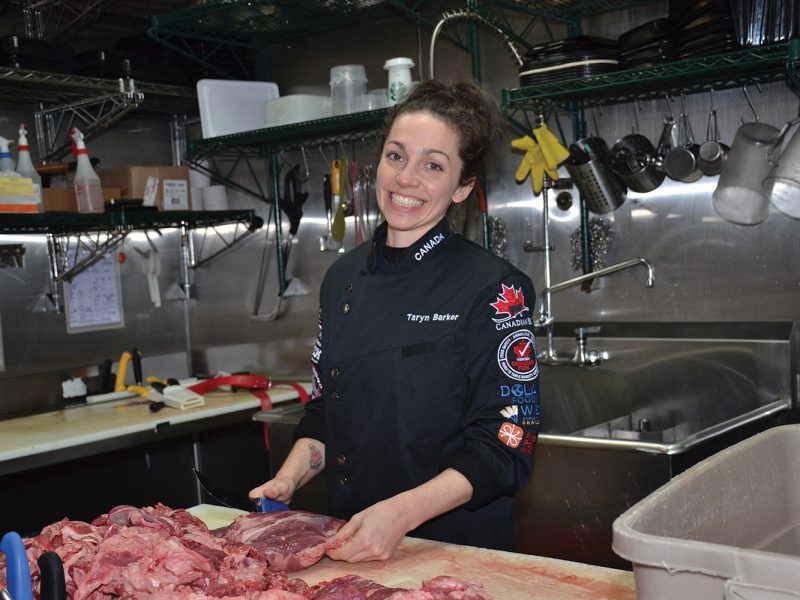
Taryn Barker was one of two BC competitors at the World Butchers’ Challenge this year. She owns The Little Butcher in Port Moody and is passionate about her trade. RONDA PAYNE

December 1, 2022 byKate Ayers

PORT MOODY – Taryn Barker and Ronnie Keely were two BC representatives on Canada’s first-ever team in the World Butchers’ Challenge this year. Their experiences have inspired each of them to improve professional development opportunities in the province for those new to the sector.

Barker of The Little Butcher in Port Moody had nothing but positive reviews of the competition, which took place in Sacramento, September 3.

Barker’s career started in high school with a customer service job at George’s, a local butcher shop in Langley.

“I worked there for about seven years. I was managing, scheduling and cutting a little bit of meat but not a lot,” Barker says. “My then-boss wanted to open another store and he just asked if I would be interested.”

Following six years of co-ownership, she obtained 100% of the business, rebranded and moved the shop to Newport Village in Port Moody.

Now 33, Barker has owned The Little Butcher for 10 years.

The opportunity to own a butcher shop came up before she was able to go to school for formal training. However, Barker is enrolled in the Industry Training Authority’s meatcutter apprenticeship program, offered in partnership with Thompson Rivers University, with a view to becoming a certified meatcutter in the new year. Up until now she has learned to do by doing through the help of her past employer and textbook study.

In 2018, keen to expand her repertoire, Barker travelled to New Zealand to participate in a butcher competition.

“Their butchering is way more advanced – just the courses, the competition, like everything around butchery – they just have a lot more education and things going on for it,” Barker says.

About five months after she returned to BC, Barker saw posts on Instagram about Canada’s budding butcher team.

She then sent an application to Peter Baarda, the team’s captain. After completing 12 assignments over three months and submitting photos and videos of her creations, in 2019 Barker was chosen to be one of eight team members. The team was supposed to compete in 2020 but the pandemic delayed the event until this September.

During the competition, each team had three and a half hours to transform a side of beef, side of pork, whole lamb and five chickens into a butcher’s case display. The Canadian team had two breakers, two trimmers and two finishers.

“I was one of two finishers, … so we were doing all the garnishes, all the seasonings, getting all the marinades ready, cutting vegetables,” Barker says. “Then we were stuffing, tying and plating the meat and putting it out on the table for display.”

The solo Butcher Apprentice and Young Butcher competitions were also part of the program.

Passion for meat-cutting

Ronnie Keely of family-owned Kam Lake-View Meats Ltd. in Cherry Creek was one of two Canadians to participate in the Young Butcher Challenge.

For this category, the 14 competitors had two and half hours to display a beef top sirloin, half a lamb, two chickens and pork loin with a belly attached, complete with garnishes, labels and cooking instructions.

Keely knew his assignment inside and out and credits his skills and passion for meat cutting to being surrounded by the craft all his life.

“I just kind of grew up working here, [but] I never actually planned on being a butcher. I wanted to be more into the culinary aspect of it,” Keely says. “So, I went and took every course I could in cooking and then last-minute decided to go into the Retail Meat Processing program at TRU and ever since then, haven’t really looked back.”

Since graduating from Thompson Rivers University in 2009, he has worked full time at his family’s business.

He heard about the World Butchers’ Challenge at a BC Meats meeting when he ran into one of his university instructors.

About 15 students enter TRU’s Retail Meat Processing program each year, says the program’s assistant teaching professor Corey Davison. Despite over 90% of graduates staying to work in BC, the province does not have enough butchers nor cut-and-wrap facilities, he adds.

“Not a week goes by where I don’t get approached by some area of BC looking for more avenues for training meat cutters. We have a huge shortage,” Davison says.

“Small-scale farming has quite a demand for meat cutters and a lot of the older generations have retired and they’re having trouble getting someone young to sort of get in there and take over the reins. To sustain the local food movement, it’s pretty vital that we keep producing [butchers] in BC so we can keep BC-raised product on BC tables.”

Competitions and screen time could help attract and retain workers in this trade, Davison says.

“I think capitalizing on sort of the sexiness of the food networks that’s been accomplished with the culinary world,” he says. “I think there’s a lot of misconception about this trade. That it’s like a dirty, bloody, messy job. Yes, the abattoir is one side, but the polished craftsmanship to take an animal and display it in a high-level butchery and make sausages and charcuterie, that is quite a skill.”

Barker and Keely were blown away by the skills, styles and expertise of their teammates and competitors.

Keely hopes that through his participation and experiences, he can encourage more people to enter the trade.

Barker agrees.

“We don’t have a lot of that in BC,” she says of programs and supports for butchers. “So, I really hope we can kind of grow that and push that because we need people to work and you want something exciting for them to look forward to and things that are intriguing.”
Related Posts

You may be interested in these posts from the same category.

Salmon Arm abattoir closes

Previous Post: « Christmas trees in demand
Next Post: Generational change in BC potato business »

Copyright © 2026 Country Life in BC · All Rights Reserved