• Menu
  • Skip to primary navigation
  • Skip to main content
  • Skip to primary sidebar

Country Life In BC Logo

The agricultural news source in British Columbia since 1915

  • Headlines
  • Calendar
  • Subscribe
  • Advertise
  • About
  • Archives
  • Contact
  • Search
  • Headlines
  • Calendar
  • Subscribe
  • Advertise
  • About
  • Archives
  • Contact
  • Search

Primary Sidebar

Originally published:

OCTOBER 2022
Vol. 108 Issue 10

Subscribe Now!

Sign up for free weekly FARM NEWS UPDATES

Select list(s) to subscribe to


By submitting this form, you are consenting to receive marketing emails from: Country Life in BC. You can revoke your consent to receive emails at any time by using the SafeUnsubscribe® link, found at the bottom of every email. Emails are serviced by Constant Contact
Your information will not be
shared or sold ever

Stories In This Edition

Greenhouse effect

Animal welfare under review

Avian influenza returns

BC Tree Fruit consolidation triggers revolt

Editorial: Sovereign realities

Back 40: Water remains a battleground in the US, BC

Viewpoint: Is agritech the tail wagging the dog?

Abattoir closure leaves producers scrambling

Canada comes up short on farm risk management

The show must go on

Ag Briefs: 4-H projects sell well at PNE

Ag Briefs: Strong growth for organics

Ag Briefs: Rate hike demands planning

Ranch suffers third natural disaster in a year

New abattoir opens in Pitt Meadows

Milk producers keeping an eye on free fatty acids

Cool season puts corn varieties to the test

BC members added to national youth council

Peace producers engage in on-farm research

Growth implants deliver big returns

Katz a keeper

Cannabis creates jobs for lean ranch operation

Post-harvest soil sampling yields input insights

Cranberry field day showcases Vasanna variety

Chilliwack tour showcases farm automation

Chilliwack blooms as Canada’s chrysanthemum capital

Grape grower has a passion for perfection

Plethora of pumpkins

Rural communities see surge in farmland sales

Farm Story: Crops prevail in spite of challenges

Woodshed: Kenneth seeks some advice on real estate

Day at the Farm delights visitors from the city

Jude’s Kitchen: Have a squish squash, very berry Thanksgiving

More Headlines

Follow us on Facebook

Comments Box SVG iconsUsed for the like, share, comment, and reaction icons

6 days ago

... See MoreSee Less

View Comments
  • Likes: 4
  • Shares: 0
  • Comments: 0

Comment on Facebook

6 days ago

On the last day of the BC Organic Conference, Thursday, Molly Thurston of Pearl Agricultural Consulting helped growers learn how to manage bugs such as codling moth, wireworm, and rootworm in organic growing systems. Her talk alongside Renee Prasad included hands-on activities in which participants checked out various traps and examined pests under microscopes. Be sure to look for more upcoming ag events on our online calendar at www.countrylifeinbc.com/calendar/

#BCAg
... See MoreSee Less

On the last day of the BC Organic Conference, Thursday, Molly Thurston of Pearl Agricultural Consulting helped growers learn how to manage bugs such as codling moth, wireworm, and rootworm in organic growing systems. Her talk alongside Renee Prasad included hands-on activities in which participants checked out various traps and examined pests under microscopes. Be sure to look for more upcoming ag events on our online calendar at www.countrylifeinbc.com/calendar/

#BCAg
View Comments
  • Likes: 15
  • Shares: 0
  • Comments: 0

Comment on Facebook

1 week ago

Well-known organic farmer and podcaster Jordan Marr gets interviewed by Country Life in BC’s own columnist and potato mavin Anna Helmer during the opening session of the BC Organic Conference at Harrison Hot Springs yesterday. Sessions run today (Wednesday) and Thursday and include organic and regenerative growing practices and expanding and advocating for the organic sector, all under the background of the newly launched Organic BC banner.

#BCAg
... See MoreSee Less

Well-known organic farmer and podcaster Jordan Marr gets interviewed by Country Life in BC’s own columnist and potato mavin Anna Helmer during the opening session of the BC Organic Conference at Harrison Hot Springs yesterday. Sessions run today (Wednesday) and Thursday and include organic and regenerative growing practices and expanding and advocating for the organic sector, all under the background of the newly launched Organic BC banner.

#BCAg
View Comments
  • Likes: 37
  • Shares: 2
  • Comments: 1

Comment on Facebook

Interested in finding out more about this

3 weeks ago

Today, we remember those who sacrificed their lives or their well-being for our freedom. Lest we forget. ... See MoreSee Less

Today, we remember those who sacrificed their lives or their well-being for our freedom. Lest we forget.
View Comments
  • Likes: 8
  • Shares: 0
  • Comments: 0

Comment on Facebook

1 month ago

FarmFolk CItyFolk is hosting its biennial BC Seed Gathering in Harrison Hot Springs November 27 and 28. Farmers, gardeners and seed advocates are invited to learn more about seed through topics like growing perennial vegetables for seed, advances in seed breeding for crop resilience, seed production as a whole and much more. David Catzel, BC Seed Security program manager with FF/CF will talk about how the Citizen Seed Trail program is helping advance seed development in BC. Expect newcomers, experts and seed-curious individuals to talk about how seed saving is a necessity for food security. ... See MoreSee Less

Link thumbnail

BC Seed Gathering - FarmFolk CityFolk

farmfolkcityfolk.ca

Save the date for our upcoming 2023 BC Seed Gathering happening this November 3rd and 4th at the Richmond Kwantlen Polytechnic University campus.
View Comments
  • Likes: 1
  • Shares: 0
  • Comments: 0

Comment on Facebook

Subscribe | Advertise

The agricultural news source in British Columbia since 1915
  • Email
  • Facebook

Abattoir closure leaves producers scrambling

Hog producers seek processing alternatives at peak season

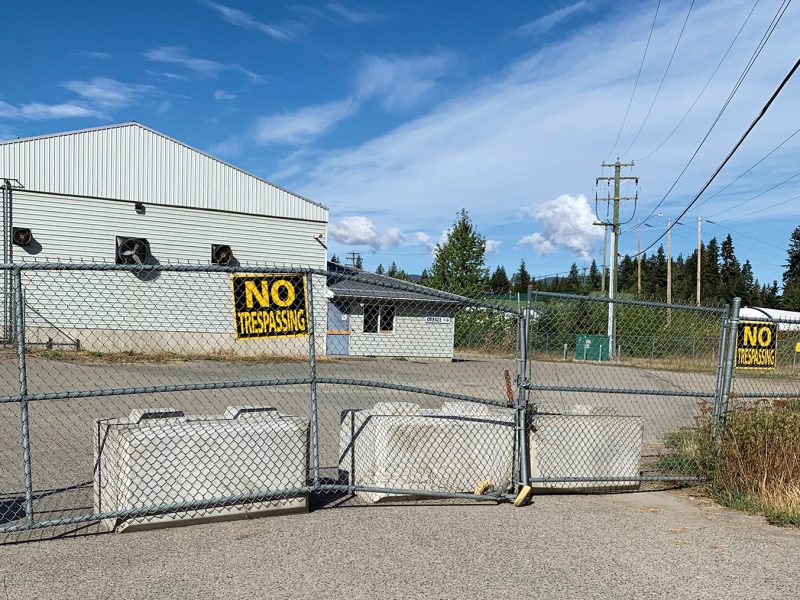
Gates are locked and barriers set up at Rocana Meats in Salmon Arm. The abrupt closure of the hog processor has left producers scrambling for abattoir space this fall. DEB STERRITT

September 28, 2022 byKate Ayers

SALMON ARM – Hog producers in the Thompson-Okanagan are without a processor after Salmon Arm’s Rocana Meats suddenly closed in August.

“It has been really, really hard for producers in that area. It couldn’t have come at a worse time,” says Small-Scale Meat Producers Association executive director and project manager Julia Smith. “Most people are finishing their hogs this time of year. You can’t book them in anywhere else. Everywhere else is booking at least a year out now. So, it’s put people in a really terrible situation.”

Rocana’s website describes the business as a growing national brand. The company sourced most of its hogs from Alberta, but the plant also did custom processing for several producers in BC, including Grand View Family Farm in Salmon Arm.

Grand View co-owner Deb Sterritt had a good working relationship with Rocana Meats, which processed the family’s pasture-raised Kunekune pigs. She visited the plant when she heard general manager Dave DeBoer was let go at the end of July, and was assured all was OK.

It wasn’t.

“I spoke to the new general manager about [custom processing], and she said that everything was the same, and not to worry about it,” says Sterritt says. “And then I went shopping and ran into one employee who told me that [the new] general manager quit. I’d only been in there like an hour before.”

Sterritt is now unsure where or when her pigs will be processed and what she’ll be able to offer customers. Rocana has not been in touch, leaving producers unsure whether new owners will step in or if the plant and its equipment are being sold.

The only firm information is that the plant is shuttered.

“It’s closed. I drove by there the other day and it was all locked up. Nobody is working there anymore,” DeBoer says. “They told us to leave; said they could look after it themselves. I left and six weeks later they have no business left. They were basically out of business.”

Foreclosure

Court documents show that Rocana had been struggling financially. Bank of Montreal demanded repayment of debt totalling $973,576 last October, and launched a foreclosure action the following month. The action was discontinued in January.

DeBoer, who according to court documents had been making mortgage and tax payments, and covering the cost of renovations and other works for Rocana since November 2019, offered to buy the business from the owners – a consortium of Chinese-Canadian investors – in a share purchase agreement valued at $4.2 million in June 2021.

But the deal didn’t proceed, and DeBoer sued the owners in March.

The owners deny that such an agreement existed.

But according to DeBoer, a new purchase agreement was drawn up in July and ready to sign. Rocana executives wanted to close three days later, but DeBoer told them that timing wouldn’t work.

“So, they told me I was no longer needed,” DeBoer says. “I looked after the place from the beginning to the end and the [owners] figured they could do it cheaper.”

DeBoer’s successor as general manager, Erika Zazzi, has also filed a small claims action against Rocana.

Rocana did not respond to requests for comment.

Rocana’s abrupt closure has some producers looking to on-farm processing to stay in business.

“We’ve had at least two of our members scrambling to get their farmgate licences set up so that they can slaughter their hogs,” Smith says. “But for these two producers alone, the limits aren’t high enough to process all their hogs. So this is really just a stopgap measure.”

Because of increased feed and fuel costs, Smith says Rocana’s closure could “be the final nail in the coffin for a lot of producers.”

“My feed costs have gone up 40% over the last three years and I buy in bulk,” she says, noting that smaller producers who don’t buy in bulk face higher prices and now face higher transport costs.

“Having to haul long, long distances to get your pigs slaughtered on top of that, I think we’re just going to lose a lot of producers over this,” she says.

Sterritt’s business model hinged on access to local processing. Shipping elsewhere is too expensive, and she would also face the added expense of cut-and-wrap services and return shipping. She has no interest in obtaining a Farmgate Plus licence.

“It’s a matter of how do we process our pigs, that are ready to be processed, in a way that’s not going to end up with a huge loss?” says Sterritt says, who would have shipped her animals in the spring if she’d known Rocana was going to shut down. “We’re going to exit. The feed costs are too high, [there’s no] access to processing, … there’s too many risks in this business and not enough money. So, we’re done.”

The repercussions of Rocana’s closure on producers’ livelihoods and food security underscore the long-standing issue of adequate local processing capacity. The issue was flagged in a 2018 report by a select standing committee of the legislature on meat production in the province.

An overhaul of the province’s meat licensing regime last year was meant to address the issue, but challenges remain.

According to the province, there are 58 licensed abattoirs in the province as well as 124 Farmgate and Farmgate Plus licences.

The licensing changes have improved poultry processing capacity, says Shelley Work of Ravenwood Acres in Salmon Arm, but she has yet to notice a difference in red meat processing capacity.

“Everything … started to bottleneck when COVID hit,” she says. “I haven’t seen that let up yet. I think there are more people looking for processing and that’s why we’ve got such a backlog, but I haven’t seen that getting any better.”

Ravenwood raises purebred registered Tamworth pigs, primarily supplying weaned piglets to others for finishing but also raising a few itself.

Work says hog slaughter dates are impossible to get, and setting up a Farmgate Plus facility would be cost-prohibitive for them. The challenges in securing slaughter dates and setting up an on-farm facility mean fewer people are coming to them for young pigs to finish.

“It impacts the breeder and the producer as well as the one who’s selling the product,” she says of the lack of processing capacity.

With files from Peter Mitham
Related Posts

You may be interested in these posts from the same category.

Spallumcheen cuts, wraps deal for butcher hub

Poultry processing goes mobile

Insurer steps up to cover farmgate abattoirs

Farmgate abattoirs shut out of insurance

Poultry gatherings banned

Avian influenza returns

Salmon Arm abattoir closes

Second high-path AI case

Small-scale producers voice concerns

Historic relief package delivered

Challenges linger for meat plants

SlaughterRight training launched by ag ministry

Previous Post: « Dry fall, wet winter ahead
Next Post: Animal activists sentenced »

Copyright © 2025 Country Life in BC · All Rights Reserved