• Menu
  • Skip to primary navigation
  • Skip to main content
  • Skip to primary sidebar

Country Life In BC Logo

The agricultural news source in British Columbia since 1915

  • Headlines
  • Calendar
  • Subscribe
  • Advertise
  • About
  • Archives
  • Contact
  • Search
  • Headlines
  • Calendar
  • Subscribe
  • Advertise
  • About
  • Archives
  • Contact
  • Search

Primary Sidebar

Originally published:

JUNE 2021
Vol. 107 Issue 6

Subscribe Now!

Sign up for free weekly FARM NEWS UPDATES

Loading form…

Your information will not be
shared or sold ever

Stories In This Edition

Growers hopeful as BC opens

Tender touch

Japanese bettle control pays off

Nursery sales rise as consumers stick close to home

Editorial: Prospering together

Back 40: A mammoth solution to climate change

Viewpoint: Teamwork essential to grow in the new normal

Wind machines in Surrey face blowback

Sidebar: Dispute resolution

BC Veg unveils strategic priorities as it looks ahead

Quick turnaround

Ag Brief: South Asia flight ban strands BC farm workers

Ag Brief: Oliver vintner dies

Ag Brief: Province delivers AITC funding

Letter: Well “registration” misleading

Province’s chicken growers see rebound

Pricing formula on horizon for poultry sector

Snooze and lose

Grain costs put pressure on livestock producers

PST applicable to horse hay sales

BC raspberry growers face global issues

Little cherry disease a big threat to fruit growers

Core knowledge lands Kelowna grower top award

Strategy needed for Crown forage resources

BC abattoir volume up 30% in 2020

Ranchers urged to plan ahead for a changing climate

Cidery ups game with orchard purchase

The milkman makes a comeback on Island

Short season doesn’t stall northern berries

Cariboo-Chilcotin sheep group formed

Viewpoint: Farm insurance crisis threatens landowners

Mushroom harvester enters final testing

Sidebar: BC mushrooms at a glance

Mushrooms add value to cut blocks

Farm Story: Diversity and inclusion extends to tractors

Equipment intentions fall

Hops and CBC-centric hemp come together

Research: Processed foods are convenient but at what cost?

Soil science key for Kootenay farm project

Research sheds light on late blight strains

Woodshed: Deborah keeps divorce news between friends

OK apples at core of social entrepreneurship

Jude’s Kitchen: To the sea in summer

More Headlines

Follow us on Facebook

Comments Box SVG iconsUsed for the like, share, comment, and reaction icons

6 days ago

A BC Forest Practices Board investigation has found overgrazing has damaged grasslands in the Coutlee Range Unit near Merritt — and the range-use plan meant to prevent it was unenforceable. With complaints about overgrazing on the rise and grasslands covering just 1% of BC's land mass, the findings raise fresh questions about how the province manages one of its most vulnerable — and valuable — food-producing ecosyste#BCAg#BCAg ... See MoreSee Less

Link thumbnail

Board finds overgrazing rules unenforceable unmeasurable

www.countrylifeinbc.com

MERRITT – A BC Forest Practices Board investigation has found instances of non-compliance related to overgrazing have damaged open grasslands in the Mine pasture, part of the Coutlee Range Unit near...
View Comments
  • Likes: 6
  • Shares: 6
  • Comments: 6

Comment on Facebook

Several ranchers in recent years have gone into temporary non use on that range , so that means the grass should grow. But drought conditions/lack of rain and snow don’t allow that to happen . Dried up springs , creeks waterholes in various pastures add to over grazing where there is water , as livestock and everything else stay close to the water source . So even though less cattle are on it , over grazing appears. There is a large volume of horses on it 365 days/year which is wrong ! They pull grass right out of the ground when it’s just trying to grow ,, opens the door for weeds to grow in. That don’t help it. Aging infrastructure ( fences) laying on the ground, pipe line building , ( lack of commitment to fence maintenance) amongst all users contributes also to over grazing. Recreational atv users leaving gates open between pastures allows livestock to go back or ahead in pastures also expidites over grazing. Logging ( bcts) has no problem laying out cut locks on both sides of a fence , then it gets smashed down during logging and they don’t take responsibility to stand it back up or clean the cattle gaurds out when they are done , that happened 4 years ago on pasture 5 up there . I bet it is still not fixed . There are lots of contributing factors to the problem.

Tragedy of the commons.

I looked through the report. I saw nothing about the effects of noxious weeds on productive grasslands. This particular area is vulnerable because of the Ministry’a efforts to diversify the use of the Grasslands.

This pasture is under tremendous pressure not only from cattle but from irresponsible local residents who treat it as a landfill dumping all manner of household debris here. And don't even get me started on the mud bogging and camping in sensitive riparian areas. The feral horses are in this pasture 365 days a year just hammering it. Would sure be nice to see some enforcement action on people who are intentionally ripping up the grasslands and riparian areas. Cattle could be a valuable resource for rebuilding soils and native grasses in this area with the help of electric fencing and/or e-collars. The humans will be harder to manage.

The Forest and Range Practices Act was written by lawyers for global forest licencee shareholders. Results-based = unenforceable.

Also, can we talk about the impact of a pipeline being built through the middle of this field for multiple years?

View more comments

1 week ago

East Kootenay rancher Randy Reay is digging a new well after two natural water sources dried up on his Crown tenures. A new Living Lakes Canada assessment found 15% of mapped aquifers in the region are high-priority for monitoring, yet 80% of those go unmonitored. With over 48% of BC's provincial observation wells reporting below-normal groundwater levels, ranchers and researchers are sounding the alarm on water security. The story is in our March edition, and we've posted it to our website thi#BCAgk.

#BCAg
... See MoreSee Less

Link thumbnail

Water woes: groundwater under pressure across BC

www.countrylifeinbc.com

JAFFRAY – As a young boy growing up in the Kootenay-Boundary region, Randy Reay never expected to run out of water. But this year, in mid-February, his fields are bare. There is no snow halfway up t...
View Comments
  • Likes: 8
  • Shares: 7
  • Comments: 1

Comment on Facebook

Jaffrey is in the east Kootenays not kooteney boundary

2 weeks ago

BC farmers are bracing for prolonged higher input costs as war in the Middle East drives up fuel and fertilizer prices. Nitrogen fertilizer costs were already climbing before the Iran conflict began, with prices still roughly 60% above pre-pandemic levels. Farm Credit Canada warns that unlike 2022, strong commodity prices may not offset rising costs this time. Local suppliers expect supply challenges and further price increases ahead.

#BCAg
... See MoreSee Less

Link thumbnail

Fertilizer prices on the rise

www.countrylifeinbc.com

War in the Middle East has delivered a generational shock to energy prices, meaning BC farmers can expect a prolonged period of higher costs not just for fuel but also for fertilizer.
View Comments
  • Likes: 2
  • Shares: 1
  • Comments: 0

Comment on Facebook

2 weeks ago

... See MoreSee Less

View Comments
  • Likes: 1
  • Shares: 0
  • Comments: 0

Comment on Facebook

2 weeks ago

Cameron Stockdale is the new executive director of provincial farm safety organization AgSafeBC. Find out more in this week's Farm News Update from Country Life in B#BCAg#BCAg ... See MoreSee Less

Link thumbnail

New leadership at AgSafe BC

www.countrylifeinbc.com

Cameron Stockdale is the new executive director of provincial farm safety organization AgSafeBC, succeeding Wendy Bennett. Bennett left AgSafeBC in September 2025, following 12 years with the…
View Comments
  • Likes: 5
  • Shares: 1
  • Comments: 0

Comment on Facebook

Subscribe | Advertise

The agricultural news source in British Columbia since 1915
  • Email
  • Facebook

Core knowledge lands Kelowna grower top award

Shane Witzke learned from the best to be the best

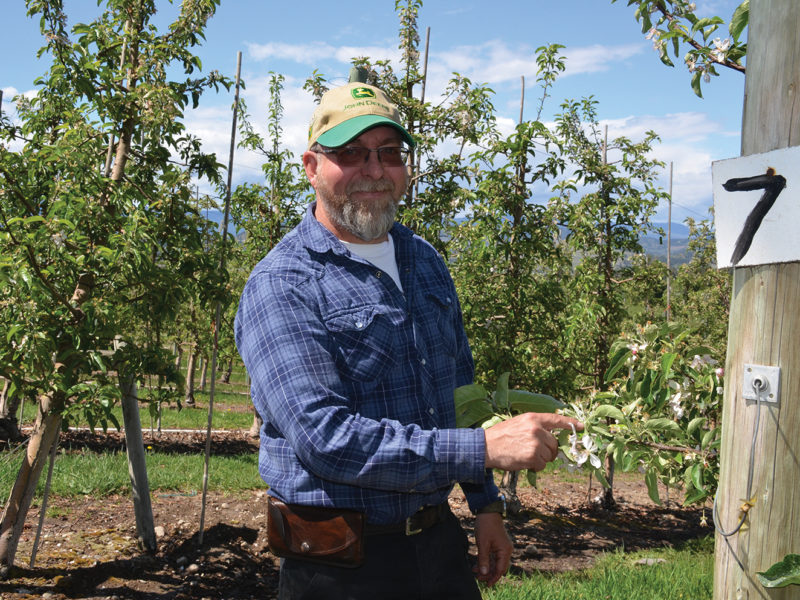
Shane Witzke knows a thing or two about pruning to maximize production and that made him a logical choice for this year’s Golden Apple award from the BC Fruit Growers Association. TOM WALKER

June 1, 2021 byTom Walker

KELOWNA – Learning from some of the best can help you be one of the best is a philosophy that’s served Kelowna orchardist Shane Witzke well.

The BC Fruit Growers Association named Witzke as recipient of this year’s Golden Apple award at its annual general meeting in February.

“I rely on what my field service advisors tell me,” says Witzke. “They have the expertise and the experience to help me with the technical issues in my orchard and then it’s up to me carry out those recommendations.”

Top-quality advice came early for Shane, who remembers learning how to prune from long-time BC Tree Fruits Co-op field person Hank Markgraf, now an independent horticultural consultant.

“Hank taught me how to prune in the early 90s and then my dad let me take over a two-acre block of Galas,” recalls Witzke. “I was able to prune more of the orchard when I got the hang of it.”

Witzke’s dad certainly knew when Shane was doing a good job. Brian Witzke was a Golden Apple winner himself in 1992.

“Our orchard is known for consistent quality,” says Shane Witzke. “I believe we are considered to be in the top 10% of growers.”

Indeed, Northview Orchards, on the Belgo bench in southeast Kelowna, is often a venue for industry events. Former BC premier Christy Clark visited in 2014 to announce renewal of the industry replant program, and the orchard was a stop on the International Fruit Tree Association tour in the summer of 2018. It hosted a pruning demonstration by Washington State University professor Stefano Musacchi last year just before the pandemic shut down events.

“It’s a really good-looking orchard,” says Markgraf, who nominated Witzke for the Golden Apple award.

“When I worked with them last spring you could see what a good job they had done with their pruning,” Markgraf explains. “Everything was so uniform and it set them up for a fantastic bloom. They also did an excellent job with their chemical thinning. They took a chance to do it early and it worked.”

That work, starting in late winter, is key to setting up a successful growing season, says Markgraf.

“Most of the work needs to be done through bloom time so that all that is left is hand thinning. You don’t want to be playing catch up through the growing season,” he explains. “But it’s not just the current year. It is all the careful work the Witzkes have done over the last 20 years to get them there.”

Learning from others is a family trait. Brian Witzke was fortunate to join a tour the BC Ministry of Agriculture organized in 1986 that introduced growers to orchard practices in Europe. He saw apples being grown on a post-and-wire (vertical axis) system, an early version of the high-density super-spindle plantings common today.

“Dad was one of the first to put in post-and-wire in the valley,” notes Shane. “And we have some of the oldest plantings of Royal Galas in BC.”

Those trees are now more than 20 years old. As Galas have slipped in popularity, Northview has grafted many of the trees over to Ambrosia or Honeycrisp, or pulled out for a full replant into high-density systems.

“The replant program has been very important for us,” says Witzke.  “It only covers a fraction of the some-$30,000 an acre cost, but it’s a help.”

Growing varieties that are popular in the market, while being diversified and timing the work load, are an important part of the Witzkes’ strategy. The 30-acre property purchased by Shane’s grandfather in 1946 now has blocks of Royal Gala, Pacific Gala, Spartans, Ambrosia and Honeycrisp. There is a new, two-acre block going in that Witzke will only describe as “a new variety” with a twinkle in his eye.

They make their choices carefully.

“I’d love to grow Pink Lady for the high returns, but we are too far north for it to ripen consistently before the fall frosts,” he says, speaking from experience.

The Witzkes lost a few bins of apples to the late October frost last fall when they could not find the workers to pick them in time. And the January freeze this year damaged a four-year-old Honeycrisp block.

“The young trees had a hard time with the -22°C,  and it’s a real shame because they gave their first light crop last year,” he says.


Related Posts

You may be interested in these posts from the same category.

Federal budget kills Living Labs

Cherry bonanza no jubilee

Arts leads BCFGA forward

Tesche leaving BCFGA

United front for fruit growers

Apple growers discuss marketing commission

BC Fruit Growers list test orchard

New fruit co-op discussed

Peach report bullish on future opportunities

BC Tree Fruits shuts down

Stabilization initiative yet to bear fruit

Veteran orchardist dies

Previous Post: « Mushrooms add value to cut blocks
Next Post: BC abattoir volume up 30% in 2020 »

Copyright © 2026 Country Life in BC · All Rights Reserved