• Menu
  • Skip to primary navigation
  • Skip to main content
  • Skip to primary sidebar

Country Life In BC Logo

The agricultural news source in British Columbia since 1915

  • Headlines
  • Calendar
  • Subscribe
  • Advertise
  • About
  • Archives
  • Contact
  • Search
  • Headlines
  • Calendar
  • Subscribe
  • Advertise
  • About
  • Archives
  • Contact
  • Search

Primary Sidebar

Originally published:

February 2018
Vol. 104 Issue 2

Subscribe Now!

Sign up for free weekly FARM NEWS UPDATES

Loading form…

Your information will not be
shared or sold ever

Stories In This Edition

Province launches ALR review

You lookin’ at me

Ambrosia royalties disputed

BC municipalities tackle farmland housing

Editorial: Love and money

Back 40: It’s time for farmers to speak up

Op-Ed: More workers needed to meet local demand

Ag waste regulation needs united front

Milk production catching up to demand

FIRB appointment comes ahead of busy year

Cottage dairy diversifies with milk dispensing system

Wildfire recovery underpins growing range of programs

Cowichan goats inspire global ambitions

Worker housing issue hinges on collaboration

Growers should file early, file complete

Disaster assistance

BCAC public trust manager steps down

Sidebar: Are you smarter than a 10th grader

Koski steps in at Investment Ag

Farmers keen to make land connections

Courtenay co-op seeks community investment

Backers flock to support sheep farm

Okanagan Spirits focuses on innovation

Research supports year-round starling traps

Feedback sought on water regs

New food guide demands changes in marketing meat

Cattle production expected to rise in 2018

Cattle production expected to rise in 2018

Affordable workshops for new farmers

Dreams become udder reality

Sheep federation charting new future

Growers watching stink bug’s spread

Research: How beavers will help improve cow digestion

Fly larvae offer sustainable alternative protein

Fish help balance greenhouse growing system

Island home to Canada’s top Highland breeder

Where good food comes from

Wannabe: Waste not, want not

Woodshed: When there is good-bad, and bad-bad

Jude’s Kitchen: Red & chocolatey

More Headlines

Follow us on Facebook

Comments Box SVG iconsUsed for the like, share, comment, and reaction icons

6 days ago

A BC Forest Practices Board investigation has found overgrazing has damaged grasslands in the Coutlee Range Unit near Merritt — and the range-use plan meant to prevent it was unenforceable. With complaints about overgrazing on the rise and grasslands covering just 1% of BC's land mass, the findings raise fresh questions about how the province manages one of its most vulnerable — and valuable — food-producing ecosyste#BCAg#BCAg ... See MoreSee Less

Link thumbnail

Board finds overgrazing rules unenforceable unmeasurable

www.countrylifeinbc.com

MERRITT – A BC Forest Practices Board investigation has found instances of non-compliance related to overgrazing have damaged open grasslands in the Mine pasture, part of the Coutlee Range Unit near...
View Comments
  • Likes: 6
  • Shares: 6
  • Comments: 6

Comment on Facebook

Several ranchers in recent years have gone into temporary non use on that range , so that means the grass should grow. But drought conditions/lack of rain and snow don’t allow that to happen . Dried up springs , creeks waterholes in various pastures add to over grazing where there is water , as livestock and everything else stay close to the water source . So even though less cattle are on it , over grazing appears. There is a large volume of horses on it 365 days/year which is wrong ! They pull grass right out of the ground when it’s just trying to grow ,, opens the door for weeds to grow in. That don’t help it. Aging infrastructure ( fences) laying on the ground, pipe line building , ( lack of commitment to fence maintenance) amongst all users contributes also to over grazing. Recreational atv users leaving gates open between pastures allows livestock to go back or ahead in pastures also expidites over grazing. Logging ( bcts) has no problem laying out cut locks on both sides of a fence , then it gets smashed down during logging and they don’t take responsibility to stand it back up or clean the cattle gaurds out when they are done , that happened 4 years ago on pasture 5 up there . I bet it is still not fixed . There are lots of contributing factors to the problem.

Tragedy of the commons.

I looked through the report. I saw nothing about the effects of noxious weeds on productive grasslands. This particular area is vulnerable because of the Ministry’a efforts to diversify the use of the Grasslands.

This pasture is under tremendous pressure not only from cattle but from irresponsible local residents who treat it as a landfill dumping all manner of household debris here. And don't even get me started on the mud bogging and camping in sensitive riparian areas. The feral horses are in this pasture 365 days a year just hammering it. Would sure be nice to see some enforcement action on people who are intentionally ripping up the grasslands and riparian areas. Cattle could be a valuable resource for rebuilding soils and native grasses in this area with the help of electric fencing and/or e-collars. The humans will be harder to manage.

The Forest and Range Practices Act was written by lawyers for global forest licencee shareholders. Results-based = unenforceable.

Also, can we talk about the impact of a pipeline being built through the middle of this field for multiple years?

View more comments

1 week ago

East Kootenay rancher Randy Reay is digging a new well after two natural water sources dried up on his Crown tenures. A new Living Lakes Canada assessment found 15% of mapped aquifers in the region are high-priority for monitoring, yet 80% of those go unmonitored. With over 48% of BC's provincial observation wells reporting below-normal groundwater levels, ranchers and researchers are sounding the alarm on water security. The story is in our March edition, and we've posted it to our website thi#BCAgk.

#BCAg
... See MoreSee Less

Link thumbnail

Water woes: groundwater under pressure across BC

www.countrylifeinbc.com

JAFFRAY – As a young boy growing up in the Kootenay-Boundary region, Randy Reay never expected to run out of water. But this year, in mid-February, his fields are bare. There is no snow halfway up t...
View Comments
  • Likes: 8
  • Shares: 7
  • Comments: 1

Comment on Facebook

Jaffrey is in the east Kootenays not kooteney boundary

2 weeks ago

BC farmers are bracing for prolonged higher input costs as war in the Middle East drives up fuel and fertilizer prices. Nitrogen fertilizer costs were already climbing before the Iran conflict began, with prices still roughly 60% above pre-pandemic levels. Farm Credit Canada warns that unlike 2022, strong commodity prices may not offset rising costs this time. Local suppliers expect supply challenges and further price increases ahead.

#BCAg
... See MoreSee Less

Link thumbnail

Fertilizer prices on the rise

www.countrylifeinbc.com

War in the Middle East has delivered a generational shock to energy prices, meaning BC farmers can expect a prolonged period of higher costs not just for fuel but also for fertilizer.
View Comments
  • Likes: 2
  • Shares: 1
  • Comments: 0

Comment on Facebook

2 weeks ago

... See MoreSee Less

View Comments
  • Likes: 1
  • Shares: 0
  • Comments: 0

Comment on Facebook

2 weeks ago

Cameron Stockdale is the new executive director of provincial farm safety organization AgSafeBC. Find out more in this week's Farm News Update from Country Life in B#BCAg#BCAg ... See MoreSee Less

Link thumbnail

New leadership at AgSafe BC

www.countrylifeinbc.com

Cameron Stockdale is the new executive director of provincial farm safety organization AgSafeBC, succeeding Wendy Bennett. Bennett left AgSafeBC in September 2025, following 12 years with the…
View Comments
  • Likes: 5
  • Shares: 1
  • Comments: 0

Comment on Facebook

Subscribe | Advertise

The agricultural news source in British Columbia since 1915
  • Email
  • Facebook

Cowichan goats inspire global ambitions

February 1, 2018 byAllison Finnamore

Vancouver Island start-up aims to revolutionize mastitis diagnosis

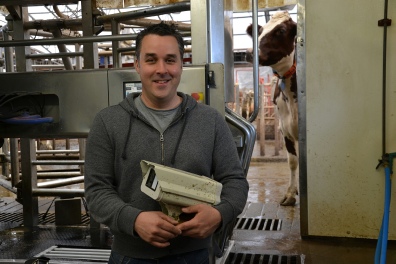
DUNCAN – British Columbia goat farmer and cheesemaker Cory Spencer, his tech-savvy neighbour Damir Wallener and agricultural communications specialist Tamara Leigh have teamed up, formed a company and spent the latter part of 2017 participating in an international business accelerator program in New York City.

The concrete jungle of one of the world’s largest cities is a long way from the pristine vales of Cowichan Valley but the work of Spencer, Wallener and Leigh over the last several months resulted in bringing EIO Diagnostics’ udder health detection system to commercialization. Their product, a diagnostic scanner – either handheld for smaller dairies or mounted for farms with more cows – checks udder health and relays images to a screen where infections can be identified. EIO Diagnostics says its multispectral imaging detects udder health sooner and cheaper than other similar products. The diagnostic system is currently undergoing testing in several commercial cow and goat dairies on Vancouver Island.

The idea for the detection system came about like many agricultural-related inventions. Spencer, who operates The Happy Goat Cheese Company with his wife Kirsten Thorarinson, worked in technology and software development prior to farming. He had a problem with his 100-head goat herd and needed a cost-effective solution – so he created one.

“I had a goat with a particularly aggressive form of mastitis where, by the time I had caught it myself … and treated it, the udder was effectively dead,” he says. “It got me thinking, how can I apply my software background into something I could use myself on the farm. How can we develop a solution that’s much less expensive than what’s commercially available and that I can use?”

He explains that the diagnostics detect the thermal signature of the infection in the udder using computer algorithms which identify the mastitis patterns.

Idea with traction

The idea for commercialization gained traction when Spencer mentioned the idea to Wallener, who lives nearby. Wallener has managed multiple start-up cycles and positive business exits, has experience in product development and has an extensive hardware/software patent history. He says he immediately saw the commercialization potential of the diagnostic scanner and that belief has solidified over the past several months as part of the team to set up EIO Diagnostics.

“When we tell the story to the people that this is going to matter the most to, they get it and they want to get involved,” Wallener says. “From the very first farmer we spoke to, their eyes lit up and they said ‘yes!’ ”

It was Wallener as CEO of the company who led the charge in the business accelerator program in New York, Food-X. The investment company partners with early stage companies across the food supply chain and fast-tracks their growth with access to start-up capital, mentorship, networking, learning and an alumni network.

For EIO Diagnostics, Wallener says Food-X’s immersion into a learning atmosphere with fellow entrepreneurs, innovative thinkers and experienced business people as mentors was exciting and motivating. It also helped keep the company on track towards its initial goals.

“When we started at Food-X, we were literally weeks old. Food-X forced me to think through really carefully on how to get from being a very young company to being a focused company,” Wallener explains, pointing out that with so many possible applications for the diagnostic equipment, the experienced Food-X mentors reminded him to be disciplined at this early stage – polish the current product before expanding. The company did, however, decide to grow the current application beyond goats to include dairy cows and sheep.

Future potential

Looking ahead, Wallener sees growth and expansion for EIO Diagnostics. He says with half a billion dairy animals around the globe, “we want to be the diagnostic tool for each and every one of them.”

EIO Diagnostics is starting with Mexico and is already working to get the diagnostic equipment set up in the barns of some of the country’s largest dairies. The company is also drawn to sub-Saharan Africa, where the United Nations expects a population explosion as the world grows to nine billion people by 2050. Wallener points out that farmers in the region face some of the toughest production challenges in the world. Spencer agrees and says EIO Diagnostics may be able to help.

“There’s a lot potential to help out developing countries that don’t have either the knowledge or the community to detect mastitis or treat mastitis,” Spencer says. The scale of farming is vastly different from developed countries, and therefore the loss of a milk-producing animal has far greater impact.

“The dairies over there are not at the production levels they are here,” he says. “If you lose one animal, you lose production capacity. Here, it’s one out of 100 animals but there, it’s one out of six. That’s a big hit in the income of that particular farmer.”

Those big ideas are exactly what draws SOSV LLC to companies like EIO Diagnostics.

Shawn Broderick, a general partner with SOSV, says the company has US$300 million in assets under management and a staff of 80 who operate accelerators in the areas of hardware, software, biology, food, robotics, medical devices, transportation, green energy and more. Broderick was present during EIO Diagnostic’s three months in New York, working to help bring its idea to reality – and beyond.

“As venture-scale investors, we want to invest in people with big ideas,” Broderick says, looking at the UN’s forecasted population growth.

“How are we going to feed those people? We’re either going to have a radically enhanced food system or we’re going to have a mass starvation and hopefully, we’re not going to the latter. Things like EIO, where they can keep cows healthy, means they get better output,” Broderick states, and increased output means feeding more people.

The distance between the Cowichan Valley, midtown Manhattan and sub-Saharan Africa is vast, but EIO Diagnostics is working to draw the geographic points closer through sound business knowledge and a practical farming diagnostic application.
Related Posts

You may be interested in these posts from the same category.

Previous Post: « Province launches ALR review
Next Post: Feedback sought on water regs »

Copyright © 2026 Country Life in BC · All Rights Reserved