• Menu
  • Skip to primary navigation
  • Skip to main content
  • Skip to primary sidebar

Country Life In BC Logo

The agricultural news source in British Columbia since 1915

  • Headlines
  • Calendar
  • Subscribe
  • Advertise
  • About
  • Archives
  • Contact
  • Search
  • Headlines
  • Calendar
  • Subscribe
  • Advertise
  • About
  • Archives
  • Contact
  • Search

Primary Sidebar

Originally published:

FEBRUARY 2021
Vol. 107 Issue 2

Subscribe Now!

Sign up for free weekly FARM NEWS UPDATES

Select list(s) to subscribe to


By submitting this form, you are consenting to receive marketing emails from: Country Life in BC. You can revoke your consent to receive emails at any time by using the SafeUnsubscribe® link, found at the bottom of every email. Emails are serviced by Constant Contact
Your information will not be
shared or sold ever

Stories In This Edition

CPR on ALR Track

Sea of greens

Farm properties rising

Genomics lab expands service to local growers

Editorial: Put farmers first

Back 40: Knowing when to pull back on extensions

Viewpoint: A watershed moment for BC farms

Egg producer questions support for local eggs

Milk consumption up among young minorities

Nutrient recovery system in third phase

North Saanich approves Sandown proprosal

Tsartlip acquire Woodwyn Farm with provincial help

Woodwynn Farm was first known as Mawuec

Pandemic was profitable for nursery growers

Researcher brings experience to sweet role

Consultant delivered practical advice

Tributes pour in for Island farmer Colin Springford

On-farm abattoir approved for Alberni Valley

Plans for a provincial weather network move forward

Feedlots under pressure with kill instability

If you go out in the woods today …

Round bale bounty

CFIA services get a funding boost

Help available for farm business succession

Sidebar: Considering all the options

Diversification helps farms prepare for challenges

Creston advocacy group continues push for food hub

Frind matches his love of data with grape production

Greenhouse sets example for others to follow

On-farm food networks wire farms for success

OK irrigation systems have a long history

Pemberton family farms beer with deep roots

When life gives you lemons

Personal money strategy as important as farm stragegy

Farm Story: Winter brings the distractions of technology

Well-designed vegetable coolers make for hot sales

Woodshed: Janice Newberry sets the record straight

Research: Plants can recognize attacking herbivores

Jude’s Kitchen: Super simple

More Headlines

Follow us on Facebook

Comments Box SVG iconsUsed for the like, share, comment, and reaction icons

6 days ago

... See MoreSee Less

View Comments
  • Likes: 4
  • Shares: 0
  • Comments: 0

Comment on Facebook

6 days ago

On the last day of the BC Organic Conference, Thursday, Molly Thurston of Pearl Agricultural Consulting helped growers learn how to manage bugs such as codling moth, wireworm, and rootworm in organic growing systems. Her talk alongside Renee Prasad included hands-on activities in which participants checked out various traps and examined pests under microscopes. Be sure to look for more upcoming ag events on our online calendar at www.countrylifeinbc.com/calendar/

#BCAg
... See MoreSee Less

On the last day of the BC Organic Conference, Thursday, Molly Thurston of Pearl Agricultural Consulting helped growers learn how to manage bugs such as codling moth, wireworm, and rootworm in organic growing systems. Her talk alongside Renee Prasad included hands-on activities in which participants checked out various traps and examined pests under microscopes. Be sure to look for more upcoming ag events on our online calendar at www.countrylifeinbc.com/calendar/

#BCAg
View Comments
  • Likes: 15
  • Shares: 0
  • Comments: 0

Comment on Facebook

1 week ago

Well-known organic farmer and podcaster Jordan Marr gets interviewed by Country Life in BC’s own columnist and potato mavin Anna Helmer during the opening session of the BC Organic Conference at Harrison Hot Springs yesterday. Sessions run today (Wednesday) and Thursday and include organic and regenerative growing practices and expanding and advocating for the organic sector, all under the background of the newly launched Organic BC banner.

#BCAg
... See MoreSee Less

Well-known organic farmer and podcaster Jordan Marr gets interviewed by Country Life in BC’s own columnist and potato mavin Anna Helmer during the opening session of the BC Organic Conference at Harrison Hot Springs yesterday. Sessions run today (Wednesday) and Thursday and include organic and regenerative growing practices and expanding and advocating for the organic sector, all under the background of the newly launched Organic BC banner.

#BCAg
View Comments
  • Likes: 37
  • Shares: 2
  • Comments: 1

Comment on Facebook

Interested in finding out more about this

3 weeks ago

Today, we remember those who sacrificed their lives or their well-being for our freedom. Lest we forget. ... See MoreSee Less

Today, we remember those who sacrificed their lives or their well-being for our freedom. Lest we forget.
View Comments
  • Likes: 8
  • Shares: 0
  • Comments: 0

Comment on Facebook

1 month ago

FarmFolk CItyFolk is hosting its biennial BC Seed Gathering in Harrison Hot Springs November 27 and 28. Farmers, gardeners and seed advocates are invited to learn more about seed through topics like growing perennial vegetables for seed, advances in seed breeding for crop resilience, seed production as a whole and much more. David Catzel, BC Seed Security program manager with FF/CF will talk about how the Citizen Seed Trail program is helping advance seed development in BC. Expect newcomers, experts and seed-curious individuals to talk about how seed saving is a necessity for food security. ... See MoreSee Less

Link thumbnail

BC Seed Gathering - FarmFolk CityFolk

farmfolkcityfolk.ca

Save the date for our upcoming 2023 BC Seed Gathering happening this November 3rd and 4th at the Richmond Kwantlen Polytechnic University campus.
View Comments
  • Likes: 1
  • Shares: 0
  • Comments: 0

Comment on Facebook

Subscribe | Advertise

The agricultural news source in British Columbia since 1915
  • Email
  • Facebook

Genomics lab expands service to local growers

Horticulture, livestock sectors benefit from high-level research

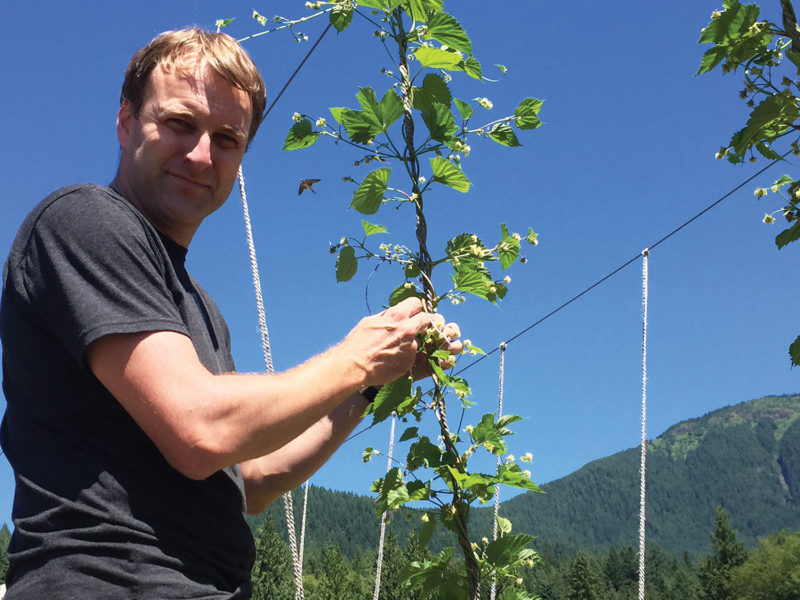
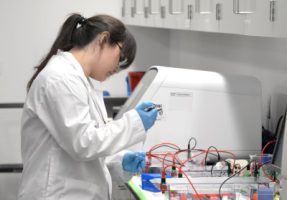
The expansion of Kwantlen Polytechnic University’s Applied Genomics Centre in Surrey this spring will support researchers like hops breeder Mathias Schuetz in their work with local growers. PHOTO / KPU

February 2, 2021 byPeter Mitham

SURREY – The expansion of a life sciences lab at Kwantlen Polytechnic University in Surrey this spring will deliver a boost to cutting-edge agricultural research in the Fraser Valley.

KPU’s existing Applied Genomics Centre offers 750 square feet of space for various research projects focused on genetics, including a hops development program.

“One thing we found is that if you look across British Columbia, there’s not a lot of universities that are focused on agriculture. Most are focused on human health, for good reason,” says centre director Paul Adams, who identified the farm sector as a distinctive niche.

While a lot of companies could benefit from a better knowledge of livestock and crop genetics, Adams says most lack access to the tools and facilities needed to conduct high-level research.

“They just don’t have access, especially small [and] medium companies,” he says. “[We’re] helping them do research and development.”

Current projects include work with WestGen to identify bacteria responsible for mastitis in dairy cattle and develop a test individual farms can use. The lab also works with Bovitech and Semex to improve the health of cattle embryos beginning at the genetic level.

On the horticulture side, the lab has partnered with Van Belle Nursery Inc. in Abbotsford to conduct DNA fingerprinting of local hydrangeas. It is also working to analyze new hop selections as part of a breeding program for the local industry.

“The lab at KPU is a big help for us in the sense that they are able to provide us with all the chemical analysis,” says Peter Voogt of Green Flora Greenhouses Ltd. in Abbotsford, who runs trials of new selections and supplies hop growers with plants. “If we would have to farm all that out to a professional lab, it would be very costly.”

The expansion will add to the lab’s capabilities, while new funding promises to support staff salaries.

KPU allocated funding last year that will give researchers 2,400 square feet of space. The lab is also one of 16 projects shortlisted for a federal grant that could provide approximately $5 million in operating funds over the next five years. Together with $2 million worth of equipment grants from the Canadian Foundation for Innovation and BC Knowledge Development Fund as well as $500,000 in industry funding, the lab will be in a stronger position to serve local growers.

“That will allow us to take what we’re doing and make it bigger and continue to build that out over the next five years,” says Adams.

KPU plant biologist Mathias Schuetz says the lab could cut the time needed to develop new hop varieties by about half. While it can take eight years of field trials to develop a promising new hop variety, the centre makes a three-year timeline realistic.

The first crosses were made in 2018 and 15 selections were planted out in 2019 in partnership with Green Flora, which has a half-acre dedicated to trials. The top performers were replanted in 2020 at Green Flora and Myrtle Meadows in Pemberton. Twenty of each selection were planted, providing enough hops for analysis. Those trials are set to continue this year.

The analysis takes place at the KPU lab.

“Their goal is to come up with new varieties that give unique flavours,” says Adams. “In the process of creating these new hops, they also want to create ones that grow better in our environment, that are less susceptible to some of the local diseases that are unique here to British Columbia. … We’re involved using genetics as well as chemical analysis to guide this process.”

Developing locally adapted hop varieties is important because most new varieties are the result of private breeding programs. Those programs typically patent the new varieties, limiting access.

This has prompted interest among BC growers in varieties the local industry can call its own and potentially offer for export. While some local researchers have investigated the potential of domesticating feral varieties, Schuetz is focusing on genetics obtained from the US Department of Agriculture’s breeding program. It’s publicly funded and makes its repository of genetic material available to researchers.

“We decided, let’s make a breeding program here,” says Schuetz. “Let’s build something here for our local industry, something that is value-added, that was developed here.”

Both government and industry, led by the BC Hop Growers Association, have rallied around the vision.

The research has already held plenty of surprises for Schuetz. While mildew resistance as well as oil content, aroma and flavour intensity are all important traits, one of the seedlings produced from the early crosses exhibited dwarfing characteristics. This is of interest to Schuetz because it could lead to the development of alternative production systems.

“We have big tall trellising systems,” he says. “Maybe there’d be a market for a dwarf variety that didn’t affect yield, [was] easier [to] harvest, less infrastructure costs.”

A successful selection also has to appeal brewers and consumers.

“It has to be something that brewers can use. It has to be something that allows them to make a unique beer style, or has a value-add to them,” says Schuetz. “They have to be easily growable, and have good yields and make financial sense for the farmer, and also have to be good for the consumer.”

Related Posts

You may be interested in these posts from the same category.

KPU genomics lab expands

Westgen looks beyond challenges

Pilot program bridges the extension gap for Gulf Island farmers

Vet shortage persists

Raspberry traits assigned values

Cherry growers discuss trade

Research association mulls future

Peace funds start flowing

Previous Post: « CPR on ALR track
Next Post: Growers scramble for flights »

Copyright © 2025 Country Life in BC · All Rights Reserved