• Menu
  • Skip to primary navigation
  • Skip to main content
  • Skip to primary sidebar

Country Life In BC Logo

The agricultural news source in British Columbia since 1915

  • Headlines
  • Calendar
  • Subscribe
  • Advertise
  • About
  • Archives
  • Contact
  • Search
  • Headlines
  • Calendar
  • Subscribe
  • Advertise
  • About
  • Archives
  • Contact
  • Search

Primary Sidebar

Originally published:

NOVEMBER 2019
Vol. 105 Issue 11

Subscribe Now!

Sign up for free weekly FARM NEWS UPDATES

Select list(s) to subscribe to


By submitting this form, you are consenting to receive marketing emails from: Country Life in BC. You can revoke your consent to receive emails at any time by using the SafeUnsubscribe® link, found at the bottom of every email. Emails are serviced by Constant Contact
Your information will not be
shared or sold ever

Stories In This Edition

ALC gets an earful

Herding Hens

Food hub funding boost

Municipalities challenge ALC over process

No bad apples

Editorial: Taking stock

Back Forty: Remembering Aunt Dolly, and others

Viewpoint: Keeping BC farms (and farmers) growing

Farm status undermined by local bylaws

Big green gourd

Heavy rains don’t wash out potato hopes

Giant hornets headline beekeepers’ concerns

Honey producers honour industry leaders

Country Life in BC wins awards at conference

Bridging the urban-rural divide

New skills needed for technology-driven agriculture

Data drives more efficient poultry farming

Ag Briefs: New CEO appointed at BC Tree Fruits

Ag Briefs: Site launched for farmers’ institutes

Ag Briefs: Child labour feedback sought

Demand underpins cheesemaker’s expansion

Cranberry growers expect lower yields

Neighbours raise stink over cannabis farms

Sheep farmers share their experiences

Lots (and lots) of pumpkins

Federation moves forward on key initiatives

Riparian assessment requirements updated

On-farm slaughter a key skill for producers

On the move

Sidebar: Better than offal

Feedback on new watering regs a concern

Market Musings: The future in beef looks like a slam dunk

Growers all ears at silage corn field day

UBC dairy centre signs five-year lease

Falkland Dairy volume buyer at Holstein Sae

Mega-dairies are the future of US farms

Research: Bacterial leaf streak lacks chemical controls

Big beef show at BC Ag Expo

Farm News: Growing prospects brighten dark autum days

BC Young Farmers look to grow north

Horse Power

Day-long 4-H event puts emphasis on safety

Woodshed: Newt schemes to rescue Kenneth’s tractor

Good gourd! Giant vegetables weigh off

Jude’s Kitchen: Late fall harvest

More Headlines

Follow us on Facebook

Comments Box SVG iconsUsed for the like, share, comment, and reaction icons

6 days ago

... See MoreSee Less

View Comments
  • Likes: 4
  • Shares: 0
  • Comments: 0

Comment on Facebook

7 days ago

On the last day of the BC Organic Conference, Thursday, Molly Thurston of Pearl Agricultural Consulting helped growers learn how to manage bugs such as codling moth, wireworm, and rootworm in organic growing systems. Her talk alongside Renee Prasad included hands-on activities in which participants checked out various traps and examined pests under microscopes. Be sure to look for more upcoming ag events on our online calendar at www.countrylifeinbc.com/calendar/

#BCAg
... See MoreSee Less

On the last day of the BC Organic Conference, Thursday, Molly Thurston of Pearl Agricultural Consulting helped growers learn how to manage bugs such as codling moth, wireworm, and rootworm in organic growing systems. Her talk alongside Renee Prasad included hands-on activities in which participants checked out various traps and examined pests under microscopes. Be sure to look for more upcoming ag events on our online calendar at www.countrylifeinbc.com/calendar/

#BCAg
View Comments
  • Likes: 15
  • Shares: 0
  • Comments: 0

Comment on Facebook

1 week ago

Well-known organic farmer and podcaster Jordan Marr gets interviewed by Country Life in BC’s own columnist and potato mavin Anna Helmer during the opening session of the BC Organic Conference at Harrison Hot Springs yesterday. Sessions run today (Wednesday) and Thursday and include organic and regenerative growing practices and expanding and advocating for the organic sector, all under the background of the newly launched Organic BC banner.

#BCAg
... See MoreSee Less

Well-known organic farmer and podcaster Jordan Marr gets interviewed by Country Life in BC’s own columnist and potato mavin Anna Helmer during the opening session of the BC Organic Conference at Harrison Hot Springs yesterday. Sessions run today (Wednesday) and Thursday and include organic and regenerative growing practices and expanding and advocating for the organic sector, all under the background of the newly launched Organic BC banner.

#BCAg
View Comments
  • Likes: 37
  • Shares: 2
  • Comments: 1

Comment on Facebook

Interested in finding out more about this

3 weeks ago

Today, we remember those who sacrificed their lives or their well-being for our freedom. Lest we forget. ... See MoreSee Less

Today, we remember those who sacrificed their lives or their well-being for our freedom. Lest we forget.
View Comments
  • Likes: 8
  • Shares: 0
  • Comments: 0

Comment on Facebook

1 month ago

FarmFolk CItyFolk is hosting its biennial BC Seed Gathering in Harrison Hot Springs November 27 and 28. Farmers, gardeners and seed advocates are invited to learn more about seed through topics like growing perennial vegetables for seed, advances in seed breeding for crop resilience, seed production as a whole and much more. David Catzel, BC Seed Security program manager with FF/CF will talk about how the Citizen Seed Trail program is helping advance seed development in BC. Expect newcomers, experts and seed-curious individuals to talk about how seed saving is a necessity for food security. ... See MoreSee Less

Link thumbnail

BC Seed Gathering - FarmFolk CityFolk

farmfolkcityfolk.ca

Save the date for our upcoming 2023 BC Seed Gathering happening this November 3rd and 4th at the Richmond Kwantlen Polytechnic University campus.
View Comments
  • Likes: 1
  • Shares: 0
  • Comments: 0

Comment on Facebook

Subscribe | Advertise

The agricultural news source in British Columbia since 1915
  • Email
  • Facebook

Giant hornets headline beekeepers’ concerns

Provincial apiarist updates beekeepers on pests, diseases

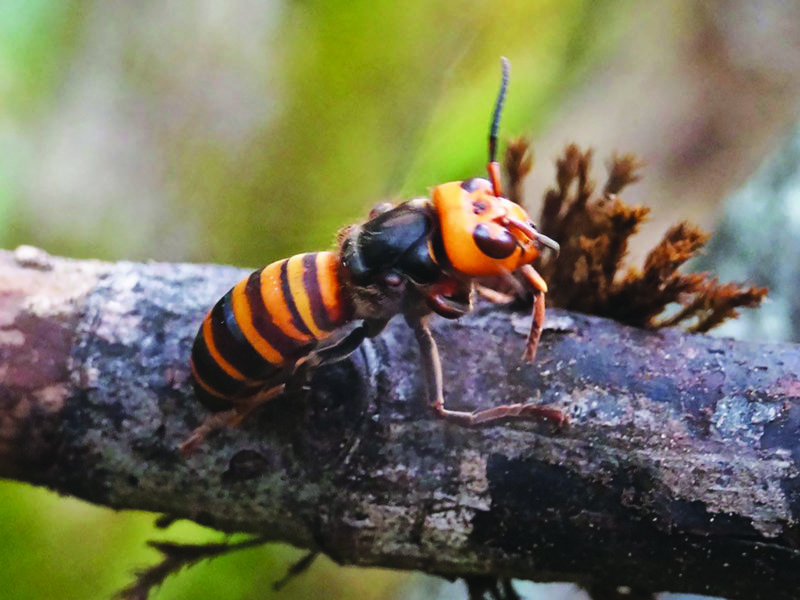
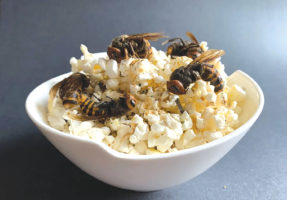
BC Ministry of Agriculture photo

November 1, 2019 byTom Walker

PRINCE GEORGE – If you want to catch a bee, ask a beekeeper to help.

That’s the strategy provincial apiculturist Paul van Westendorp used when two Asian giant hornets were spotted and captured at a Nanaimo-area apiary in September, and it’s a good thing he did.

“This is a totally other creature,” van Westendorp told delegates to the BC Honey Producers Association annual general meeting in Prince George, October 4-6. “It is the apex insect predator – the ultimate insect hunter. They can destroy a commercial honeybee hive in less than an hour.”

Asian giant hornets include a number of insects in the Vespa genus, van Westendorp explains.

“The one we saw in Nanaimo, Vespa mandarinia, is a ground-nester,” he says.

The hornets raid a colony by biting and dismembering young bees and then steal the bee brood and turn it into “protein meatballs” to bring back to their nests, van Westendorp continues.

“We have full confidence that if they establish themselves in BC, beekeepers will be able to deal with them effectively,” he says. “These insects have an oversize head and you will be able to screen for them.”

But that is not the least of it.

The hornets are also a threat to livestock and wildlife, not to mention humans. People typically provoke attacks when they unwittingly disturb a nest.

“In Japan, there are 40 to 60 human fatalities each year from sting attacks,” van Westendorp says, noting just a few dozen can cause trouble. “Each hornet can sting multiple times and their venom contains a cytolytic peptide that will cause tissue damage and bleeding.”

He says one of the beekeepers involved in the eradication mission was stung several times through his beekeepers outfit, and there were open wounds on his legs.

Nanaimo beekeepers knew what to do, however. Van Westendorp reached out to them after four additional sightings, aside from at the apiary.

“I contacted them for help after the sightings, and after confirming with different agencies the insect we were dealing with,” says van Westendorp. “They did a fantastic job.”

The Nanaimo squad mapped where the sightings were, considered the insect’s behaviour, and calculated where to look.

“They found the nest in the forest within a couple of hours,” he says. “It’s a grand story and the beekeepers deserve all the credit.”

Some 100 hornets were gassed with CO2 at dusk, dug out of the nest and soaked in alcohol to preserve them. There were drones, but no virgin queens were found, confirming that the nest had not had time to develop to a point that the insects would spread.

“That’s not the end of it,” says van Westendorp, adding that it is suspected they arrived via the port of Nanaimo.

“We need to be vigilant in 2020 to make sure that they did not establish themselves,” he says, noting that the climate can’t be counted on to curtail the pests. “I’ve seen nest cone that has been in a fridge for 24 hours and a freezer for 24 hours and the brood were still wiggling.”

The rest of van Westendorp’s report was not as dramatic.

He says he was happy with the responses to the province’s annual spring survey that went out to the 403 beekeepers who are registered to have 10 colonies or more.

“We received 155 online responses for a total of 39% returned, which I consider excellent,” he says.

The survey noted 54,000 colonies went into the winter of 2018, with 37,000 surviving in the spring, for a 32% winter mortality. Van Westendorp says the weather was a key factor in those losses.

“We had virtually no winter until January 26, when the temperature suddenly dropped into the basement and we had strong Arctic outflows for about six weeks,” he notes. “That really sucked the life out of a lot of colonies, particularly those on the coast that are not accustomed to such extreme weather conditions. They ran out of fuel.”

Van Westendorp reminded beekeepers of the need for a veterinarian’s prescription to purchase any of the three antibiotics that are registered for use in bee colonies.

“You need to establish a relationship with your local vet and perhaps the local club can work with the vet as well, to coordinate with smaller backyard beekeepers,” he says.

There was an increase in the incidence of EFB (European Foul Brood) disease noted in samples that were tested across the province.

Some EFB was recorded after blueberry pollination, but much more after the dearth period that occurred in the late spring when cold weather limited flower production and bees began running out of food.

“As soon as the nectar flow resumed, the EFB disappeared completely,” van Westendorp says.

There does not appear to have been an increase in the occurrence of Nosema, adds van Westendorp, with the highest levels continuing to be in coastal BC. The antibiotic Fumagillin is being re-introduced in Canada and is available through the Alberta Honey Producers Co-operative.

“But I have heard some concerns that it is not as benign as we have always believed,” says van Westendorp.

A mystery disease has struck a number of colonies in the Kootenays. First vice-president Jeff Lee of Honey Bee Zen Apiaries in Creston lost 300 hives this year.

“We simply do not know what is going on. It appears to be a combination of varroa mites and viruses that seem to be working together,” says van Westendorp. “They are making it very miserable for our bees to survive.”

Small hive beetle was not detected in the Fraser Valley this year, says van Westendorp. But he has seen photographs from beekeepers in Bellingham who have found adults.

There will be a free webinar series, “Introduction to Beekeeping,” offered Saturday mornings in January and February 2020. A master course will be held at UBC on February 10
Related Posts

You may be interested in these posts from the same category.

Japanese beetle spreads

Canada holds off Asian giant hornet restrictions

Beekeepers suffer colony losses

Asian Giant Hornet

Hornet catch has beekeepers vigilant

Armyworm precautions urged

Japanese beetle fight continues

Vole control in blueberries

Buggy season

Previous Post: « New skills needed for technology-driven agriculture
Next Post: Neighbours raise stink over cannabis farms »

Copyright © 2025 Country Life in BC · All Rights Reserved