• Menu
  • Skip to primary navigation
  • Skip to main content
  • Skip to primary sidebar

Country Life In BC Logo

The agricultural news source in British Columbia since 1915

  • Headlines
  • Calendar
  • Subscribe
  • Advertise
  • About
  • Archives
  • Contact
  • Search
  • Headlines
  • Calendar
  • Subscribe
  • Advertise
  • About
  • Archives
  • Contact
  • Search

Primary Sidebar

Originally published:

AUGUST 2019
Vol. 105 Issue 8

Subscribe Now!

Sign up for free weekly FARM NEWS UPDATES

Loading form…

Your information will not be
shared or sold ever

Stories In This Edition

Province allows family on farms

Teamwork!

Rain hammers cherry crop

Sidebar: A brief history

Chilcotin ranchers’ hope for hay crop washed away

Editorial: Dog days

Back Forty: Keeping the kids safe down on the farm

Viewpoint: Top-down governance no way to help caribou

Egg board set to get cracking on quota distribution

Get ’em while you can

Feds address labour shortages

Bee healthy!

Marketing board names new entrant winners

BC berry research gets big funding boost

BC hosts International Blueberry Organization

Tour showcases innovation, marketing savvy

Governments agree to national park reserve

BC’s oldest farm seeks new management

Apple dieback investigation underway

Bumper crop for raspberries fails to materialize

Balance key to restoring fire-affected range

Global demand set to buoy cattle prices

A good start helps calves finish in top shape

Ranchers collaborate to preserve grasslands

Rotational grazing pays off year-round

Sidebar: Track costs, see profits

Stock show kicks off summer for 4-H members

Finding new potential for a lost native berry

Sidebar: Others see same benefits

Shuswap tour showcases local producers

Research: Do honeybees spread viruses to wild bees?

Volken Academy breaks ground on new farm

Woodshed: Romance is in the air, for all but the Hendersons

Fourth-generation farmers chart ambitious course

Jude’s Kitchen: In-season produce is king

More Headlines

Follow us on Facebook

Comments Box SVG iconsUsed for the like, share, comment, and reaction icons

6 days ago

A BC Forest Practices Board investigation has found overgrazing has damaged grasslands in the Coutlee Range Unit near Merritt — and the range-use plan meant to prevent it was unenforceable. With complaints about overgrazing on the rise and grasslands covering just 1% of BC's land mass, the findings raise fresh questions about how the province manages one of its most vulnerable — and valuable — food-producing ecosyste#BCAg#BCAg ... See MoreSee Less

Link thumbnail

Board finds overgrazing rules unenforceable unmeasurable

www.countrylifeinbc.com

MERRITT – A BC Forest Practices Board investigation has found instances of non-compliance related to overgrazing have damaged open grasslands in the Mine pasture, part of the Coutlee Range Unit near...
View Comments
  • Likes: 6
  • Shares: 6
  • Comments: 6

Comment on Facebook

Several ranchers in recent years have gone into temporary non use on that range , so that means the grass should grow. But drought conditions/lack of rain and snow don’t allow that to happen . Dried up springs , creeks waterholes in various pastures add to over grazing where there is water , as livestock and everything else stay close to the water source . So even though less cattle are on it , over grazing appears. There is a large volume of horses on it 365 days/year which is wrong ! They pull grass right out of the ground when it’s just trying to grow ,, opens the door for weeds to grow in. That don’t help it. Aging infrastructure ( fences) laying on the ground, pipe line building , ( lack of commitment to fence maintenance) amongst all users contributes also to over grazing. Recreational atv users leaving gates open between pastures allows livestock to go back or ahead in pastures also expidites over grazing. Logging ( bcts) has no problem laying out cut locks on both sides of a fence , then it gets smashed down during logging and they don’t take responsibility to stand it back up or clean the cattle gaurds out when they are done , that happened 4 years ago on pasture 5 up there . I bet it is still not fixed . There are lots of contributing factors to the problem.

Tragedy of the commons.

I looked through the report. I saw nothing about the effects of noxious weeds on productive grasslands. This particular area is vulnerable because of the Ministry’a efforts to diversify the use of the Grasslands.

This pasture is under tremendous pressure not only from cattle but from irresponsible local residents who treat it as a landfill dumping all manner of household debris here. And don't even get me started on the mud bogging and camping in sensitive riparian areas. The feral horses are in this pasture 365 days a year just hammering it. Would sure be nice to see some enforcement action on people who are intentionally ripping up the grasslands and riparian areas. Cattle could be a valuable resource for rebuilding soils and native grasses in this area with the help of electric fencing and/or e-collars. The humans will be harder to manage.

The Forest and Range Practices Act was written by lawyers for global forest licencee shareholders. Results-based = unenforceable.

Also, can we talk about the impact of a pipeline being built through the middle of this field for multiple years?

View more comments

1 week ago

East Kootenay rancher Randy Reay is digging a new well after two natural water sources dried up on his Crown tenures. A new Living Lakes Canada assessment found 15% of mapped aquifers in the region are high-priority for monitoring, yet 80% of those go unmonitored. With over 48% of BC's provincial observation wells reporting below-normal groundwater levels, ranchers and researchers are sounding the alarm on water security. The story is in our March edition, and we've posted it to our website thi#BCAgk.

#BCAg
... See MoreSee Less

Link thumbnail

Water woes: groundwater under pressure across BC

www.countrylifeinbc.com

JAFFRAY – As a young boy growing up in the Kootenay-Boundary region, Randy Reay never expected to run out of water. But this year, in mid-February, his fields are bare. There is no snow halfway up t...
View Comments
  • Likes: 8
  • Shares: 7
  • Comments: 1

Comment on Facebook

Jaffrey is in the east Kootenays not kooteney boundary

2 weeks ago

BC farmers are bracing for prolonged higher input costs as war in the Middle East drives up fuel and fertilizer prices. Nitrogen fertilizer costs were already climbing before the Iran conflict began, with prices still roughly 60% above pre-pandemic levels. Farm Credit Canada warns that unlike 2022, strong commodity prices may not offset rising costs this time. Local suppliers expect supply challenges and further price increases ahead.

#BCAg
... See MoreSee Less

Link thumbnail

Fertilizer prices on the rise

www.countrylifeinbc.com

War in the Middle East has delivered a generational shock to energy prices, meaning BC farmers can expect a prolonged period of higher costs not just for fuel but also for fertilizer.
View Comments
  • Likes: 2
  • Shares: 1
  • Comments: 0

Comment on Facebook

2 weeks ago

... See MoreSee Less

View Comments
  • Likes: 1
  • Shares: 0
  • Comments: 0

Comment on Facebook

2 weeks ago

Cameron Stockdale is the new executive director of provincial farm safety organization AgSafeBC. Find out more in this week's Farm News Update from Country Life in B#BCAg#BCAg ... See MoreSee Less

Link thumbnail

New leadership at AgSafe BC

www.countrylifeinbc.com

Cameron Stockdale is the new executive director of provincial farm safety organization AgSafeBC, succeeding Wendy Bennett. Bennett left AgSafeBC in September 2025, following 12 years with the…
View Comments
  • Likes: 5
  • Shares: 1
  • Comments: 0

Comment on Facebook

Subscribe | Advertise

The agricultural news source in British Columbia since 1915
  • Email
  • Facebook

Marketing board names new entrant winners

Process awarded quota to three out of 95 applicants

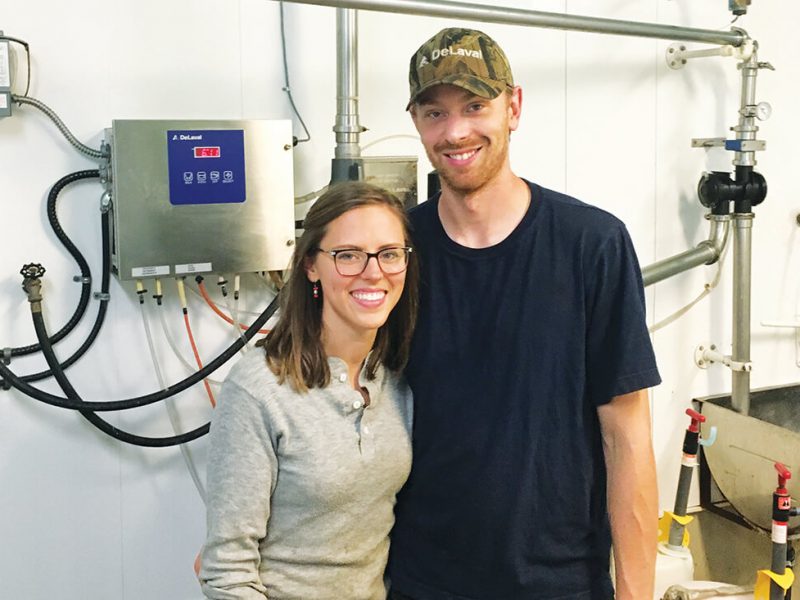
Melanie & Edward Dyson

August 1, 2019 byDavid Schmidt

ABBOTSFORD—The BC Milk Marketing Board has chosen the first three successful applicants in its New Entrant Program.

After clearing the waitlist in its previous Graduated Entry Program, the BCMMB introduced the NEP in August 2018. Ninety-five applicants paid the $250 fee to be included in the first draw, held in February 2019. A random draw selected eight applicants for the second step in the process. Each was required to submit a detailed business plan to a board-appointed selection committee.

Chaired by Walt Goerzen, who also chairs the board’s Milk Industry Advisory Committee and Specialty Producers Advisory Committee, the committee included two agri-business reps, one financial services rep, one processor rep from the Western Dairy Council, one producer chosen by the BC Dairy Association and one current GEP producer.

After meeting with each applicant and studying their business plans, the committee recommended and the board accepted Edward and Melanie Dyson of Port Alberni, Jonathan and Eleny Quapp of Rosedale and William Romeyn of Chilliwack to be the first three successful applicants.

“It was quite a challenge to pick three from the eight,” Goerzen said, noting they had a “diverse” set of applicants to choose from.

In the end they focused on each applicant’s experience, business plan and passion for the industry.

Experience was critical. The committee questioned the chances of an applicant succeeding without any direct experience in dairying, Goerzen says, and he expects the committee to recommend tightening future application criteria to weed out unsuitable applicants.

“It’s a new program so the process has some room for adjustments,” he notes, pointing out the BC Egg Marketing Board’s NEP has a more detailed initial application process which may have some merit in the dairy industry.

Another important question was whether the applicants could begin a dairy operation without the help of the NEP.

“Helping new entrants into the dairy industry that otherwise couldn’t do that is a key aspect of the program,” Goerzen states.

Edward Dyson, one of the three successful applicants, calls himself “a second-generation wannabe dairy farmer” at 27 years old. His parents, Agricultural Land Commission chair Jennifer Dyson and her husband, were once on BCMMB’s GEP waitlist but gave up waiting after several years.

Instead, the Dysons moved to Port Alberni in 2003 and started a water buffalo dairy. The herd has 70 animals and they’re currently milking 20 water buffalo. (The number fluctuates.)

“I’m already running a dairy farm, just with a different species,” Dyson says.

He and his wife, Melanie, a 24-year-old agricultural graduate of the University of Alberta, are already living on the family farm. Dyson is presently “an unofficial full partner” in the farm and he says the farm ownership will be reorganized to meet NEP requirements.

Dyson admits “a bit of nervousness” about the process but felt “we were good candidates. We spent quite a bit of time on our business plan.”

He believes he has a head start, noting the farm already has a double-four herringbone parlour for its water buffalo herd. The parlour will be retrofitted so it can be used to milk both the water buffalo, which they will continue to farm, and the dairy cows.

“Our goal is to start by this time next year,” he says. “We want to take our time to get healthy animals and do things right.”

As new entrants, the Dysons will receive 15 kgs of Continuous Daily Quota, worth $547,500 at the current quota exchange price, enough for about 12 to 13 cows. The program also provides a 1:1 matching grant of up to eight kgs for additional kilograms purchased on the exchange, something Dyson expects to take full advantage of.

“We hope to maximize the program within five years,” he says.

BCMMB manager of policy and communication Vicki Crites explains that the NEP quota is subject to a declining assessment of 10% a year.

“After 10 years they would cease to be ‘new entrants’ and would simply be considered producers,” she explains.

Dyson admits that even 31 kgs of CDQ may not be enough to make the farm fully viable as a stand-alone dairy but believes it is “a good start.”

“It’s pretty tough to get a start in the industry,” he says, noting, “we have the water buffalo to help us in the early years and hope to grow the dairy over time.”

Dyson admits he and Melanie are guinea pigs for the new program.

“With the water buffalo, we had to be open and transparent so we’re used to the attention. We’re happy to share our experience with the public and the industry,” he says.

Although the program accepted only three applicants this year, that will change.

“The 2019 NEP process was considered a transition year,” Crites says. “The board will run another NEP application and selection process in 2020 (and every second year thereafter). The 2020 process will select six new entrants for production starts in 2021 and 2022. New deadline dates and an updated user guide for the 2020 NEP selection process will be posted to the board’s website in fall 2019, with an expected application deadline early in 2020.”
Related Posts

You may be interested in these posts from the same category.

Greater interest in dairy

Vet urges dairies to be vigilant against HPAI

Westgen looks beyond challenges

Western dairy groups streamline

New Zealand follows US challenge

Dairy compensation fund opens

Fraser Valley flooding continues

Catastrophic flooding hits Fraser Valley

Cedar Valley footage released

Promotions help secure markets

Quick action on allegations

Cheesemakers felt the heat this summer

Previous Post: « Vineyard damage lowers expectations
Next Post: Finding new potential for a lost native berry »

Copyright © 2026 Country Life in BC · All Rights Reserved