• Menu
  • Skip to primary navigation
  • Skip to main content
  • Skip to primary sidebar

Country Life In BC Logo

The agricultural news source in British Columbia since 1915

  • Headlines
  • Calendar
  • Subscribe
  • Advertise
  • About
  • Archives
  • Contact
  • Search
  • Headlines
  • Calendar
  • Subscribe
  • Advertise
  • About
  • Archives
  • Contact
  • Search

Primary Sidebar

Originally published:

OCTOBER 2022
Vol. 108 Issue 10

Subscribe Now!

Sign up for free weekly FARM NEWS UPDATES

Select list(s) to subscribe to


By submitting this form, you are consenting to receive marketing emails from: Country Life in BC. You can revoke your consent to receive emails at any time by using the SafeUnsubscribe® link, found at the bottom of every email. Emails are serviced by Constant Contact
Your information will not be
shared or sold ever

Stories In This Edition

Greenhouse effect

Animal welfare under review

Avian influenza returns

BC Tree Fruit consolidation triggers revolt

Editorial: Sovereign realities

Back 40: Water remains a battleground in the US, BC

Viewpoint: Is agritech the tail wagging the dog?

Abattoir closure leaves producers scrambling

Canada comes up short on farm risk management

The show must go on

Ag Briefs: 4-H projects sell well at PNE

Ag Briefs: Strong growth for organics

Ag Briefs: Rate hike demands planning

Ranch suffers third natural disaster in a year

New abattoir opens in Pitt Meadows

Milk producers keeping an eye on free fatty acids

Cool season puts corn varieties to the test

BC members added to national youth council

Peace producers engage in on-farm research

Growth implants deliver big returns

Katz a keeper

Cannabis creates jobs for lean ranch operation

Post-harvest soil sampling yields input insights

Cranberry field day showcases Vasanna variety

Chilliwack tour showcases farm automation

Chilliwack blooms as Canada’s chrysanthemum capital

Grape grower has a passion for perfection

Plethora of pumpkins

Rural communities see surge in farmland sales

Farm Story: Crops prevail in spite of challenges

Woodshed: Kenneth seeks some advice on real estate

Day at the Farm delights visitors from the city

Jude’s Kitchen: Have a squish squash, very berry Thanksgiving

More Headlines

Follow us on Facebook

Comments Box SVG iconsUsed for the like, share, comment, and reaction icons

6 days ago

... See MoreSee Less

View Comments
  • Likes: 4
  • Shares: 0
  • Comments: 0

Comment on Facebook

7 days ago

On the last day of the BC Organic Conference, Thursday, Molly Thurston of Pearl Agricultural Consulting helped growers learn how to manage bugs such as codling moth, wireworm, and rootworm in organic growing systems. Her talk alongside Renee Prasad included hands-on activities in which participants checked out various traps and examined pests under microscopes. Be sure to look for more upcoming ag events on our online calendar at www.countrylifeinbc.com/calendar/

#BCAg
... See MoreSee Less

On the last day of the BC Organic Conference, Thursday, Molly Thurston of Pearl Agricultural Consulting helped growers learn how to manage bugs such as codling moth, wireworm, and rootworm in organic growing systems. Her talk alongside Renee Prasad included hands-on activities in which participants checked out various traps and examined pests under microscopes. Be sure to look for more upcoming ag events on our online calendar at www.countrylifeinbc.com/calendar/

#BCAg
View Comments
  • Likes: 15
  • Shares: 0
  • Comments: 0

Comment on Facebook

1 week ago

Well-known organic farmer and podcaster Jordan Marr gets interviewed by Country Life in BC’s own columnist and potato mavin Anna Helmer during the opening session of the BC Organic Conference at Harrison Hot Springs yesterday. Sessions run today (Wednesday) and Thursday and include organic and regenerative growing practices and expanding and advocating for the organic sector, all under the background of the newly launched Organic BC banner.

#BCAg
... See MoreSee Less

Well-known organic farmer and podcaster Jordan Marr gets interviewed by Country Life in BC’s own columnist and potato mavin Anna Helmer during the opening session of the BC Organic Conference at Harrison Hot Springs yesterday. Sessions run today (Wednesday) and Thursday and include organic and regenerative growing practices and expanding and advocating for the organic sector, all under the background of the newly launched Organic BC banner.

#BCAg
View Comments
  • Likes: 37
  • Shares: 2
  • Comments: 1

Comment on Facebook

Interested in finding out more about this

3 weeks ago

Today, we remember those who sacrificed their lives or their well-being for our freedom. Lest we forget. ... See MoreSee Less

Today, we remember those who sacrificed their lives or their well-being for our freedom. Lest we forget.
View Comments
  • Likes: 8
  • Shares: 0
  • Comments: 0

Comment on Facebook

1 month ago

FarmFolk CItyFolk is hosting its biennial BC Seed Gathering in Harrison Hot Springs November 27 and 28. Farmers, gardeners and seed advocates are invited to learn more about seed through topics like growing perennial vegetables for seed, advances in seed breeding for crop resilience, seed production as a whole and much more. David Catzel, BC Seed Security program manager with FF/CF will talk about how the Citizen Seed Trail program is helping advance seed development in BC. Expect newcomers, experts and seed-curious individuals to talk about how seed saving is a necessity for food security. ... See MoreSee Less

Link thumbnail

BC Seed Gathering - FarmFolk CityFolk

farmfolkcityfolk.ca

Save the date for our upcoming 2023 BC Seed Gathering happening this November 3rd and 4th at the Richmond Kwantlen Polytechnic University campus.
View Comments
  • Likes: 1
  • Shares: 0
  • Comments: 0

Comment on Facebook

Subscribe | Advertise

The agricultural news source in British Columbia since 1915
  • Email
  • Facebook

Peace producers engage in on-farm research

Projects aim to establish a baseline for soil carbon levels

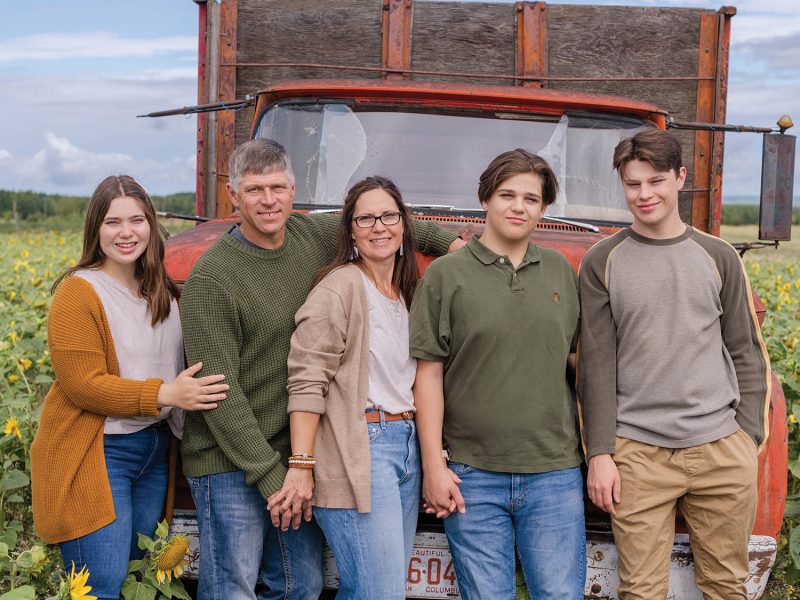
Les and Hannah Willms and their family are hopeful their participating in the BC Grain Producers’ Living Labs study will help them find new ways to improve their soils and adapt to climate change. SUBMITTED

September 28, 2022 byKate Ayers

DAWSON CREEK – The Peace Region is conducting climate change adaptation research, thanks to federal funding.

The area received nearly

$6 million in funding through Agriculture and Agri-Food Canada’s Agricultural Climate Solutions – Living Lab program to develop best management practices that solve climate change challenges.

“I find the Peace Region is often forgotten about or maybe is a second thought, so to have an agricultural initiative come to our region is extremely valuable and I believe will create a lot of spin-offs,” says Peace Region Living Lab extension coordinator Nadia Mori. “Already I’ve noticed the BC and Alberta researchers, producers and commodity groups, through the application process, worked a lot closer together when usually we would work separately. I think just that has created a lot of synergies.”

The project spans the BC and Alberta Peace Region and supports research over the next five years to investigate such parameters as carbon sequestration; greenhouse gas emissions; environmental co-benefits including water infiltration rates, soil health and species diversity; and socioeconomic factors of best management practices.

“There are roughly 13 Living Labs in total (nationally) and none of them are cross-provincial so … we were quite skeptical that our application would be accepted because it usually is a provincial initiative,” Mori says. “But at the same time, the Peace Region as a whole, especially if you look at it from a watershed basis, it does make sense to put it together [because] geographical, soil and climatic factors are all very similar.”

60 farms

The project launched this fall, starting with baseline data collection of one-metre-deep soil core samples to measure carbon levels on each of the 60 participating farms.

The region has been identified as one of the areas with the greatest carbon sequestration potential, Mori adds.

“I think that is one of the reasons that the region was selected,” she says.

Neil Ward, a rancher northwest of Fort St. John, echoes this sentiment.

“This might be one of the largest carbon sinks in North America. It’s not recognized as that,” he says. “I think it may gain some recognition for how special the area is and how well agriculture does here and how important it all is.”

Ward runs 850 cow-calf pairs and 600 yearling heifers on his ranch and looks forward to learning just how much carbon his land sequesters.

“We all know we’re putting back quite a bit of carbon into the ground through grassland management and I’m quite excited to see how much,” he says.

A unique aspect of Living Lab research is that they are in fact “living,” which means that experimental designs and practices can evolve over time.

“It’s a five-year project. Usually you get a one-year project or maybe two or three but to have a five-year project to work on is really exciting and then to have the living portion of it,” Mori says. “So, if we do something for two years and we notice that we should tweak the practice, we can do that because we’re not locked in like if you have a rigid science experiment.”

Other important distinctions of this type of research is that it is producer-driven and looks at agricultural operations as whole systems.

“We really want to look at how the whole farm comes together around this practice. What are all the aspects that it influences? It could change the labour needs or family dynamics, which are all kinds of little secondary effects that may also be important for why or why not something is being adopted,” Mori says.

At Ward’s ranch, researchers will monitor his rotational grazing practices.

“The biggest thing that they’re doing is that they’re actually studying regular agricultural practices of a rancher rather than in a controlled environment,” Ward says. “They’re on the ground studying what’s actually happening on an actual real ranch.”

Solution-based

At Willms Sunflowers in Rose Prairie, Les and Hannah Willms have been conducting their own experimental projects for years, so they were eager to join the Living Lab through the BC Grain Producers Association.

“It’s an interesting program … it’s investing in helping us find solutions to improve our soils,” Hannah says. “We’re farmers so we grow stuff but because the climate is changing, we need to find solutions for our ground so we can improve soil infiltration, manage the growing times here better.”

The Willms have a no-till operation and they’ve planted such crops as radishes, turnips, clovers and alfalfa to break up compaction, fix nitrogen and sequester carbon.

But to adopt best management practices, they need to make dollars and sense, Hannah urges.

‘”It’s a struggle for farmers to figure out how to fund some of this stuff,” she says. “Especially with cover crops up here in northeastern BC; they aren’t something you can do after your cash crops. The season is short. When we take our cash crops off, typically we’re getting snow.”

Last year the Willms planted cover crops after receiving a grant from the BC Hydro Peace Agricultural Compensation Fund. The Living Lab is an extension of this work.

“It’s a really good connection to have because we can connect with these agrologists from across the province and Alberta to help build our soils,” Les says. “If we can increase our organic matter and grow better crops in the tough years, then we will sequester more carbon.”

To disseminate findings to the remaining 1,540 producers in the region, the participating groups will create learning clusters and facilitate on-farm gatherings.

There will be opportunities for the community to visit farm research sites, be part of field days and collect data as part of the peer-to-peer learning and adoption, Mori says.

The project is led by the Peace Region Forage Seed Association and includes the Peace River Forage Association of BC, Northern Co-Hort/NEAT, BC Grain Producers Association, Fourth Sister Farm, North Peace Applied Research Association, Mackenzie Applied Research Association, SARDA Ag Research and the Peace Country Beef & Forage Association.

Related Posts

You may be interested in these posts from the same category.

Corn helps improve soil but fails grazing test

Federal budget kills Living Labs

Peace prepares for active fire season

Peace producers break ground

Province funds feed access

PRFA projects receive funding boost

Ottawa funds beneficial practices

Peace producers work to expand meat processing capacity

Grain sector receive funding

Mental wellness resources meet a growing need

Peace whipped by wild winds

Projects receive Site C funds

Previous Post: « No licence, no problem
Next Post: Interest rates rise, again »

Copyright © 2025 Country Life in BC · All Rights Reserved