• Menu
  • Skip to primary navigation
  • Skip to main content
  • Skip to primary sidebar

Country Life In BC Logo

The agricultural news source in British Columbia since 1915

  • Headlines
  • Calendar
  • Subscribe
  • Advertise
  • About
  • Archives
  • Contact
  • Search
  • Headlines
  • Calendar
  • Subscribe
  • Advertise
  • About
  • Archives
  • Contact
  • Search

Primary Sidebar

Originally published:

July 2018
Vol. 104 Issue 7

Subscribe Now!

Sign up for free weekly FARM NEWS UPDATES

Select list(s) to subscribe to


By submitting this form, you are consenting to receive marketing emails from: Country Life in BC. You can revoke your consent to receive emails at any time by using the SafeUnsubscribe® link, found at the bottom of every email. Emails are serviced by Constant Contact
Your information will not be
shared or sold ever

Stories In This Edition

Sweet basil

Committee cancels meetings

Sidebar: Greater co-ordination; less conflict

Prince George packing plant gets further study

Sidebar: Co-op model lets producers pocket profits

Editorial: Buy the billions

Back Forty: Canada isn’t the cure for what ails US dairy

OpEd: Dairy industry will endure current trade issues

ALC allegations nix Delta farmer’s vision

Letters: Elk know no boundaries

Precautions taken against Japanese beetle

Great spring for nurseries

Chicken pricing formula isn’t right

Pitt crew

Criteria for Crown tenure still unclear

McClary’s leased to Aquilinis

Strawberries kick berry season off to good start

Food advocates grapple with rural-urban interface

Research updates presented to cherry growers

New farmers need to research livestock needs

Time for tea

Ag Brief: Farmers still waiting on new ag waste regs

Ag Brief: Drought watch

AgBrief: Good to meet ewe

Ag Brief: Staff change at FF/CF

Ag Brief: Market trail

Riparian restorations benefit from farm funding

Young Farmers network at Okanagan tour

Salmon Arm fleece brings top dollar

Perseverance, ingenuity aid haskap harvest

BC ranchers praised for wildfire response

Committee work pinpoints rancher priorities

Mentorship program helps expand horizons

Tour gives public insight to dairy farming

Island welcomes Angus breeders

Experts weigh in on future of raspberry cultivars

Preparation, customer service key to market success

Top 10 list for market success

UVF ag curriculum continues to diversify

Research: Going green

Buy BC relaunched

Farm camps for kids

Henderson continues on crash course

Jude’s Kitchen: It’s easy to make July veggie month

More Headlines

Follow us on Facebook

Comments Box SVG iconsUsed for the like, share, comment, and reaction icons

6 days ago

... See MoreSee Less

View Comments
  • Likes: 4
  • Shares: 0
  • Comments: 0

Comment on Facebook

7 days ago

On the last day of the BC Organic Conference, Thursday, Molly Thurston of Pearl Agricultural Consulting helped growers learn how to manage bugs such as codling moth, wireworm, and rootworm in organic growing systems. Her talk alongside Renee Prasad included hands-on activities in which participants checked out various traps and examined pests under microscopes. Be sure to look for more upcoming ag events on our online calendar at www.countrylifeinbc.com/calendar/

#BCAg
... See MoreSee Less

On the last day of the BC Organic Conference, Thursday, Molly Thurston of Pearl Agricultural Consulting helped growers learn how to manage bugs such as codling moth, wireworm, and rootworm in organic growing systems. Her talk alongside Renee Prasad included hands-on activities in which participants checked out various traps and examined pests under microscopes. Be sure to look for more upcoming ag events on our online calendar at www.countrylifeinbc.com/calendar/

#BCAg
View Comments
  • Likes: 15
  • Shares: 0
  • Comments: 0

Comment on Facebook

1 week ago

Well-known organic farmer and podcaster Jordan Marr gets interviewed by Country Life in BC’s own columnist and potato mavin Anna Helmer during the opening session of the BC Organic Conference at Harrison Hot Springs yesterday. Sessions run today (Wednesday) and Thursday and include organic and regenerative growing practices and expanding and advocating for the organic sector, all under the background of the newly launched Organic BC banner.

#BCAg
... See MoreSee Less

Well-known organic farmer and podcaster Jordan Marr gets interviewed by Country Life in BC’s own columnist and potato mavin Anna Helmer during the opening session of the BC Organic Conference at Harrison Hot Springs yesterday. Sessions run today (Wednesday) and Thursday and include organic and regenerative growing practices and expanding and advocating for the organic sector, all under the background of the newly launched Organic BC banner.

#BCAg
View Comments
  • Likes: 37
  • Shares: 2
  • Comments: 1

Comment on Facebook

Interested in finding out more about this

3 weeks ago

Today, we remember those who sacrificed their lives or their well-being for our freedom. Lest we forget. ... See MoreSee Less

Today, we remember those who sacrificed their lives or their well-being for our freedom. Lest we forget.
View Comments
  • Likes: 8
  • Shares: 0
  • Comments: 0

Comment on Facebook

1 month ago

FarmFolk CItyFolk is hosting its biennial BC Seed Gathering in Harrison Hot Springs November 27 and 28. Farmers, gardeners and seed advocates are invited to learn more about seed through topics like growing perennial vegetables for seed, advances in seed breeding for crop resilience, seed production as a whole and much more. David Catzel, BC Seed Security program manager with FF/CF will talk about how the Citizen Seed Trail program is helping advance seed development in BC. Expect newcomers, experts and seed-curious individuals to talk about how seed saving is a necessity for food security. ... See MoreSee Less

Link thumbnail

BC Seed Gathering - FarmFolk CityFolk

farmfolkcityfolk.ca

Save the date for our upcoming 2023 BC Seed Gathering happening this November 3rd and 4th at the Richmond Kwantlen Polytechnic University campus.
View Comments
  • Likes: 1
  • Shares: 0
  • Comments: 0

Comment on Facebook

Subscribe | Advertise

The agricultural news source in British Columbia since 1915
  • Email
  • Facebook

Perseverance, ingenuity aid haskap harvest

Okanagan grower envisions being a hub for BC haskap production

July 1, 2018 byMyrna Stark Leader

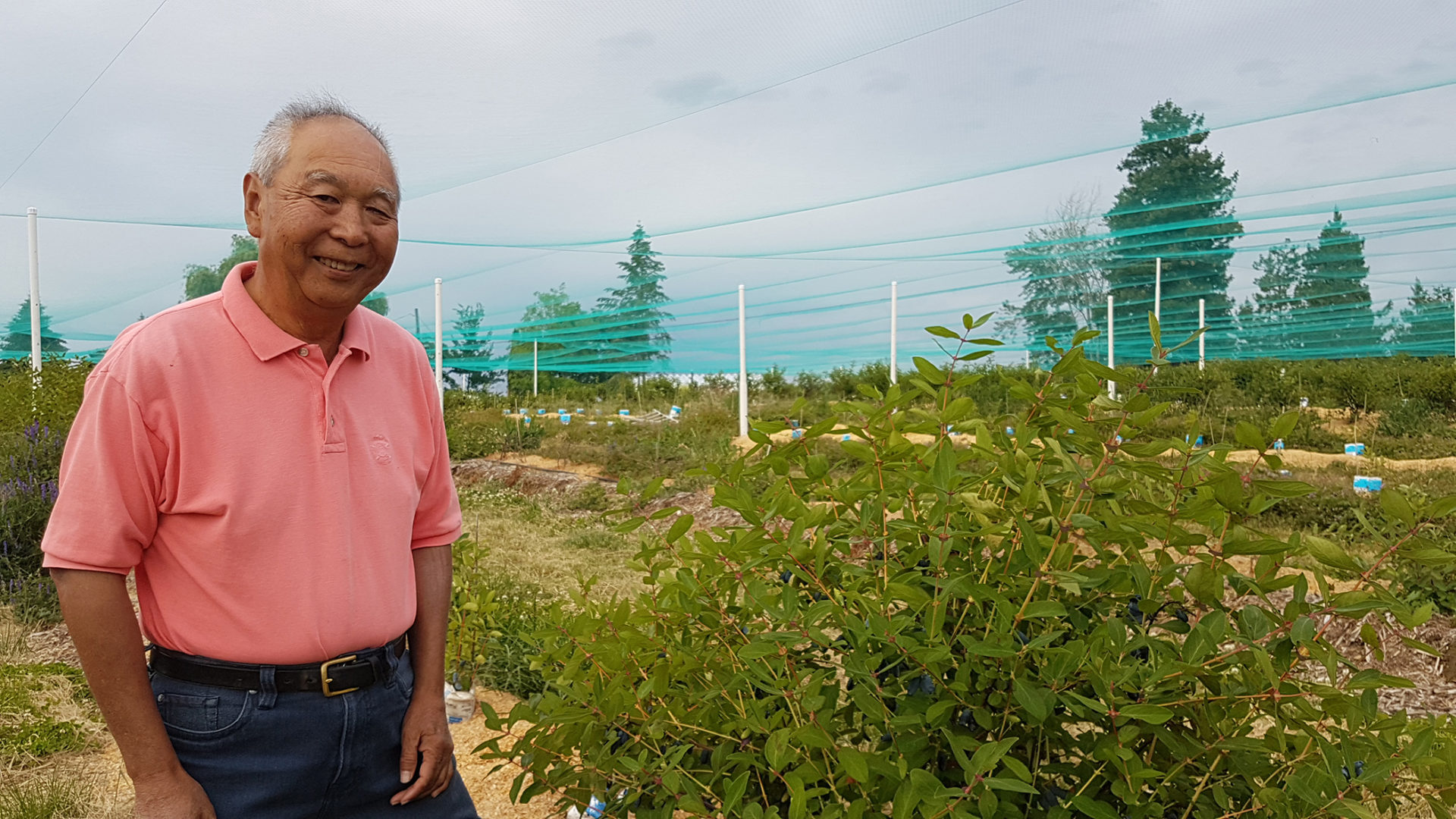
KELOWNA – Growing a new crop is not for the faint of heart. In June, after five years in the making, Reg Tomiye harvested his first full crop of haskap berries. They grow in front of his home on a nine-acre plot in South East Kelowna which was converted from an apple and sour cherry orchard.

Tomiye, whose grandfather came to the area in the early 1900s to farm, started AgriForest Bio-Technologies, a tree nursery business in the 1970s. When he sold it and some land, he wasn’t ready to quit having his hands in the business of agriculture with his horticulture, financial and business background.

“We started planting in the fall of 2013 but the plants we get are quite small so what’s normally three to four years to harvest has become five,” says Tomiye who was told about the crop by Kamlesh Patel at AgriForest.

Tomiye says haskaps are well-known in Japan for their health benefits. Hokkaido Island has a history of using the thin-skinned berry dating back hundreds of years. They’re soft and have a unique flavour like a blend of several berries with a zing at the finish, depending on variety and ripeness.

New crop, new challenges

Growing the self-financed berry crop didn’t come without perseverance and innovation.

“The first year that we had any berries, a couple years ago, I saw the berries on the plants and I went back the next day and they were all gone. There were starlings all over so the whole field was wiped out,” he explains, saying he looked at cannons and drones as bird control. However, smart birds arrive at 5 am when noise bylaws and neighbours are more restrictive.

Needing to monitor the crop, weed and control pests, and with the berry’s delicate nature, he’s spent about $80,000 to encase the entire field rather than placing net on top as is done with grapes. Visiting the crop feels a bit like walking into a more sophisticated net version of a childhood blanket fort.

“We engineered the canopy over a two-year period. We got some good old Alberta oil drill pipe and a 12-foot auger attached to the end of an excavator to drill the post holes 10 feet deep and then concreted them in. Then, we cabled everything. But last year we didn’t have everything secured. A wind storm blew all the netting and we lost quite a bit,” says Tomiye.

As a result, he designed cross-sectional cabling to strengthen the structure. He’s also engineered a telescoping post for the middle of the crop to provide support for the net and enable the harvesting equipment which straddles each row from the top.

“This year the netting is staying in place. Last year, it would move 15 feet one way or the other in the wind, which broke wires.”

Hope for ROI

With five varieties and some numbered research plants from the University of Saskatchewan in his plantings, Tomiye continues to experiment with new varieties.

Tomiye uses a blueberry harvester and has two reefer trailers to do the processing. The berries will be frozen. His 2018 crop looks good in terms of size, sugar content and volume. He’s keeping detailed records on varietal results and hoping to see a return on his investment this year.

He plans to market some locally to consumers or chefs. One of the benefits is that haskaps are an early season berry. They may fetch $15 per pound. But his eyes are focused on future opportunities. He’s been talking with overseas buyers who visit the Okanagan looking at cherries.

He sees potential for his farm to become a central haskap collection, processing and distribution facility for frozen berries or berry powder which opens up further use in the food, cosmetic and medicine industries. He says new firmer berry varieties with more upright growth would also help move a commercial industry forward.

“It’s starting to get planted here in BC but people are afraid because there’s no established market. We need to prove we have a market and we can process haskap,” he says.
Related Posts

You may be interested in these posts from the same category.

Haskaps hold potential for northern growers

Previous Post: « Elk sightings have producers concerned
Next Post: New farmers need to research livestock needs »

Copyright © 2025 Country Life in BC · All Rights Reserved