
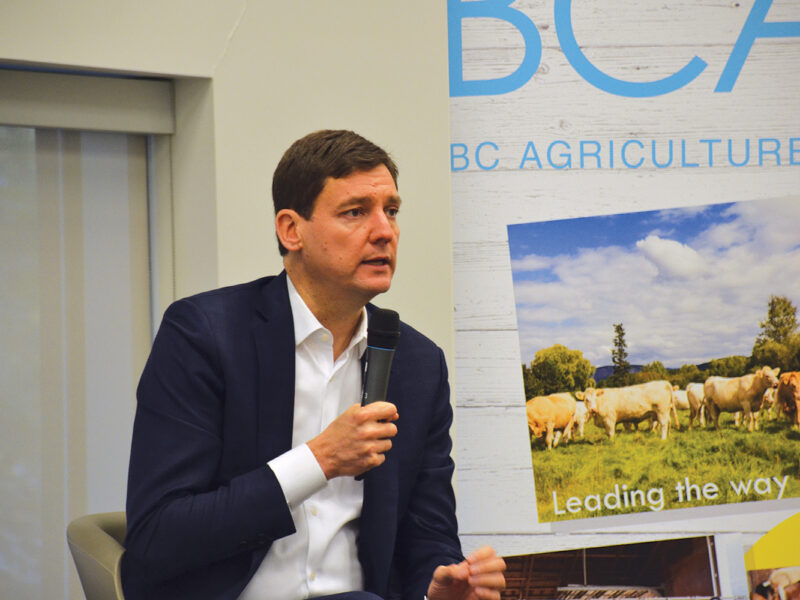
Premier David Eby is under fire for prejudicing the outcome of the province’s consultation on relaxing the rules around processing activities within the Agricultural Land Reserve (ALR).
Addressing the Greater Vancouver Board of Trade on October 13, Eby promised to change the rules requiring food processors located within the ALR to source 50% of their ingredients locally if re-elected.
A discussion paper released in July proposed allowing processors located on lower-class soils to source just 5% of ingredients locally. A public consultation led by the agriculture ministry closed September 17, with 250 submissions received.
The BC Agriculture Council (BCAC) says promising to change the rules before the results of the public consultation are made public and discussed undermines the process.
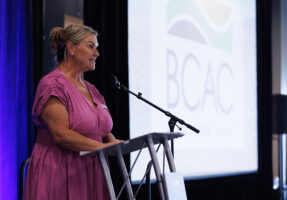
“Farmers, ranchers, local governments and others took time to respond in good faith to a process the government asked them to take part in,” said Jennifer Woike, President of BCAC. “Committing to the outcome before the public has seen what was said undermines confidence that the consultation could change anything and raises fair questions about whether the process was ever meant to.”
BCAC, together with a broad range of stakeholders in the agriculture sector, has spoken out against the change. BC Food & Beverage, which represents processors, support the change, and has told Country Life in BC that many farm groups support it.
BC Food & Beverage, together with BCAC, chaired the Premier’s Task Force on Agriculture and Food Economy, which urged a review of the Agriculture Land Commission prior to any major regulatory changes.
“The premier’s task force already pointed a way to help with this issue, and that’s developing a land strategy that supports both agriculture viability and processing together,” BCAC executive director Danielle Synotte told Country Life in BC last month. “Why is a narrow regulatory change being advanced before the broader, strategic premier’s task force recommendations are being implemented?”
BCAC, as well as some of its member organizations including the BC Fruit Growers Association, has asked the various parties and candidates running in the October 24 provincial election to state their vision for agriculture in the next legislative session.
While a dedicated online page BCAC set up to track responses from party leaders had yet to be populated as of October 14, various party platforms posted online give a glimpse of possible responses.
The NDP platform focuses on supporting sector resilience through topping up the perennial crop renewal program and expanding the Extreme Weather Preparedness Fund.
The Conservative platform features a fulsome discussion of agriculture, promising to invest in research and cut costs through microloans and tax incentives to small-scale growers.
Conservative policy also calls for cutting red tape and reviewing the Agricultural Land Commission to ensure farmers have access to processing and distribution capacity within the Agricultural Land Reserve.
Protecting water for agriculture both through legislation and expanded water storage capacity are other elements of the platform.
Centre BC’s platform promises to set 10-year targets for farm production, income, investment, processing and exports, with annual reporting to track progress. The party also promises to “update
outdated farm-classification rules so farmland is farmed, and help young and new farmers get onto the land.”
The BC Green Party has not posted an updated platform since the 2024 election, when it pledged to increase farmland protections and ensure that local, small-scale farmers were favoured over large-scale operators.
All content on this website is copyrighted, and cannot be republished or reproduced without permission.




 BC growers see rising input costs