• Menu
  • Skip to primary navigation
  • Skip to main content
  • Skip to primary sidebar

Country Life In BC Logo

The agricultural news source in British Columbia since 1915

  • Headlines
  • Calendar
  • Subscribe
  • Advertise
  • About
  • Archives
  • Contact
  • Search
  • Headlines
  • Calendar
  • Subscribe
  • Advertise
  • About
  • Archives
  • Contact
  • Search

Primary Sidebar

Originally published:

MARCH 2021
Vol. 107 Issue 3

Subscribe Now!

Sign up for free weekly FARM NEWS UPDATES

Loading form…

Your information will not be
shared or sold ever

Stories In This Edition

Province to make Premises ID law

A wee bit of green

No extension for groundwater

Pandemic trends a moving target as spring comes

Editorial: Safe and secure

Back 40: Making the most of a simple pleasure

Viewpoint: Regenerative agriculture is the way of the future

SlaughterRight training launched by ministry

Ottawa to bankroll foreign worker quarantine

Ag advocates honoured at virtual gala

Coping with adversity requires an open mind

Blueberry growers dodge US trade complaint

Open for business

Codling moth control strategy shows promise for SWD

Cherry growers continue to focus on export markets

Ministry prepares to lend support to tree fruit co-op

Delta farm entrepreneur built strong relationships

Dairy picks new entrant short list

Early advocate for farmworkers’ rights remembered

Markets consider allowing Alberta vendors

Ranchers plead with province to address elk issue

Sidebar: Fencing program protects hay

Falkland beef plant finetuning operations

District A sets ambitious agenda

Don’t underestimate scope of farmers institutes

Everlasting

Strict pandemic plan keeps workers safe

Growers face up to labour challenges

Time to tap

Sidebar: Housing key for SAWP workers

Tulip festival to bloom again in Spallumcheen

Hazelnut growers face increased disease, pest threats

Resources go online

Hope prevails as hazelnuts target expansion

Research: Wildfires influence pollinator offspring

Raspberry growers see improved IQF pricing

Raspberry researchers select for hardiness

Direct farm marketers prepared for new season

Sudden dieback now showing up in cherries

Viewpoint: Consumers need more than a Buy Local campaign

New framework to measure AITC outcomes

Farm News: Wishful thinkign for the winter that wasn’t

Ewe know it’s spring

Juiced up over local produce options

Peer groups help foster innovation, support

Sidebar: How to start

Sisters create website to help small producers

Woodshed: Divorce proceedings take off with a dog fight

Gardener pens book about mason bees

Jude’s Kitchen: Spring is coming

More Headlines

Follow us on Facebook

Comments Box SVG iconsUsed for the like, share, comment, and reaction icons

4 hours ago

The Township of Langley Farm and Ranch Exhibition Society is hosting a public open house this evening to gather input on plans to transform the historic Belmont Farm into an agricultural exhibition, education and heritage hub. Farmers, ranchers, and community members are invited to share their feedback. The open house is at the George Preston Rec Centre, 6-8 pm.

Township of Langley Farm and Ranch Exhibition Society
#BCAg
... See MoreSee Less

The Township of Langley Farm and Ranch Exhibition Society is hosting a public open house this evening to gather input on plans to transform the historic Belmont Farm into an agricultural exhibition, education and heritage hub. Farmers, ranchers, and community members are invited to share their feedback. The open house is at the George Preston Rec Centre, 6-8 pm. 

Township of Langley Farm and Ranch Exhibition Society 
#BCAg
View Comments
  • Likes: 4
  • Shares: 0
  • Comments: 0

Comment on Facebook

7 hours ago

The sold-out Southern Interior Horticulture show continues today. Education sessions range from rodent control to new tree fruit varieties, with the afternoon devoted to improving spraying techniques for orchardists and vineyard managers. When not listening to speakers, producers are checking the trade show.

#BCAg
... See MoreSee Less

The sold-out Southern Interior Horticulture show continues today. Education sessions range from rodent control to new tree fruit varieties, with the afternoon devoted to improving spraying techniques for orchardists and vineyard managers. When not listening to speakers, producers are checking the trade show.

#BCAg
View Comments
  • Likes: 6
  • Shares: 0
  • Comments: 0

Comment on Facebook

9 hours ago

The BC Poultry Association has lowered its avian flu biosecurity threat level from red to yellow, citing declining HPAI risk factors and fewer wild bird infections. Strong biosecurity practices helped BC limit cases this winter to 38 premises, down from 81 last year. For more, see today's Farm News Update from Country Life in #BCAg#BCAg ... See MoreSee Less

Link thumbnail

Poultry biosecurity notches down

www.countrylifeinbc.com

Declining risk factors for highly pathogenic avian influenza (HPAI) have prompted the BC Poultry Association to lower the industry’s biosecurity threat level from red to yellow. The decision…
View Comments
  • Likes: 11
  • Shares: 2
  • Comments: 1

Comment on Facebook

🐥💛

1 day ago

The application deadline for cost-shared funding through the Buy BC program is coming up on February 20. Up to $2 million through the Buy BC Partnership Program is available annually to BC producers and processors to support local marketing activities that increase consumer awareness of BC agriculture and BC food and beverages. For more information, visit buybcpartnershipprogram.ca/.

Buy BC

#BCAg
... See MoreSee Less

Link thumbnail

Home - Buy BC Partnership Program

buybcpartnershipprogram.ca

Buy BC Partnership Program Increase your visibility with Buy BC The Buy BC Partnership Program is a fundamental component of Buy BC that provides up to $2 million in cost-shared funding annually to lo...
View Comments
  • Likes: 3
  • Shares: 0
  • Comments: 0

Comment on Facebook

1 day ago

The Sik-E-Dakh (Glen Vowell) First Nation's Skeena Fresh hydroponic operation has doubled production capacity thanks to a $130,632 Northern Development Infrastructure Trust grant. Growing lettuce, kale, herbs and more in shipping containers, the operation uses 90% less water than traditional farming while providing 1,200 people with year-round access to fresh, locally grown greens. Their story is in the February edition of Country Life in BC, the agricultural news source for BC’s farmers and ranchers.

Northern Development Initiative Trust
#BCAg
... See MoreSee Less

The Sik-E-Dakh (Glen Vowell) First Nations Skeena Fresh hydroponic operation has doubled production capacity thanks to a $130,632 Northern Development Infrastructure Trust grant. Growing lettuce, kale, herbs and more in shipping containers, the operation uses 90% less water than traditional farming while providing 1,200 people with year-round access to fresh, locally grown greens. Their story is in the February edition of Country Life in BC, the agricultural news source for BC’s farmers and ranchers. 

Northern Development Initiative Trust 
#BCAg
View Comments
  • Likes: 15
  • Shares: 1
  • Comments: 0

Comment on Facebook

Subscribe | Advertise

The agricultural news source in British Columbia since 1915
  • Email
  • Facebook

Strict pandemic plan keeps workers safe

Fruitgrower didn’t have a single COVID-19 case last summer

KEEPING EVERYONE SAFE. The Carlson family of Carcajou Fruit Co. in Summerland employed strict COVID-19 protocols early on to keep their families and workers safe. Many of those protocols will continue after the pandemic ends. CARCAJOU FRUIT CO.

March 1, 2021 byTom Walker

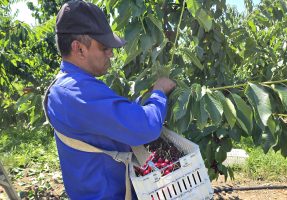
SUMMERLAND – Carcajou Fruit Co. is a 160-acre family business that typically hires 60 domestic workers to pick their cherries over a six-week period each summer.

But the COVID-19 pandemic last summer changed the labour game for the family-owned orchard. While the farm was lucky to receive 13 foreign workers through the Seasonal Agricultural Worker Program, the farm’s human resources manager and COVID-19 coordinator Claire Tamang gave growers attending the Lower Mainland Horticultural Improvement Association’s short course at the end of January tips on managing domestic workers during the pandemic.

“In the past, we have been able to recruit backpackers, both from overseas and eastern Canada,” says Tamang.

With the border closed to non-essential travel and interprovincial travel discouraged, Carcajou was forced to look closer to home for harvest help.

Carcajou has a colourful, friendly website where workers can apply. There are short descriptions of the jobs, working conditions and benefits.

“We were able to attract a number of local restaurant workers who had been laid off,” says Tamang. “They had accommodation in the area and transport, so that was positive for us, and we paid them for travelling time.”

Carcajou was also able to hire a number of tree planters whose season usually runs from April to June.

“They are used to piecework and they already had experience living in a COVID-safe camp,” says Tamang.

Unlike for foreign workers, farmers aren’t required to provide housing for seasonal domestic workers such as backpackers, but it’s no secret that good picker camps attract the best workers. For out-of-town workers, Carcajou has three separate picker camps. It charges workers $5 a day, which covers the cost of tent platforms, fully equipped kitchen shelters, washroom and laundry facilities, lockers, WiFi and a full-time cleaner. In 2020, anyone who used their own vehicle to drive themselves and others to the orchards did not pay the $5 daily camp fee.

This is a significant improvement over some camps that spring up in orchards over the summer.  But Carcajou had expectations of pickers in return.

“We are not a party camp,” says Tamang, noting that long-standing policies remained in place. “We don’t allow pets or outside visitors; this is our home, too. We needed people to stay put.”

All workers completed the AgSafe COVID-19 awareness training first, then attended a mandatory orientation session that set out Carcajou’s expectations.

“We ended up having a lot of first-year pickers,” says Tamang. “They weren’t as fast as some of our backpacker crews, but they were happy to have work and abide by our expectations.”

Employees were grouped in work units of five that would live, eat and travel to the orchards together. They would self-assess each morning, mask-up in close situations, use sanitizing stations as they entered the orchard and refrain from mixing with other groups. If there was a pause in the harvest, workers weren’t to be picking up jobs at neighbouring farms.

“If they wanted extra work on a Saturday we found something for them to do,” says Tamang.

And there were to be none of the usual summer bush parties.

“We were strict, but we figured the risk of a shut-down from COVID and not being able to bring in our highly perishable crop far outweighed replacing a worker,” explains Tamang. “It helped that someone else was making the rules, but we expect that we will continue most of our routines in future summers.”

Four workers had to self-isolate while waiting for test results and received isolation pay, but there wasn’t a single case of COVID among Carcajou staff the entire summer.

Retaining travelling summer help can be challenging, so Carcajou pays what it calls a “bitter-end bonus” of 2-4 cents a pound for workers who stay the entire season.

“We would often have pickers who would take the last week off to head to the beach before going back to school,” says Tamang. “But most of our crop are late season cherries that we pick right up till the end of August.”

Even so, there was still time for fun.

“We had someone volunteer to be the social director and they organized beach days and we had our usual year-end party, though it was not the traditional blow out,” says Tamang.

Two chefs among the pickers were hired to cater a take-out bowl party and there was a musician, but employees stayed in their work units.

“We didn’t want to be the source of an exposure right at the end of our season,” says Tamang. “Workers packed up their camps and were on the road the next morning.”
Related Posts

You may be interested in these posts from the same category.

Cherry growers focus on labour

Senate report on TFWs

SAWP points to reforms

Foreign worker consultation planned

Industry looks to move needle on labour shortage

COVID-19 response reviewed

Federal election call

Farmers market returns

Sector events start growing

WorkSafeBC increases inspections

Sunrise Poultry COVID outbreak

Flight ban strands workers

Previous Post: « Growers anxious about labour
Next Post: Don’t underestimate scope of farmers institutes »

Copyright © 2026 Country Life in BC · All Rights Reserved