
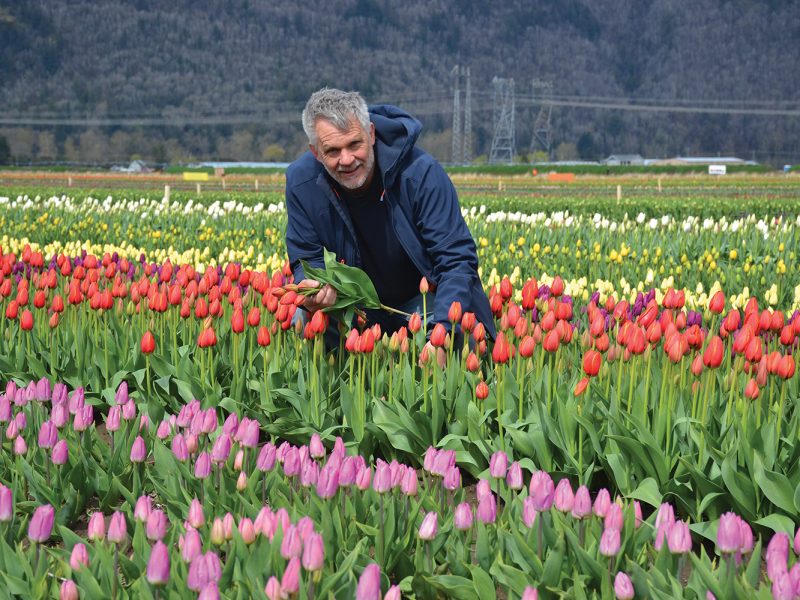
ABBOTSFORD – On a bright sunny day in early April, Nick Warmerdam points out his office window at No. 4 and Marion roads to a spot about half a kilometre away across the Trans-Canada Highway.
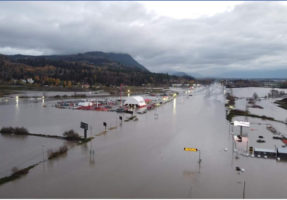
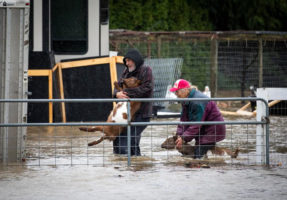
“The dike broke over there,” says Warmerdam, recalling when Sumas Prairie flooded in November 2021. “The water came through here fast. We had about six feet of water on the fields.”
While his crew was busy hand-pulling rogue daffodil bulbs from his tulip fields further south along Marion Road in preparation for the start of the Abbotsford Tulip Festival in mid April, Warmerdam opened up about the flood and its aftermath.
“I was actually in Mexico when it happened,” he recalls. “Here on this side of dike, it went from no evacuation alert to immediate evacuation the next morning. I [spoke] to my son at 6 o’clock. By the time we finished the call, the police had come by to tell him to get out.”
Warmerdam considered rushing back to Abbotsford, but after speaking to a few of his neighbours, he heeded their advice and stayed put for another week.
The owner of Lakeland Flowers, a commercial cut flower wholesaler, he made arrangements to divert three containers of tulip bulbs already en route from the Netherlands and cancel other orders that hadn’t shipped yet.
“We lost a little bit of money, but we didn’t lose it all,” he says.
Cancelling his seasonal workers was also a high priority. The first group was due to arrive from Mexico the following week to begin preparations for the 2022 growing season.
Lakeland Flowers has relied heavily on seasonal agricultural workers since the BC program began in 2004. Before the flood, Warmerdam was normally getting 80 to 90 workers to supplement a local crew of six to 10 people.
When Warmerdam returned to Abbotsford from Mexico, he waded through three feet of water to reach his house. Inside, there were telltale water marks on the walls at around 18 inches and a thick layer of mud over everything. It had been built just four years earlier, and he spent a week clearing out garbage and mud, ripping out wet drywall and insulation and airing it out.
Then, together with his son, two workers and some volunteer help, his attention turned to his four acres of greenhouses and warehouses where water decommissioned the automated equipment and deposited three inches of mud.
“The priorities at the time were to get the electrical service working again and then get my heating for the greenhouse working so that if it started to freeze hard, we wouldn’t lose all of the water piping in the greenhouse,” he says.
The power and heat was working just in time for the freeze that followed in late December.
But this April, areas that normally would be teeming with activity and filled with plants was eerily empty with just a couple of crews repairing equipment and only a fraction of the area devoted to trays of tulips, lavender and peonies. The equipment has yet to be fully fixed, but Warmerdam is hopeful that much of it, including a $600,000 tulip buncher from the Netherlands, can be salvaged.
As the flood water flowed over Marion Road it created a cascading waterfall effect on the far side and the current undermined the road base creating giant holes. He found his neighbour’s tractor upside down in one of them.
His own fields were under water for about three weeks. Warmerdam has a total of 200 acres. Most of his peonies survived the flood, but some didn’t produce flowers last year. He says they look more promising this year.
Warmerdam received some emergency funding for losses to his tulip and daffodil bulbs that were in the ground, which he used to replace stock, but he ran into the $3 million cap before he finished replanting. Crop insurance covered some of the income he lost on his bulbs, but he wishes the limits had covered more than just a part of his losses.
“That’s going to work against [the government’s] goal of having people invest in agriculture if they only cover losses up to a certain size,” he laments.
Insurance has been another challenge.
“Different things were insured by different companies,” he says. “It’s a fairly big place so it’s a little harder to get coverage.”
His equipment was covered but he learned, much to his surprise, that he didn’t have flood insurance on his buildings. Following a bunkhouse fire in 2018, his long-time underwriter didn’t renew his coverage and he had to find a new provider. He was given to understand that he had flood coverage, but that wasn’t the case. He is currently in litigation.
Warmerdam says the whole experience has been “kind of stressful.”
“There’s a lot of chaos and then there’s a lot of uncertainty,” he says. “You can’t fix everything all at once. What to start with? What to put off? What to get help with? It actually requires quite a bit of thought and planning to deal with it.”
Shift in direction
Warmerdam turned 60 in early April. That milestone, combined with the flooding, has made him re-evaluate his business and streamline his activities.
“I don’t really think that I’m interested in climbing the hill of getting back to where I was,” he says. “The flood and the short and long-term repercussions from [it] spurred me to cut back a little quicker. I’m getting used to not putting myself under as much pressure.”
Previously he was doing greenhouse tulips as well as field daffodils, tulips and peonies, but he says it’s difficult to operate a wholesale cut flower business with as many as 80 people in the field picking flowers, especially after his business was interrupted for two years.
Although he bailed out of the 2022 season and spent the year cleaning up, he did manage to do a sunflower u-pick last summer.
“You kind of need to have the momentum. It just looked like the right time to cut back on the wholesale cut flower activities and switch over more to retail,” he says.
Going forward, he expects wholesale will only be 10% of his business with the rest of the focus on retail and agritourism.
Despite that, he was intending to start shipping field tulips to the United Flower Growers Co-op auction by mid April with peonies to follow. He’s missed out on the last two years, although he did send some sunflowers to auction last summer.
Warmerdam has about 45 acres of tulips, including 27 acres earmarked for the tulip festival. He plans to selectively harvest tulips from the festival fields to leave enough blooms so visitors don’t notice a “few are missing.”
He also has plans to extend the season for his agritourism business. The tulip festival ends at Mother’s Day but he’s diversifying to include other flowers.
“We’re trying to extend that through Labour Day,” notes Warmerdam. “We planted some acres of lavender and I’ve bought some hydrangea plants.”
There’s also the peonies and he’s planting lupines and sunflowers again. An experiment with winter canola didn’t pan out this year, but he’s hoping the plants may yet flower in time for the festival. This is a business model he thinks he will enjoy doing for quite a few years.
“If you’re doing it all yourself when you get closer to 60, the little details start to get to you more,” he says. “I think what I’m doing now, I can do for a long time. I like that.”
If his father, Peter Warmerdam, is any example, Nick has plenty of years ahead of him. Peter started Lakeland Flowers in 1974. Now 95, he was “forcibly retired” out of the business eight years ago, at the age of 87.

 Homemade food rules are too restrictive