• Menu
  • Skip to primary navigation
  • Skip to main content
  • Skip to primary sidebar

Country Life In BC Logo

The agricultural news source in British Columbia since 1915

  • Headlines
  • Calendar
  • Subscribe
  • Advertise
  • About
  • Archives
  • Contact
  • Search
  • Headlines
  • Calendar
  • Subscribe
  • Advertise
  • About
  • Archives
  • Contact
  • Search

Primary Sidebar

Originally published:

May 2018
Vol. 104 Issue 5

Subscribe Now!

Sign up for free weekly FARM NEWS UPDATES

Select list(s) to subscribe to


By submitting this form, you are consenting to receive marketing emails from: Country Life in BC. You can revoke your consent to receive emails at any time by using the SafeUnsubscribe® link, found at the bottom of every email. Emails are serviced by Constant Contact
Your information will not be
shared or sold ever

Stories In This Edition

Fraser Valley bee shortage overstated

Still waiting: ag waste regs

Cannabis shift delivers hit to vegetable sector

Peter’s legacy

Editorial: The straight dope

Back Forty: Our best friend deserves greater recognitiontory

Overheard: Farmers should embrace First Nations model

Change is coming, fast and furious

Foundation effective in fueling ag projects

New meat producer association launched

Sidebar: On board

Traceability regs to include animal movement

Report recommends FN approval on tenures

Province urged to regulate farmhouse size

Dairy group highlights industry needs on tour

Ottawa plays hardball with Agassiz leases

IAF showcases innovative ag projects

Neonics in water not from farm operations

Potato growers need to exploit opportunities

Spuds in tubs

Vegetable commission optimistic

Sidebar: Variety update

MacAulay grilled over farm labour issues

Apiarists want pollination income to count

Sidebar: BCHPA launches pollinator health study

Raspberry growers increase board size

Popham meets with berry growers

Hazelnut growers flush with optimism

Ranchers schooled in disaster preparation

Westgen eyes beef semen sales for growth

Big prize money draws big entries

Holstein auction sets new sale benchmark

North 40 bull tops Vanderhoof sale

Reclaiming market share in a global economy

Day-neutrals show promise for strawberry fields

Weather skews results in Peace variety trials

Salal berries have market potential

Vole control in blueberries

Wannabe: When tragedy brings us together

Watchful eye

Woodshed Chronicles: Henderson masterminds an apology

Jude’s Kitchen: Celebrate May with beef on the ‘barbie’

More Headlines

Follow us on Facebook

Comments Box SVG iconsUsed for the like, share, comment, and reaction icons

7 days ago

... See MoreSee Less

View Comments
  • Likes: 4
  • Shares: 0
  • Comments: 0

Comment on Facebook

7 days ago

On the last day of the BC Organic Conference, Thursday, Molly Thurston of Pearl Agricultural Consulting helped growers learn how to manage bugs such as codling moth, wireworm, and rootworm in organic growing systems. Her talk alongside Renee Prasad included hands-on activities in which participants checked out various traps and examined pests under microscopes. Be sure to look for more upcoming ag events on our online calendar at www.countrylifeinbc.com/calendar/

#BCAg
... See MoreSee Less

On the last day of the BC Organic Conference, Thursday, Molly Thurston of Pearl Agricultural Consulting helped growers learn how to manage bugs such as codling moth, wireworm, and rootworm in organic growing systems. Her talk alongside Renee Prasad included hands-on activities in which participants checked out various traps and examined pests under microscopes. Be sure to look for more upcoming ag events on our online calendar at www.countrylifeinbc.com/calendar/

#BCAg
View Comments
  • Likes: 15
  • Shares: 0
  • Comments: 0

Comment on Facebook

1 week ago

Well-known organic farmer and podcaster Jordan Marr gets interviewed by Country Life in BC’s own columnist and potato mavin Anna Helmer during the opening session of the BC Organic Conference at Harrison Hot Springs yesterday. Sessions run today (Wednesday) and Thursday and include organic and regenerative growing practices and expanding and advocating for the organic sector, all under the background of the newly launched Organic BC banner.

#BCAg
... See MoreSee Less

Well-known organic farmer and podcaster Jordan Marr gets interviewed by Country Life in BC’s own columnist and potato mavin Anna Helmer during the opening session of the BC Organic Conference at Harrison Hot Springs yesterday. Sessions run today (Wednesday) and Thursday and include organic and regenerative growing practices and expanding and advocating for the organic sector, all under the background of the newly launched Organic BC banner.

#BCAg
View Comments
  • Likes: 37
  • Shares: 2
  • Comments: 1

Comment on Facebook

Interested in finding out more about this

3 weeks ago

Today, we remember those who sacrificed their lives or their well-being for our freedom. Lest we forget. ... See MoreSee Less

Today, we remember those who sacrificed their lives or their well-being for our freedom. Lest we forget.
View Comments
  • Likes: 8
  • Shares: 0
  • Comments: 0

Comment on Facebook

1 month ago

FarmFolk CItyFolk is hosting its biennial BC Seed Gathering in Harrison Hot Springs November 27 and 28. Farmers, gardeners and seed advocates are invited to learn more about seed through topics like growing perennial vegetables for seed, advances in seed breeding for crop resilience, seed production as a whole and much more. David Catzel, BC Seed Security program manager with FF/CF will talk about how the Citizen Seed Trail program is helping advance seed development in BC. Expect newcomers, experts and seed-curious individuals to talk about how seed saving is a necessity for food security. ... See MoreSee Less

Link thumbnail

BC Seed Gathering - FarmFolk CityFolk

farmfolkcityfolk.ca

Save the date for our upcoming 2023 BC Seed Gathering happening this November 3rd and 4th at the Richmond Kwantlen Polytechnic University campus.
View Comments
  • Likes: 1
  • Shares: 0
  • Comments: 0

Comment on Facebook

Subscribe | Advertise

The agricultural news source in British Columbia since 1915
  • Email
  • Facebook

Vole control in blueberries

Raptors can help control rodents
April 30, 2018 byRonda Payne

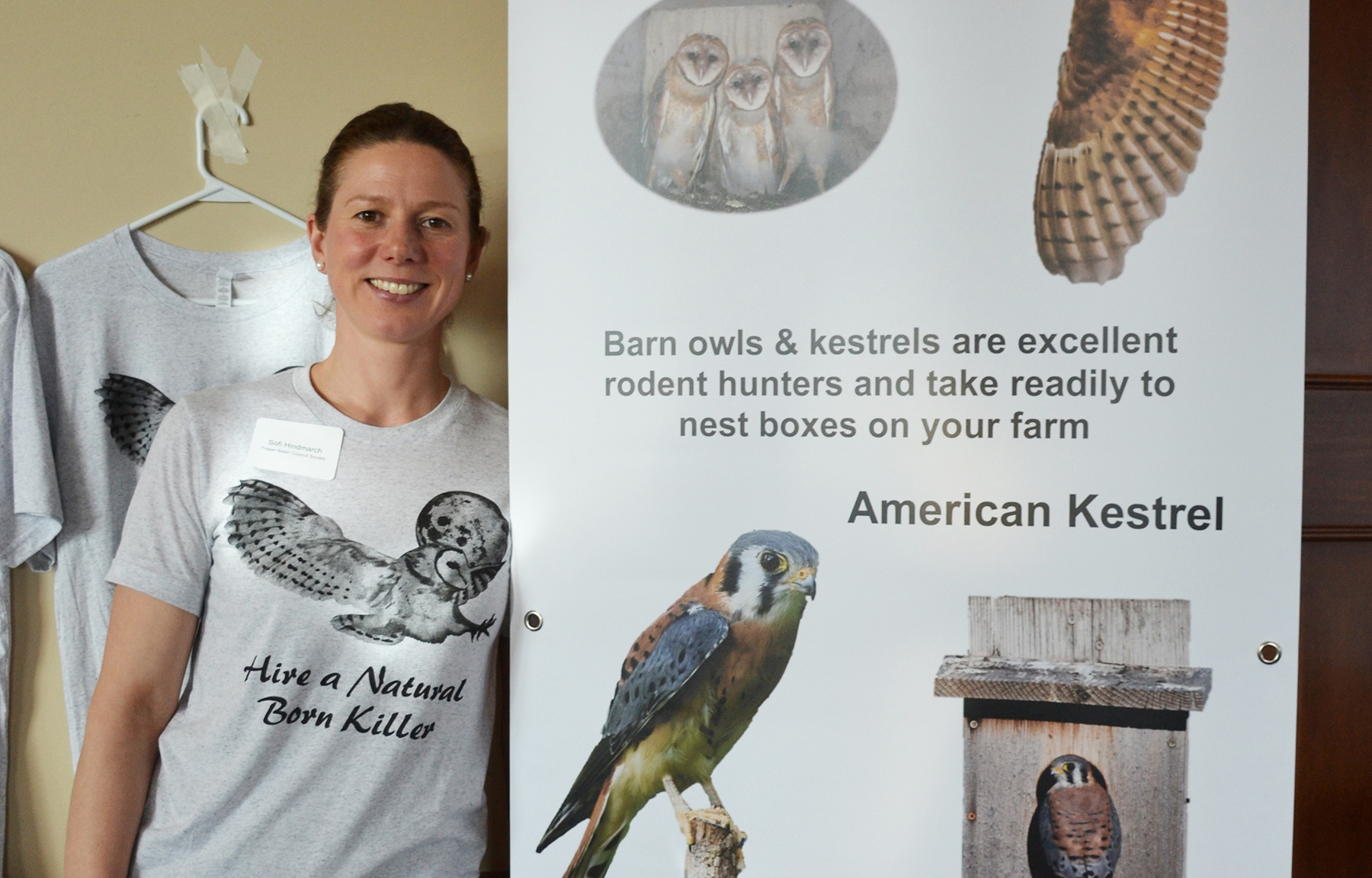
LANGLEY – Vole, mouse, shrew or mole: researcher Sofi Hindmarch wants to help blueberry growers better understand the rodents in their fields to help them reduce the volume and cost of rodenticides and improve the health of their plants.
A project co-ordinator with the Fraser Valley Conservancy, Hindmarch’s work with barn owls and other raptors is well known around the Lower Mainland. This project will include producing videos to help educate farmers.
“We are getting with the times,” she says.
The videos will provide information similar to fact sheets but delivered in a way that can be easily accessed on phones, computers and tablets. The first will be about voles because they’re especially prone to mistaken identity.
The Townsend’s vole is typically 11 to 14 cm in length (excluding the tail) and weighs 45 to 90 grams. It has chocolate brown fur that hides the ears, and a tail less than half its body length.
Deer mice are very common in blueberry fields and are much smaller (15 to 25 grams) with light brown to grey fur, visible rounded ears, long tails and they tend to hop along the ground rather than run like a vole.
Shrews and moles are often in blueberry fields but are seldom seen, which shouldn’t be troubling because shrews eat insects and moles eat worms. They don’t dine on plant roots and stems like a vole.
Of the rodents, only the voles feed extensively on woody shrubs and tree seedlings when grasses and sedges aren’t available, primarily in the late fall and winter. They can cause a significant amount of damage to a blueberry field.
While appearance is one way to determine if a rodent is a vole, mole or mouse, another method of identification is by looking at the tunneling.
Voles leave holes in the ground of about five centimeters in diameter, whereas mouse holes are much smaller, at about 2.5 centimetres. Vole holes lack dirt piles, unlike molehills.
Vole tunnels are often visible on the surface of the ground as runway depressions that lead to holes and deeper tunnels. The highest vole densities typically occur in fall and winter and their tunnels are commonly seen when the snow melts.
Voles like to burrow along the rows of blueberry bushes, giving them easy access to roots and stems for food. Some of the signs of feeding on blueberry bushes include parallel grooves from front teeth, scratch patterns in various directions, damage above or below ground and any damage will also have tunnels and runways nearby.
While weevil damage may mimic vole damage, it lacks the parallel teeth grooves, a presence of weevil larvae, leaf notching from adult weevils and a lack of tunnels and runways.
“The key thing we want to get to farmers is the (correct) identification of voles in a blueberry field,” Hindmarch says.
According to Hindmarch, monitoring shows that fields with less vegetation (or close-cropped grass) have fewer voles as do fields that flood and aren’t adjacent to grassy fields.
Reducing rodenticide use
A second video will focus on a subject near and dear to Hindmarch’s heart – reducing rodenticide use.
“We want to reduce the amount of rodenticide in the agricultural landscape,” she says.
Rather than constantly deploying rodenticides, Hindmarch recommends using them in a targeted and efficient manner. This requires an understanding of rodent behaviour and a regular assessment of the effectiveness of the controls.
Rodenticides approved for use in fields include brands like Ground Force, Ramik Green and Ramik Brown.
She says rodenticides should be the last resort of control, not the first or only option.
“All our residue data is showing the rodenticide in raptors is 100%,” says Hindmarch. This means that every raptor studied has at least one type of rodenticide in their system, often more. Hindmarch’s research has found rodenticides can harm these traditional friends of farmers and leave them unable to fly properly. Many die.
Part of keeping raptors (and pets) safe starts with reducing grassy vegetation and monitoring. If this isn’t effective, a targeted PVC pipe bait station can be placed where damage is most severe, as voles don’t travel far from their holes. By using bait stations only in areas with damage, farmers can reduce rodenticide costs.
Since raptors eat voles, Hindmarch says bait stations should be temporary to prevent secondary poisoning of raptors.
Ideally, Hindmarch would like to see raptors like barn owls or hawks used to control vole populations. She continues to set up nest boxes on farm land to encourage barn owls and advise farmers on where to place perching poles to attract raptors that can assist in rodent control.

Related Posts

You may be interested in these posts from the same category.

Japanese beetle spreads

Canada holds off Asian giant hornet restrictions

Giant hornets headline beekeepers’ concerns

Armyworm precautions urged

Japanese beetle fight continues

Buggy season

Previous Post: « Poultry growers adjust to reduced antibiotic use
Next Post: ALC crippled while province mulls revitalization »

Copyright © 2025 Country Life in BC · All Rights Reserved