
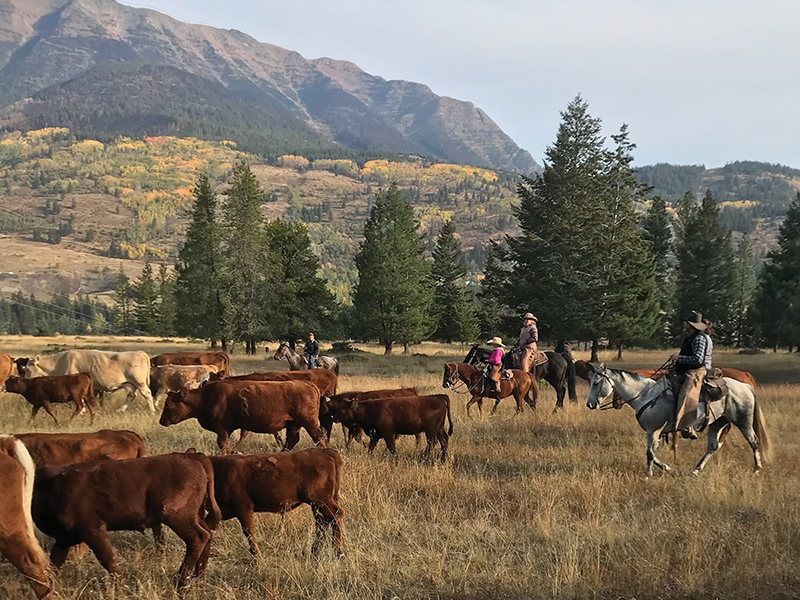
JAFFRAY – As a young boy growing up in the Kootenay-Boundary region, Randy Reay never expected to run out of water.
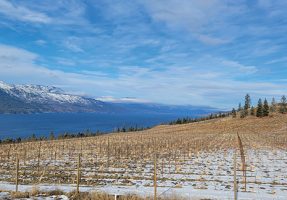
But this year, in mid-February, his fields are bare. There is no snow halfway up the Rocky Mountains. And he’s digging a new well on one of his Crown tenures because two of his natural water sources have dried up.
“We were blessed for 100 years with lots of natural water sources and none of us ever thought it was going to be an issue,” says Reay, who runs 500 head of cattle. “A lot of these natural water sources are going dry. They’re not recharging; we haven’t had the runoff to replenish them.”
Consistent droughts and climate change are placing increasing pressure on BC’s natural water sources and aquifers – the underground layers of rock, gravel or sand that store groundwater for many rural households, farms and businesses. A new scientific assessment commissioned by Living Lakes Canada found that 15% of mapped aquifers in the Kootenay-Boundary region are a high priority for monitoring based on factors such as water demand, proximity to communities and agricultural use.
About 80% of these high-priority aquifers in the region are not currently monitored despite their importance for local communities, the report found. Several at-risk aquifer “hotspots” critical to agricultural and community water supplies were identified, including the Baynes Lake area, the Sparwood and Fernie areas and southwest of Golden.
“This is a very important region as far as water security goes because it’s connected to one of the biggest water towers in North America,” says Arlo Bryn-Thorn, program manager with Living Lakes Canada. “It’s integral we’re protecting these water sources for Canada and the US alike.”
The Living Lakes assessment, funded by the Investment Agriculture Foundation of BC, is one of 10 studies being conducted throughout the province to determine agriculture water supply management or feasibility studies, according to the BC government. IAFBC is also fundng assessments by the City of Surrey, Okanagan Indian Band, the Sunshine Coast and Bulkley-Nechako regional districts.
A multi-year project is also nearing completion by the province’s River Forecast Centre to operationalize research from Simon Fraser University, according to the BC Ministry of Water, Land and Resource Stewardship (WLRS), which monitors groundwater conditions through the Provincial Groundwater Observation Well Network (PGOWN).
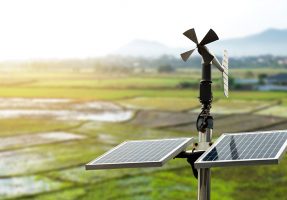
The project will combine data from PGOWN, which currently has over 240 active wells, with climate data from weather stations, hydrometric stations and other sources to help forecast groundwater drought conditions weeks or months in advance to provide some potential early warning signals.
Of the provincial observation wells, over 48% have below-normal groundwater level, with many at record-low levels as of February 2026, according to the ministry.
“As BC is experiencing drought more frequently, there is an ongoing need to improve scientific knowledge and monitoring of aquifer characteristics, groundwater availability and groundwater interaction with surface water,” WLRS says in a statement to Country Life in BC.
Snowpack observations
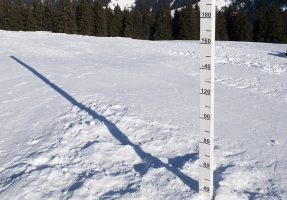
The BC River Forecast Centre reports that the provincial mountain snowpack averaged 96% of normal on February 1, with most locations normal or above normal. The drought-prone Peace Region, which ended last season at Level 4 drought, is at 122% of normal.
River Forecast Centre hydrologist Jonathan Boyd says the Okanagan is experiencing the lowest snowpack this year at 67% of normal. Kelowna saw the least precipitation since 1900 this winter, while Penticton plumbed lows not seen since 1907.
Bryn-Thorn hopes the Kootenay aquifer assessment will spark meaningful conversations, expand monitoring programs and help advocate for freshwater protection. Through the Columbia Basin Groundwater Monitoring Program, Living Lakes partners with 32 well owners to track seasonal and annual changes in groundwater levels.
“Getting a better, more comprehensive idea of how water resources are fluctuating, increasing pressures from industry demand and climate change is really important for understanding … how we can prepare for the inevitable shortages,” he says.
Reay agrees more needs to be done in his region, noting government bureaucracy has made it difficult to get water systems in place when they need them. He received a Grassland and Rangeland Enhancement Program grant from the Columbia Basin Trust to put in his new well.
“It’s been a real plus but it’s never enough,” he says. “We’re going to have to be smarter in how we use our water or we’re going to be in a situation where these cattle aren’t going to use these Crown ranges. And without these Crown ranges, there’s no industry.”

 Fertilizer prices on the rise