
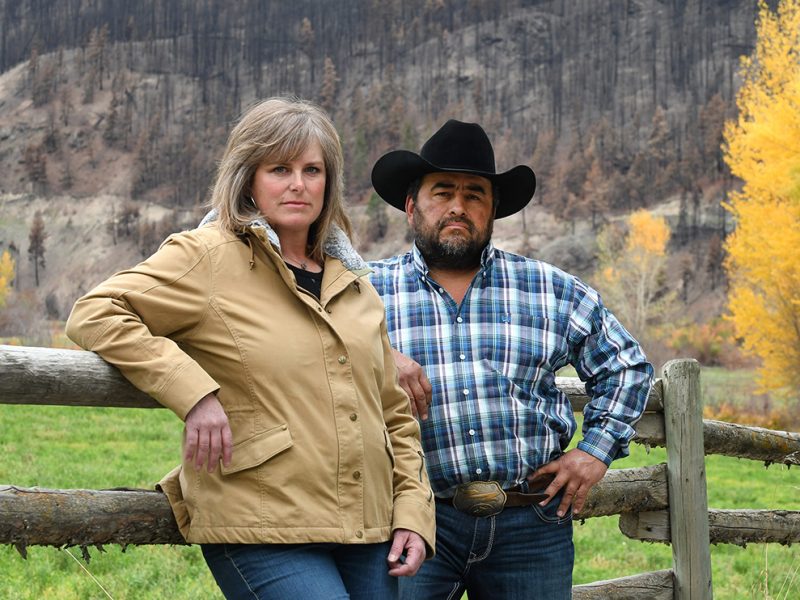
MERRITT – Rhonda and Wayne MacDonald of Bar FX Ranch planned to stay and fight the approaching Lytton Creek fire until they lost power. But as they loaded up their last liner with cattle, a fire tornado breached the top of a hill and raced towards them against the smoky dusk skies.
It was in that moment the MacDonalds, along with their cattle, retreated to safer grounds and left their ranch between Merritt and Spences Bridge on Hwy 8, hoping to return to some semblance of home.
“It is a risk that we take when we range in the mountains. We realize that,” says Rhonda. “It was a risk this year, but the end result didn’t have to happen. It was a lack of resources … and lack of common sense. And it’s not the people working on the ground, it’s the people sitting in offices making the calls.”
While firefighters were brought in from across North America and overseas, high winds fanned flames that outran nearly 5,000 firefighters and made this year the third most destructive in history after 2017 and 2018. A total of 1,610 wildfires burned more than 868,200 hectares this season.
Now that the fires have been brought under control and the smoke has cleared, government officials, fire crews and producers are trying to learn from this year’s experiences.
“There are different ways to measure fire management success. Some people use area burned, but I don’t think that’s the most appropriate one,” says Mike Flannigan, BC research chair in predictive services, emergency management and fire science at Thompson Rivers University. “It’s more about impact. The numbers aren’t in yet, but I believe in many metrics, 2021 was the most impactful of those years. There was loss of life directly related to fire, which didn’t happen in other years. It was a devastating and catastrophic fire season in many regards.”
This rings true for the MacDonalds, who had 110 head of cattle on 100,000 acres of range earlier this year. But when the wildfires struck, 11 cow-calf pairs perished. They are still missing 10 cows and five calves that have yet to be recovered. One day, they had 21 riders out on range to gather cattle as fire conditions escalated.
“The whole ranching community came together to give us a hand. But then it got to the point where it was too dangerous to go,” says MacDonald. “I wish BC Wildfire Service could have walked the bush with us. You could smell them before you saw them. Those images are engraved in our brains.”
The extreme heat and fire conditions that fueled intense fires, exhausting personnel and resources, demand a change in how wildfires are managed, says Flannigan.
“Fire management is adaptive, but I think we do have to change the way we do business,” he says.
A first step would be allowing prescribed and natural burns on the landscape.
“The reason for this is because a recently burned area is unlikely to reburn for 15 or 20 years. If it does reburn, it’s lower intensity and easier to put out,” he says. “Natural fires are Mother Nature at work.”
Indigenous firekeepers have conducted low-intensity cultural burns since time immemorial to rebalance ecosystems and facilitate regeneration. This approach prevents fire fuel such as branches and dry vegetation from building up in forests. However, under the BC Bush Fire Act of 1874, the emphasis was put on preventing fire rather than working with it.
But without regular management of forest floor debris, high-severity fires become more likely. They can also take on a life of their own. Development also makes it difficult for firefighting agencies to let fires run their course.
“For BC Wildfire Service to allow natural fires when and where possible is challenging because there are very few areas in the province that do not have a ranch, cabin, cottage, community, infrastructure or some societal value that allow fire on the landscape,” says Flannigan.
An in-the-moment fire control tactic is backburning or burn-out operations.
“The principle is that where a wildfire is spreading, start a new fire backing into the wind so that it’s much lower intensity and you can manage it. The new fire consumes frontal fuel. It’s very effective,” says Flannigan.
But appropriate forecasts and familiarity with the local landscape are critical. Unfortunately, the MacDonalds were on the receiving end of a backburn gone awry.
“We had an Australian backburn specialist that was here making the decisions about burning up our countryside. When they lit the first backburn here on August 9, we were shocked,” says MacDonald. “I got a hold of our range agrologist that morning because we heard via the grapevine that they were going to light a backburn. She got a hold of BC Wildfire Service who said, ‘Oh no, we’re still a few days out.’ This was at 7:30 or 8 that morning and by 10:25, BC Wildfire Service had issued a press statement that they were starting a backburn that afternoon.”
No consultation
Ranchers weren’t the only ones left in the dark. So were other government employees.
“My husband was born and raised here, and he knows the areas where they lit the backburns and where they were working like the back of his hand. He spent his childhood and part of his adult life up there,” says MacDonald. “We range our cattle and go up there quite often. And there was no consultation with any of the stakeholders up there about lighting backburns. At the time they lit the first backburn, that fire was all but out.”
It was also the middle of the afternoon, when the temperature was 37°C and winds were picking up.
“It always gets windy here in the afternoon. I understand why they want to backburn, however, when we’ve had eight weeks or more of drought, it’s not the time. You try to put the fires out,” says MacDonald. “How about we log it and make use of that wood in conjunction with controlled burns in March and April or October and November when it can be easily controlled? You don’t do it in August when it’s hot and dry with no measurable rain since May.”
The fire from the backburn hit their ranch on August 15.
“We assumed it would come from the west, but it came from the west farther south than us and then the wind changed, and it wrapped around and came from the east. It was bizarre. It was ranked as a 6+ fire. All the firefighters I talked to had never seen that kind of fire,” says MacDonald.
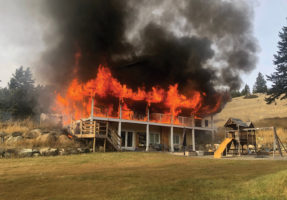
Rank 6 is the highest mark on the BC Wildfire Service scale and describes fire behaviour that’s extreme and aggressive. MacDonald says the fire lived up to its rank, destroying six houses, four shops, four barns as well as hay sheds and several outbuildings.
“Our neighbour’s Tesla is a melted pile of aluminum,” she adds.
The province was unable to confirm the claim, saying it’s still too early to have a complete picture.
The MacDonalds started preparing for fires the day after fire erased the village of Lytton on June 30. They disposed of combustibles and debris in their yard and cleared a 12-foot diameter around the bottom of every hydro pole. But they still lost the poles because the fire was so intense.
But through their daily preparation, cleaning and watering, the couple’s home was saved as well as Rhonda’s mother’s place down the road.
Some residents in the fire zones believe that enhanced communication and local collaboration would help reduce losses to wildfire.
A statement to Country Life in BC from the BC Ministry of Agriculture, Food and Fisheries says the “use of liaisons from the BC Cattlemen’s Association who were embedded directly into the BC Wildfire Incident Command Structure” strengthened this year’s wildfire response efforts. It also noted “increased coordination and support for agriculture producers to undertake fire response operations in consultation with the BC Wildfire Service.”
But that’s not what the MacDonalds found when they were invited to help put out a nearby fire.
During the third week of July, RCMP notified the MacDonalds that a fire was consuming a farm 10 kilometres down the road and that firefighters could use some support. They loaded and sent down two water trucks, and two more came from local businesses in Merritt.
“All four of those trucks sat up at the Shackan Band Hall and were sent home full after two hours because they weren’t signed up with Forestry,” says MacDonald. “At that point, none of us wanted to get paid. We just wanted to help and put this damn fire out and we weren’t allowed. That really has to change. … What is wrong if someone wants to help like that and have them sign a waiver on site? I understand there is a liability factor, but I think that anyone who shows up with equipment knows what they are doing and that there’s risk.”
Checks and balances
Flannigan agrees that local resources are valuable, but adequate training is required before heading onto the frontlines.
“I think using local knowledge and resources can be quite beneficial but there has to be standard training and checks and balances,” he says. “There has to be coordination. People could be at the wrong place at the wrong time. We don’t want any injuries or loss of life that could be avoidable.”
Todd Stone, the BC Liberal MLA for Kamloops‒South Thompson, is calling for a public inquiry into the government’s management of wildfires this season. The province, which investigated the response to the record-breaking 2017 wildfire and flood season, has not promised a similar report on this year’s efforts.
But learning from experience is critical, especially as wildfires are expected to continue to pose a threat to BC as seasonal temperatures and the risk of drought increase.
While prescribed burns help manage fuels and programs such as FireSmart educate communities and encourage collaborative solutions, there’s no single answer as BC prepares to live with more extreme weather and wildfires.
“There’s no silver bullet,” says Flannigan. “(But) there is always stuff to burn in BC.”


 Country Life in BC wins big