• Menu
  • Skip to primary navigation
  • Skip to main content
  • Skip to primary sidebar

Country Life In BC Logo

The agricultural news source in British Columbia since 1915

  • Headlines
  • Calendar
  • Subscribe
  • Advertise
  • About
  • Archives
  • Contact
  • Search
  • Headlines
  • Calendar
  • Subscribe
  • Advertise
  • About
  • Archives
  • Contact
  • Search

Primary Sidebar

Originally published:

OCTOBER 2020
Vol. 106 Issue 10

Subscribe Now!

Sign up for free weekly FARM NEWS UPDATES

Loading form…

Your information will not be
shared or sold ever

Stories In This Edition

BC Beef set to launch

All in the Family

Peace leads farmland sales

Second residences allowed in ALR until July 2021

Ready for the season

Editorial: Turkey run

Back 40: Some things about farming never change

Viewpoint: Growing craft beer sector built on community connections

BC Tree Fruits prepares to sell assets, apples

Sidebar: No quick fix

Cherry growers slammed by record losses

Pickers – and choosers

Animal rights activists land in court

Meat producers frustrated by consultations

A2 milk launch aimed at lactose-intolerant

Ag Briefs: Northern Health signs on with FeedBC

Ag Briefs: Cranberry outlook brightens

Ag Briefs: Agriculture nabs recovery funding

Ag Briefs: North Okanagan reaches farmers

Pandemic delays review of anti-dumping order

Potato field day showcases new varieties

Province tightens rules for employers

Peace grain growers gather bitter harvest

Learning to do

Vancouver Island grain harvest looks promising

Slaughter waste receives fresh funding

Ranchers threaten litigation over treaty negotiations

Sweet sale

Sidebar: Rancers seek compensation for Chilcotin land losses

Ardill Ranch receives Century Farm award

Sidebar: The long haul

Research: Regenerative ranching counters climate change

A new generation keeps the family greenhouse growing

Hazelnut growers on the lookout for invasive stink bug

New president for BC Hazelnut

First-gen farmers plot a vision for success

New research director puts people first

Reflective tarps piloted in FV blubeberries

Speciality mushroom growers come into their own

Seeking insights

Dairy success is about attention to detail

Woodshed: To Rocky’s end, and flirting with danger

Green bean trials target large grower needs

Farm Story: There’s plenty to put the dynamite in the family dynamic

AITC rolls out virtual options for teachers

Jude’s Kitchen: Brunch for a bunch

More Headlines

Follow us on Facebook

Comments Box SVG iconsUsed for the like, share, comment, and reaction icons

4 hours ago

The Township of Langley Farm and Ranch Exhibition Society is hosting a public open house this evening to gather input on plans to transform the historic Belmont Farm into an agricultural exhibition, education and heritage hub. Farmers, ranchers, and community members are invited to share their feedback. The open house is at the George Preston Rec Centre, 6-8 pm.

Township of Langley Farm and Ranch Exhibition Society
#BCAg
... See MoreSee Less

The Township of Langley Farm and Ranch Exhibition Society is hosting a public open house this evening to gather input on plans to transform the historic Belmont Farm into an agricultural exhibition, education and heritage hub. Farmers, ranchers, and community members are invited to share their feedback. The open house is at the George Preston Rec Centre, 6-8 pm. 

Township of Langley Farm and Ranch Exhibition Society 
#BCAg
View Comments
  • Likes: 4
  • Shares: 0
  • Comments: 0

Comment on Facebook

7 hours ago

The sold-out Southern Interior Horticulture show continues today. Education sessions range from rodent control to new tree fruit varieties, with the afternoon devoted to improving spraying techniques for orchardists and vineyard managers. When not listening to speakers, producers are checking the trade show.

#BCAg
... See MoreSee Less

The sold-out Southern Interior Horticulture show continues today. Education sessions range from rodent control to new tree fruit varieties, with the afternoon devoted to improving spraying techniques for orchardists and vineyard managers. When not listening to speakers, producers are checking the trade show.

#BCAg
View Comments
  • Likes: 6
  • Shares: 0
  • Comments: 0

Comment on Facebook

9 hours ago

The BC Poultry Association has lowered its avian flu biosecurity threat level from red to yellow, citing declining HPAI risk factors and fewer wild bird infections. Strong biosecurity practices helped BC limit cases this winter to 38 premises, down from 81 last year. For more, see today's Farm News Update from Country Life in #BCAg#BCAg ... See MoreSee Less

Link thumbnail

Poultry biosecurity notches down

www.countrylifeinbc.com

Declining risk factors for highly pathogenic avian influenza (HPAI) have prompted the BC Poultry Association to lower the industry’s biosecurity threat level from red to yellow. The decision…
View Comments
  • Likes: 11
  • Shares: 2
  • Comments: 1

Comment on Facebook

🐥💛

1 day ago

The application deadline for cost-shared funding through the Buy BC program is coming up on February 20. Up to $2 million through the Buy BC Partnership Program is available annually to BC producers and processors to support local marketing activities that increase consumer awareness of BC agriculture and BC food and beverages. For more information, visit buybcpartnershipprogram.ca/.

Buy BC

#BCAg
... See MoreSee Less

Link thumbnail

Home - Buy BC Partnership Program

buybcpartnershipprogram.ca

Buy BC Partnership Program Increase your visibility with Buy BC The Buy BC Partnership Program is a fundamental component of Buy BC that provides up to $2 million in cost-shared funding annually to lo...
View Comments
  • Likes: 3
  • Shares: 0
  • Comments: 0

Comment on Facebook

1 day ago

The Sik-E-Dakh (Glen Vowell) First Nation's Skeena Fresh hydroponic operation has doubled production capacity thanks to a $130,632 Northern Development Infrastructure Trust grant. Growing lettuce, kale, herbs and more in shipping containers, the operation uses 90% less water than traditional farming while providing 1,200 people with year-round access to fresh, locally grown greens. Their story is in the February edition of Country Life in BC, the agricultural news source for BC’s farmers and ranchers.

Northern Development Initiative Trust
#BCAg
... See MoreSee Less

The Sik-E-Dakh (Glen Vowell) First Nations Skeena Fresh hydroponic operation has doubled production capacity thanks to a $130,632 Northern Development Infrastructure Trust grant. Growing lettuce, kale, herbs and more in shipping containers, the operation uses 90% less water than traditional farming while providing 1,200 people with year-round access to fresh, locally grown greens. Their story is in the February edition of Country Life in BC, the agricultural news source for BC’s farmers and ranchers. 

Northern Development Initiative Trust 
#BCAg
View Comments
  • Likes: 15
  • Shares: 1
  • Comments: 0

Comment on Facebook

Subscribe | Advertise

The agricultural news source in British Columbia since 1915
  • Email
  • Facebook

A new generation keeps the family greenhouse growing

Corne and Paul Moerman among Canada’s top young growers

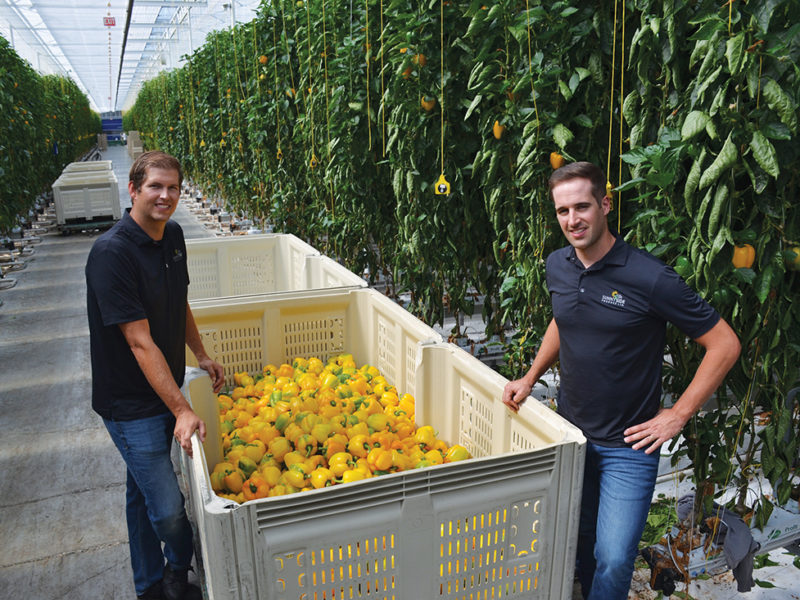
Cousins Corne, left, and Paul Moerman grew up and into the family’s greenhouse operation. When they officially joined the business, they started a grading and packing business and now grow, grade and sell their peppers under the Windset Farm label. PHOTO / RONDA PAYNE

October 1, 2020 byMyrna Stark Leader

SURREY – With locations in Surrey and Delta, Sunnyside Produce Ltd. has steadily grown its greenhouse pepper operation to more than 70 acres in the past 25 years. With annual production of more than 10,000 tonnes, it’s among the largest pepper producers in BC.

It’s a notable achievement for what began as a five-acre operation established by cousins Jos and Bram Moerman. The business is still family-run but a succession planning exercise in 2017 has brought Jos’s son Corne and Bram’s son Paul on board. The younger cousins are set to take over the entire operation in three years, cementing their place as fourth-generation growers.

Jos and Bram Moerman each owned half of separate greenhouses in Holland. Both of them sold to their partners and moved to start life in Canada, initially setting up a greenhouse in Abbotsford in 1996.

“They wanted a new opportunity and a change of lifestyle,” says Corne who was 10 at the time. “Holland has a dense population and traffic jams…There was another family from Holland that had moved to BC so they visited them and decided to move.”

Sunnyside Produce, as it’s known today, grew steadily. It relocated to Surrey in 2006, then in 2012 opened another location in Delta.

“We added 14 acres [of] new greenhouses in 2018 and planned for this year’s expansion of another 14 long before COVID-19 so, luckily, everything is going as planned,” says Corne.

It wasn’t a surprise when Corne got involved in growing early on. Both his grandfather and the great-grandfather he and Paul share were in the greenhouse business.

“Every holiday, pro-d day off school, Christmas, or if we didn’t do a family vacation, we were always working on the farm,” he says. “We had a roadside stand and dad gave me a few rows of tomatoes at the beginning of the season and I was responsible for all the work with those plants.”

Suspecting he may like to continue the family greenhouse tradition, he went to Holland after high school. For six months, he worked for three different greenhouses.

“That’s where I realized that this is what I want to do. There’s something new going on every day,” says Corne, now 33. He joined the family business in 2008, along with his cousin, after attending Kwantlen Polytechnic University for two years.

Succession done right

While their fathers focused on the production side, Corne and Paul were given the responsibility of starting a pepper grading and packing business. Previously, all their product had gone to BC Hot House. They began grading for themselves and then for others under the name Sunnyside Grading.

“We hired our own labour and leased the business from our fathers. That’s how we learned the business side,” explains Paul, who is also 33.

That business and two others were eventually folded into today’s single company which produces and grades peppers for the Canadian and US markets. They’re sold by Windset Farms. While it’s important to feed Canadians, Corne estimates about 60% of their production goes to the far larger US market in California.

In 2020, to continue to diversify the operation, along with bell and mini pointed peppers, they started growing red, orange and chocolate-coloured sweet tooth peppers. The long narrow peppers have the highest sugar content of any sweet pepper. They’re a hit with consumers and garner a higher price, offering more stable returns. There’s less price fluctuation than with bell peppers and the different products work well together. For example, mini pointed peppers produce more steadily, compared to the full-size bells. This helps even out bell production which shifts between weeks of huge production followed by slower growing times.

But smaller peppers are also more work. More peppers means more hand-picking. To meet labour needs during peak times, the company employs about 80 full-time workers from Mexico, 60 local contract labourers and 20 hired staff.

Foreign workers are hired through the Seasonal Agricultural Worker Program, which Sunnyside has participated in for 13 years, starting with two employees. Normally, these workers arrive in mid-March, mid-April and mid-May and stay for eight months. This year’s first arrivals were delayed by about a month due to COVID-19 travel restrictions. However, their returning workers were ready with the necessary paperwork when charter flights were allowed to land in April.

“We really rely on them. They aren’t just doing the simple roles anymore. They have computer jobs and are forklift operators,” Paul explains.

Replacing human labour with technology like harvesting robots may be considered in the future but right now robots are still too slow. They also require greenhouses to be configured a certain way for optimal benefits.

“I went to Yakima in early January to visit one of the newest/biggest apple facilities and to see where our boxes are being produced. They had some cool machinery and it’s really impressive, but you have to be a certain size for the purchase to make financial sense. Our equipment is mostly from 2008,” says Corne.

The family is excited for completion of the latest addition, hoping it will yield the same production and quality peppers grown in their 2018 expansion. That build also included new office space and additional foreign worker housing – all of it paid for with company earnings and bank financing.

Similar to breaking new ground for expansion, the family members have also had to cultivate their working relationships through succession. Corne’s dad went out on his own from his father much sooner than Corne has so it’s been a learning process.

Today, each of the fathers and sons has their own responsibilities and tasks, enabling each to have individual identities in the company. However, they keep the lines of communication open by holding a group meeting every two weeks, whether there are two items to discuss or 10.

“You need to make the time even though everyone is busy,” Corne stresses. “These meetings help us to be on the same page, focus on things like long-term goals, while staying out of each other’s way day-to-day.”

Community outreach

While internal communication may be key, the owners also believe in educating the community. They host school tours and an annual open house to encourage the public to learn where their food originates. They’re regular participants in the annual BC Greenhouse Veggie Days promotion, but this year they participated in a video series instead.

“We show people inside the greenhouse, the boiler room, the irrigation room and we try to answer all their questions,” says Corne. “It’s rewarding for us to see people who are interested and want to know more.”

As for the future generation, Corne’s daughters, age 2 and 5, already spend time in the greenhouse, but it’s still too early to tell if they’ll carry on the family tradition. His brother and sister weren’t interested.

Asked if he ever gets sick of eating peppers, Corne replies, “To be honest, I probably don’t eat enough.”



Related Posts

You may be interested in these posts from the same category.

Carbon tax relief begins

Greenhouse, nursery specialist named

COVID-19 hits Fraser Valley farms

Beefsteak tomatoes get smoked

Tomato virus targeted

BCAC defends pot growers

Greenhouse growers see rebound in acreage

Greenhouse vegetables rebound from cannabis

Province offers greenhouse growers tax relief

Greenhouse growers propose infrastructure project

Previous Post: « BC Beef set to launch
Next Post: Meat producers frustrated by consultations »

Copyright © 2026 Country Life in BC · All Rights Reserved