• Menu
  • Skip to primary navigation
  • Skip to main content
  • Skip to primary sidebar

Country Life In BC Logo

The agricultural news source in British Columbia since 1915

  • Headlines
  • Calendar
  • Subscribe
  • Advertise
  • About
  • Archives
  • Contact
  • Search
  • Headlines
  • Calendar
  • Subscribe
  • Advertise
  • About
  • Archives
  • Contact
  • Search

Primary Sidebar

Originally published:

January 2020
Vol. 106 Issue 1

Subscribe Now!

Sign up for free weekly FARM NEWS UPDATES

Select list(s) to subscribe to


By submitting this form, you are consenting to receive marketing emails from: Country Life in BC. You can revoke your consent to receive emails at any time by using the SafeUnsubscribe® link, found at the bottom of every email. Emails are serviced by Constant Contact
Your information will not be
shared or sold ever

Stories In This Edition

Province signals ALR changes

Winter wonderland

Growers support piece rates

High-priced harvest heading for sweet success

Editorial: A new start

Back Forty: The service economy steps away from the land

Viewpoint: Subsistence farming is a thing of the past, isn’t it?

Cherry growers see record crop losses in 2019

Agricultural impacts from new rail trail sought

Small farmers raise concerns about CanadaGap

BC food costs set to rise

Farmers’ institutes gather for second annual meeting

Foodlands trust initiative inches forward

Sidebar: Two proponents short-listed for Sandown farm

Shifting climate brings changes to vineyard practices

Bright future

Processing plant will cut transportation costs

Date change bolsters turnout at dairy meetings

BC Holstein set pace for Canada in 2019

Trade deals remain top issue

Dairy honours Jim Thompson

BC’s largest farm show kicks off new year

Pacific Ag Show keeps up with changing times

Sidebar: Ag innovation day

Sidebar: CannaTech West back for second year

Popular dairy tour will feature lots of variety

Sidebar: Dairy Expo continues at ag show

Bison could be key to climate change resilence

Research: Clay improves degradability of dairy feed

Consumers, producers need mutual understanding

Deep learning helps root out weeds

Langley farmers see beauty in small lots

Commission offers new guide for hog production

Young farmers are making global waves

Fatal sheep diseases are largely preventable

Labour of love keeps historic farm in family

Glyphosate may be safe, but its days are numbered

Woodshed: Susan embarks on her secret rendevous

Farm Story: The farm roars headlong into winter

Jude’s Kitchen: Comforting crockpot meals keep it simple

More Headlines

Follow us on Facebook

Comments Box SVG iconsUsed for the like, share, comment, and reaction icons

6 days ago

... See MoreSee Less

View Comments
  • Likes: 4
  • Shares: 0
  • Comments: 0

Comment on Facebook

7 days ago

On the last day of the BC Organic Conference, Thursday, Molly Thurston of Pearl Agricultural Consulting helped growers learn how to manage bugs such as codling moth, wireworm, and rootworm in organic growing systems. Her talk alongside Renee Prasad included hands-on activities in which participants checked out various traps and examined pests under microscopes. Be sure to look for more upcoming ag events on our online calendar at www.countrylifeinbc.com/calendar/

#BCAg
... See MoreSee Less

On the last day of the BC Organic Conference, Thursday, Molly Thurston of Pearl Agricultural Consulting helped growers learn how to manage bugs such as codling moth, wireworm, and rootworm in organic growing systems. Her talk alongside Renee Prasad included hands-on activities in which participants checked out various traps and examined pests under microscopes. Be sure to look for more upcoming ag events on our online calendar at www.countrylifeinbc.com/calendar/

#BCAg
View Comments
  • Likes: 15
  • Shares: 0
  • Comments: 0

Comment on Facebook

1 week ago

Well-known organic farmer and podcaster Jordan Marr gets interviewed by Country Life in BC’s own columnist and potato mavin Anna Helmer during the opening session of the BC Organic Conference at Harrison Hot Springs yesterday. Sessions run today (Wednesday) and Thursday and include organic and regenerative growing practices and expanding and advocating for the organic sector, all under the background of the newly launched Organic BC banner.

#BCAg
... See MoreSee Less

Well-known organic farmer and podcaster Jordan Marr gets interviewed by Country Life in BC’s own columnist and potato mavin Anna Helmer during the opening session of the BC Organic Conference at Harrison Hot Springs yesterday. Sessions run today (Wednesday) and Thursday and include organic and regenerative growing practices and expanding and advocating for the organic sector, all under the background of the newly launched Organic BC banner.

#BCAg
View Comments
  • Likes: 37
  • Shares: 2
  • Comments: 1

Comment on Facebook

Interested in finding out more about this

3 weeks ago

Today, we remember those who sacrificed their lives or their well-being for our freedom. Lest we forget. ... See MoreSee Less

Today, we remember those who sacrificed their lives or their well-being for our freedom. Lest we forget.
View Comments
  • Likes: 8
  • Shares: 0
  • Comments: 0

Comment on Facebook

1 month ago

FarmFolk CItyFolk is hosting its biennial BC Seed Gathering in Harrison Hot Springs November 27 and 28. Farmers, gardeners and seed advocates are invited to learn more about seed through topics like growing perennial vegetables for seed, advances in seed breeding for crop resilience, seed production as a whole and much more. David Catzel, BC Seed Security program manager with FF/CF will talk about how the Citizen Seed Trail program is helping advance seed development in BC. Expect newcomers, experts and seed-curious individuals to talk about how seed saving is a necessity for food security. ... See MoreSee Less

Link thumbnail

BC Seed Gathering - FarmFolk CityFolk

farmfolkcityfolk.ca

Save the date for our upcoming 2023 BC Seed Gathering happening this November 3rd and 4th at the Richmond Kwantlen Polytechnic University campus.
View Comments
  • Likes: 1
  • Shares: 0
  • Comments: 0

Comment on Facebook

Subscribe | Advertise

The agricultural news source in British Columbia since 1915
  • Email
  • Facebook

Bison could be key to climate change resilience

Research into heat-adapted cattle breeds leads back to bison

January 1, 2020 byTom Walker

MERRITT – How do you design a cow for the evolving Canadian climate?

That’s the question Thompson Rivers University associate professor John Church asked the BC Bison Association in late October, noting the estimated increase in global temperatures could see cattle regularly exposed to summer heat approaching 40°C.

Countering the effects of heat stress is a growing focus for North America’s cattle industry.

“We know that cattle will feed less and that will impact their average daily gain in high heat conditions, and it will also impact conception rates,” Church says. “What they are finding in Texas is that when cattle go through a big heat wave, it damages their gut linings permanently and they have to be on feed longer to get to finished size in the feedlot.”

Church says it takes a lot for cattle to die from heat, but 5,000 cattle perished from extreme heat in California in 2017. Research is on-going into heat-tolerant traits and breeds, as well as mitigation strategies such as shading and water cooling.

“But we still have the cold,” says Church, noting that winter temperatures can hit -40°C, the exact opposite of summer’s highs.

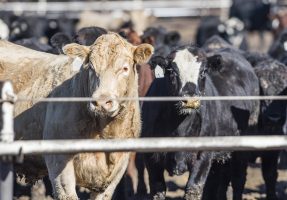
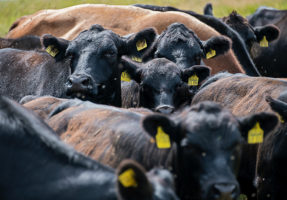
Cattle that perform well in hot climates, such as Brahmas, have light-coloured, thin coats that wouldn’t help them in the cold. Black Angus tolerate the cold, but their coat colour absorbs the heat in summer.

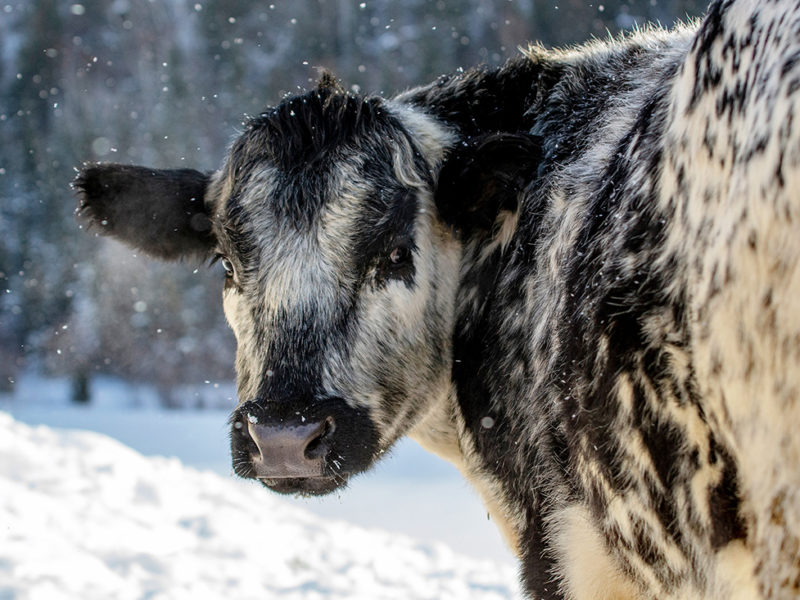
“We started to look at Canadian Speckle Park cattle,” says Church. “It’s a registered Canadian-developed breed that is known for producing well-marbled meat on a variety of forage. They are naturally polled, good calvers and are considered docile.”

But most important for Church, their coats range from black with light speckling, to nearly all white. Church wondered if the white coats would make them better-adapted to heat than Black Angus.

Church’s heat stress studies used a drone-mounted infrared thermal camera to fly over cattle and measure their surface temperature. The drone flew around the animals and sampled a variety of locations on the body.

The results, he says, were “shocking.”

On a 24°C day, Church says the Speckle Park were averaging 31.2°C while the Black Angus were 36.4°C.

“When we did all the stats, it was about a seven-degree Celsius difference between the two breeds of animals,” he says.

That’s due to the albedo effect, Church explains – the phenomenon on light-coloured surface reflecting more solar radiation than a dark surface.

In addition to studying Speckle Park, Church says he is working on his own breed, which he’s dubbed “Church’s Climate Master.” He is experimenting with Senepol, a very heat-tolerant breed from the Bahamas, and crossing them with Red Angus. He’s also looking at back-crossing Japanese Akaushi cattle with the Senepol.

But what does all this mean for bison producers?

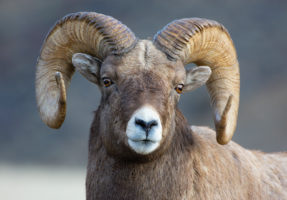
Church notes that bison are naturally adapted to North America’s climate and its changes over the millennia.

“Bison have been in North America at least six million years and they have already survived a six-degree Celsius temperature warming according to archeological records,” he says.

Church wonders if the time is right to revive beefalo breeding, the bison-cattle crosses produced in the 1960s.

“I’ve read all the studies,” says Church. “The idea was you could take cattle and bison and cross them, and the hope was you would get something that was more adapted to the climate and a little easier to handle.”

It was a good idea that flopped, Church says.

“In fact, they got the worst of both,” he says. “They got cattle that were wild as shit to handle, just as bad as bison, and they weren’t very cold-tolerant.”

His recommendation is to boost bison numbers, and see them as a genuine alternative to cattle.

“We could just eat bison and give up cattle if it gets hot,” Church says. “I am convinced they can adapt better than our cows can.”

Some will argue that beef cattle have displaced bison from their rightful place in North America, but he notes that they’ve done more than that. While some estimates put the number of bison at 60-70 million “before we shot them all,” he says there are now about 120 million cows on the continent. It would be very hard to replace that large of a meat source with bison.

“And have you ever tried to milk one?” he asks with a chuckle. “I don’t think so, and that might be a problem.”
Related Posts

You may be interested in these posts from the same category.

Province funds climate readiness

Producers take steps against heat

Province funds weather preparedness

Female ranchers excited for mentorship opportunities

Beef export markets grow

Ranchers watching bluetongue outbreak

Drought puts focus on livestock nutrition

Beef impact bumps up

Canada at “negligible risk” for BSE

Farmer-chef connections still paying off

Producers beef up support for Island cattle

ACARN hosts largest-ever workshop

Previous Post: « Cherry growers see record crop losses in 2019
Next Post: Province signals ALR changes »

Copyright © 2025 Country Life in BC · All Rights Reserved