• Menu
  • Skip to primary navigation
  • Skip to main content
  • Skip to primary sidebar

Country Life In BC Logo

The agricultural news source in British Columbia since 1915

  • Headlines
  • Calendar
  • Subscribe
  • Advertise
  • About
  • Archives
  • Contact
  • Search
  • Headlines
  • Calendar
  • Subscribe
  • Advertise
  • About
  • Archives
  • Contact
  • Search

Primary Sidebar

Originally published:

AUGUST 2020
Vol. 105 Issue 8

Subscribe Now!

Sign up for free weekly FARM NEWS UPDATES

Select list(s) to subscribe to


By submitting this form, you are consenting to receive marketing emails from: Country Life in BC. You can revoke your consent to receive emails at any time by using the SafeUnsubscribe® link, found at the bottom of every email. Emails are serviced by Constant Contact
Your information will not be
shared or sold ever

Stories In This Edition

Master of Vine

Second farm locked down

COVID-19 darkens sales outlook

Initiative takes aim at invasive Asian hornets

Editorial: Relax, rethnk, reset

Back 40: A fire prevention and response plan is crucial

OpEd: Food priorities need to focus on the basics

BC berries face mixed outlook this season

Pandemic puts the squeeze on blueberry growers

U-picks popular as consumers seek outdoor activities

Cosures underscore need for licensing reform

Small-lot farmers  call for greater infrastructure

Ag Briefs: Milk production adjusted to meet demand

Ag Briefs: Former minister of agriculture Ed Conroy dies

Ag Briefs: Paton introduces artisan food bill in legislature

Ag Briefs: Milk board takes out recall insurance

Vancouver Island hazelnut plans focus on growth

Hazelnut replant program enters home stretch

Agrologists unveil new designation

Woodjam Ranch honoured for sustainability

Outlook cautiously optimistic for fall run

Sidebar: Set-aside program easing backlog

Research: Managing crop residue to increase soil health

Inaugural viticulturist of the year chosen

Shuswap couple sees future in elderberries

Research farm grows in the Garden City

New crops could join greenhouse association

Garlic time

Farm Story: Summertime road trips

4-H auctions steer toward online formula

Woodshed: Kenneth takes social distancing up a level

Consumers are responding to transparency

Rain-be-gone

Jude’s Kitchen: Outdoor appies while keeping your distance

More Headlines

Follow us on Facebook

Comments Box SVG iconsUsed for the like, share, comment, and reaction icons

6 days ago

... See MoreSee Less

View Comments
  • Likes: 4
  • Shares: 0
  • Comments: 0

Comment on Facebook

7 days ago

On the last day of the BC Organic Conference, Thursday, Molly Thurston of Pearl Agricultural Consulting helped growers learn how to manage bugs such as codling moth, wireworm, and rootworm in organic growing systems. Her talk alongside Renee Prasad included hands-on activities in which participants checked out various traps and examined pests under microscopes. Be sure to look for more upcoming ag events on our online calendar at www.countrylifeinbc.com/calendar/

#BCAg
... See MoreSee Less

On the last day of the BC Organic Conference, Thursday, Molly Thurston of Pearl Agricultural Consulting helped growers learn how to manage bugs such as codling moth, wireworm, and rootworm in organic growing systems. Her talk alongside Renee Prasad included hands-on activities in which participants checked out various traps and examined pests under microscopes. Be sure to look for more upcoming ag events on our online calendar at www.countrylifeinbc.com/calendar/

#BCAg
View Comments
  • Likes: 15
  • Shares: 0
  • Comments: 0

Comment on Facebook

1 week ago

Well-known organic farmer and podcaster Jordan Marr gets interviewed by Country Life in BC’s own columnist and potato mavin Anna Helmer during the opening session of the BC Organic Conference at Harrison Hot Springs yesterday. Sessions run today (Wednesday) and Thursday and include organic and regenerative growing practices and expanding and advocating for the organic sector, all under the background of the newly launched Organic BC banner.

#BCAg
... See MoreSee Less

Well-known organic farmer and podcaster Jordan Marr gets interviewed by Country Life in BC’s own columnist and potato mavin Anna Helmer during the opening session of the BC Organic Conference at Harrison Hot Springs yesterday. Sessions run today (Wednesday) and Thursday and include organic and regenerative growing practices and expanding and advocating for the organic sector, all under the background of the newly launched Organic BC banner.

#BCAg
View Comments
  • Likes: 37
  • Shares: 2
  • Comments: 1

Comment on Facebook

Interested in finding out more about this

3 weeks ago

Today, we remember those who sacrificed their lives or their well-being for our freedom. Lest we forget. ... See MoreSee Less

Today, we remember those who sacrificed their lives or their well-being for our freedom. Lest we forget.
View Comments
  • Likes: 8
  • Shares: 0
  • Comments: 0

Comment on Facebook

1 month ago

FarmFolk CItyFolk is hosting its biennial BC Seed Gathering in Harrison Hot Springs November 27 and 28. Farmers, gardeners and seed advocates are invited to learn more about seed through topics like growing perennial vegetables for seed, advances in seed breeding for crop resilience, seed production as a whole and much more. David Catzel, BC Seed Security program manager with FF/CF will talk about how the Citizen Seed Trail program is helping advance seed development in BC. Expect newcomers, experts and seed-curious individuals to talk about how seed saving is a necessity for food security. ... See MoreSee Less

Link thumbnail

BC Seed Gathering - FarmFolk CityFolk

farmfolkcityfolk.ca

Save the date for our upcoming 2023 BC Seed Gathering happening this November 3rd and 4th at the Richmond Kwantlen Polytechnic University campus.
View Comments
  • Likes: 1
  • Shares: 0
  • Comments: 0

Comment on Facebook

Subscribe | Advertise

The agricultural news source in British Columbia since 1915
  • Email
  • Facebook

Closures underscore need for licensing reform

Growing demand for local food demands a larger abattoir licensing vision

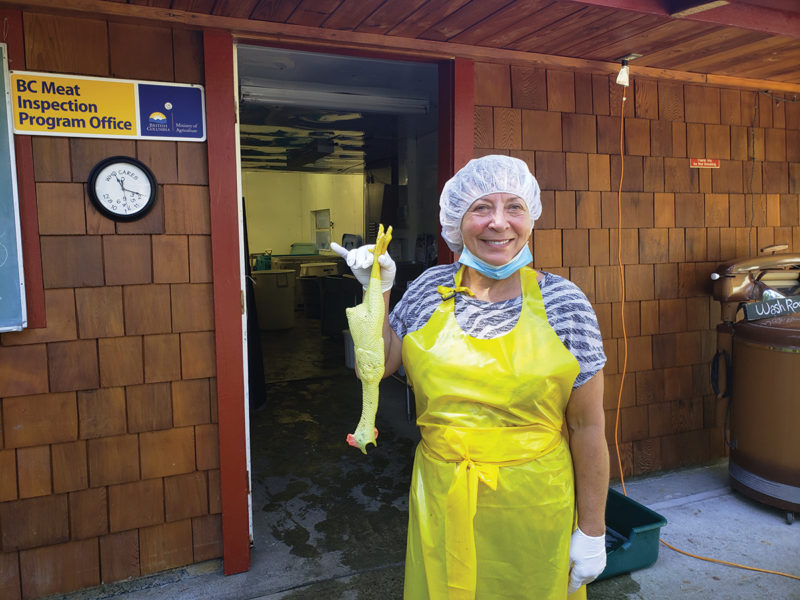
Lori Gillis has processed her final chicken at The Cluck Stops Here, another casualty of abattoir owners not being able to find new owners for their businesses as they reach retirement age. PHOTO / MYRNA STARK LEADER

August 1, 2020 byPeter Mitham

COOMBS – A year ago, Lori Gillis was sounding the alarm about the coming wave of retirements that threatened to drastically reduce meat processing capacity on Vancouver Island. She was 66, and had nearly 23 years’ experience under her belt.

“All the butchers – red and poultry – we’re all in the same sort of age group,” says Gillis, who runs The Cluck Stops Here, a licensed Class A poultry plant in Coombs. “We can’t last forever and no one is coming up behind us.”

She thought she might have another 18 months, or until the end of 2021 at the very latest, but then a long-time employee resigned, citing arthritis. Shortly afterwards, while working her garden, Gillis’ own hands stiffened and refused to cooperate with her.

“My hands can’t do it anymore,” she said. “But the demand is huge.”

Despite growing demand for her services from small-scale producers, which only seems to have increased in the wake of COVID-19 and greater interest in local food, she decided to close. She called the clients she could, and in July was handling the last few birds for the clients she couldn’t reach.

“It’s just tidying up now,” she said.

Al’s Feathers Be Gone in Port Alberni is taking on most of her clients, but Gillis says shops like hers filled an important niche. Her closure follows that of Plecas Meats in Nanaimo this spring, leaving 10 Class A abattoirs on Vancouver Island – five each  for red meat and poultry.

Changing times

Changing times mean the rules need to change to ensure the services of the smaller abattoirs that provided custom slaughter won’t be lost. Gillis says this requires more than an expansion of Class D licences, a move the province made in June to boost processing capacity in the Alberni-Clayoquot Regional District as well as two other areas.

Class D abattoirs are geared to provide fresh meat on a regional basis but lack inspection, which limits distribution to within their home region. This supports local processing but caps the extent to which it can grow. Processors looking to expand need to have inspection services to facilitate access to larger markets, not just within their region.

Moreover, the demand for local slaughter capacity is outstripping the ability of smaller processors to accommodate it. A larger plant, such as Island Farmhouse Poultry in Duncan, has limited capacity to handle custom slaughter.

“The equipment that they use in an industrial plant is very fast,” says Gillis. “[But] it doesn’t hold the home-grown birds, which are much larger. … The little plants are so needed.”

Without a viable solution, she expects underground processing will increase. BC Ministry of Agriculture compliance and enforcement staff have opened 188 files related to the Meat Inspection Regulation since 2014. The files led to 21 illegal operations being shut down and at least six new abattoirs licensed as a result of compliance and enforcement activities.

Gillis herself was an underground operator before licensing in 2010.

“We had no trouble with going into the meat inspection system. It was just a smooth transition; we basically were operating like that anyway,” she says.

Incentives

The threat of fines – a last resort, says the province – and incentives to upgrade plants helped bring many operators into compliance at the time.

“They offered all kinds of government grants to help you switch over. That was a very good incentive – first the fine, and I didn’t want to lose my farm, and then the incentive to upgrade the buildings,” she says.

But now that the new licensing system has become established, it has to adapt to reflect current realities.

Changing times

“Times have changed,” she says. “There’s a whole switch in society in how we’re viewing food and our lives. … There seems to be a huge increase in people growing their own chickens. You could say, in a hard way, the system is archaic.”

One scenario she sees is a closer relationship between farmers and processors. She suggests a processing co-op where growers would contract with an abattoir operator for services. The need for closer relationships throughout the value chain is an idea supported by other industry groups, including the BC Association of Abattoirs.

Gillis also sees the need for training that addresses both the technical aspects of butchering animals, but also animal welfare and consumer concerns.

“We need something better than the D and the E licences,” she says. “[Farmers] will always butcher their meat; regulation is not going to stop them. … There should be a course for them, a certificate, and a yearly meeting.”

But training is in short supply.

Olds College in Alberta offers slaughter courses and occasional workshops focused on slaughter for personal use (the ministry says these are not a concern), but no formal, accredited training program in BC.

A series of workshops hosted by the BC Ministry of Agriculture and BC Breeder and Feeder Association last year focused on animal welfare/humane handling and slaughter hygiene at 10 locations throughout BC.

BC Association of Abattoirs executive director Nova Woodbury was one of the trainers – independent of her association work – and says the association supports training for all members of the slaughter industry

“BCAA is supportive of training of absolutely everybody who is involved with the slaughter of animals,” she says. “The better we are all at it, the better it is for the animals and the consumers.”

She looks forward to provincial training initiatives resuming as the province continues to reopen following the pandemic.

Catching her breath

Gillis, for her part, is taking a break from raising her own birds right now as she catches her breath, but she’s concerned about what awaits her next year. She’ll be just like any other small-lot producer at that point.

“We have the barn, we have the feeders and all that, but I’m going to need a place to take my birds to,” she exclaims. “So I’m quite curious. … It’s going to be interesting because I’m on the other end of the spectrum now.”
Related Posts

You may be interested in these posts from the same category.

Women offer ‘cutting-edge’ skills

New licences, new inspections

Challenges linger for meat plants

Provincial meat licensing overhaul effective October

BC abattoir volume up 30% in 2020

No surprises in Throne speech

Province reveals abattoir changes

SlaughterRight training launched by ag ministry

Rural recovery funds agriculture

New executive director for Small-Scale Meat Producers

Meat producers frustrated by consultations

Abattoir association calls for action

Previous Post: « Inaugural viticulturist of the year chosen
Next Post: Food priorities need to focus on the basics »

Copyright © 2025 Country Life in BC · All Rights Reserved