• Menu
  • Skip to primary navigation
  • Skip to main content
  • Skip to primary sidebar

Country Life In BC Logo

The agricultural news source in British Columbia since 1915

  • Headlines
  • Calendar
  • Subscribe
  • Advertise
  • About
  • Archives
  • Contact
  • Search
  • Headlines
  • Calendar
  • Subscribe
  • Advertise
  • About
  • Archives
  • Contact
  • Search

Primary Sidebar

Originally published:

MAY 2024
Vol. 110 Issue 5

Subscribe Now!

Sign up for free weekly FARM NEWS UPDATES

Loading form…

Your information will not be
shared or sold ever

Stories In This Edition

Livestock oversight to change

Horsepower

Boost in wool prices welcomed

Ag council expands membership

Editorial: Shining a light

Back 40: Perseverance, resilience carry us forward

Viewpoint: Pastured poultry producers face barriers

Federal funding delay stalls berry research

Market time

Strawberry trials face funding challenges

Dairy demand prompts quota increase

Ag Briefs: Provincial funding for UFV lab

Ag Briefs: BC Tree sells packinghouse site

Letters: Speaker, story hits a nerve

BC Veg finds its footing to a bright future

Eastern Filbert Blight threatens to resurface

Delta farmers welcome irrigation study

Tree talk

AgSafe BC celebrates accomplishments

Foreign worker numbers rise

Volunteers remain the backbone of successful fairs

Celebrated leader a force in BC wine sector

Cheap wine poses a threat to VQA label

Beekeepers face a tough year with weather, pests

Sidebar: Tech transfer program steady

Cranberry congress focuses on production

Sidebar: Cranberry organizations staying strong looking to the future

Mobile slaughter trailers rolled out

Chetwynd rancher leaves a lasting legacy

Virtual fencing could be a reality for ranchers

Bullish

Farm Story: Could garlic be less complicated?

Hopper management starts early this year

Sidebar: Peace braces for grasshoppers

Woodshed: The slugfest may be over but …

Plowing ahead

Jude’s Kitchen: Retro food for a ‘vintage’ Mom on her day

More Headlines

Follow us on Facebook

Comments Box SVG iconsUsed for the like, share, comment, and reaction icons

2 hours ago

The Agricultural Land Commission is laying off staff after years of flat funding under the BC NDP. ALC chair Jennifer Dyson warns that application volumes, enforcement activity and legal obligations have all risen while its operating budget has stayed effectively flat — meaning longer wait times ahead for some services.

#BCAg
... See MoreSee Less

Link thumbnail

Land Commission lays off staff

www.countrylifeinbc.com

With no budget increase this year, the Agricultural Land Commission (ALC) is laying off six staff to make ends meet. “Ongoing financial constraints and the requirement to operate within the approved...
View Comments
  • Likes: 0
  • Shares: 1
  • Comments: 0

Comment on Facebook

6 days ago

A BC Forest Practices Board investigation has found overgrazing has damaged grasslands in the Coutlee Range Unit near Merritt — and the range-use plan meant to prevent it was unenforceable. With complaints about overgrazing on the rise and grasslands covering just 1% of BC's land mass, the findings raise fresh questions about how the province manages one of its most vulnerable — and valuable — food-producing ecosyste#BCAg#BCAg ... See MoreSee Less

Link thumbnail

Board finds overgrazing rules unenforceable unmeasurable

www.countrylifeinbc.com

MERRITT – A BC Forest Practices Board investigation has found instances of non-compliance related to overgrazing have damaged open grasslands in the Mine pasture, part of the Coutlee Range Unit near...
View Comments
  • Likes: 6
  • Shares: 6
  • Comments: 6

Comment on Facebook

Several ranchers in recent years have gone into temporary non use on that range , so that means the grass should grow. But drought conditions/lack of rain and snow don’t allow that to happen . Dried up springs , creeks waterholes in various pastures add to over grazing where there is water , as livestock and everything else stay close to the water source . So even though less cattle are on it , over grazing appears. There is a large volume of horses on it 365 days/year which is wrong ! They pull grass right out of the ground when it’s just trying to grow ,, opens the door for weeds to grow in. That don’t help it. Aging infrastructure ( fences) laying on the ground, pipe line building , ( lack of commitment to fence maintenance) amongst all users contributes also to over grazing. Recreational atv users leaving gates open between pastures allows livestock to go back or ahead in pastures also expidites over grazing. Logging ( bcts) has no problem laying out cut locks on both sides of a fence , then it gets smashed down during logging and they don’t take responsibility to stand it back up or clean the cattle gaurds out when they are done , that happened 4 years ago on pasture 5 up there . I bet it is still not fixed . There are lots of contributing factors to the problem.

Tragedy of the commons.

I looked through the report. I saw nothing about the effects of noxious weeds on productive grasslands. This particular area is vulnerable because of the Ministry’a efforts to diversify the use of the Grasslands.

This pasture is under tremendous pressure not only from cattle but from irresponsible local residents who treat it as a landfill dumping all manner of household debris here. And don't even get me started on the mud bogging and camping in sensitive riparian areas. The feral horses are in this pasture 365 days a year just hammering it. Would sure be nice to see some enforcement action on people who are intentionally ripping up the grasslands and riparian areas. Cattle could be a valuable resource for rebuilding soils and native grasses in this area with the help of electric fencing and/or e-collars. The humans will be harder to manage.

The Forest and Range Practices Act was written by lawyers for global forest licencee shareholders. Results-based = unenforceable.

Also, can we talk about the impact of a pipeline being built through the middle of this field for multiple years?

View more comments

1 week ago

East Kootenay rancher Randy Reay is digging a new well after two natural water sources dried up on his Crown tenures. A new Living Lakes Canada assessment found 15% of mapped aquifers in the region are high-priority for monitoring, yet 80% of those go unmonitored. With over 48% of BC's provincial observation wells reporting below-normal groundwater levels, ranchers and researchers are sounding the alarm on water security. The story is in our March edition, and we've posted it to our website thi#BCAgk.

#BCAg
... See MoreSee Less

Link thumbnail

Water woes: groundwater under pressure across BC

www.countrylifeinbc.com

JAFFRAY – As a young boy growing up in the Kootenay-Boundary region, Randy Reay never expected to run out of water. But this year, in mid-February, his fields are bare. There is no snow halfway up t...
View Comments
  • Likes: 8
  • Shares: 7
  • Comments: 1

Comment on Facebook

Jaffrey is in the east Kootenays not kooteney boundary

2 weeks ago

BC farmers are bracing for prolonged higher input costs as war in the Middle East drives up fuel and fertilizer prices. Nitrogen fertilizer costs were already climbing before the Iran conflict began, with prices still roughly 60% above pre-pandemic levels. Farm Credit Canada warns that unlike 2022, strong commodity prices may not offset rising costs this time. Local suppliers expect supply challenges and further price increases ahead.

#BCAg
... See MoreSee Less

Link thumbnail

Fertilizer prices on the rise

www.countrylifeinbc.com

War in the Middle East has delivered a generational shock to energy prices, meaning BC farmers can expect a prolonged period of higher costs not just for fuel but also for fertilizer.
View Comments
  • Likes: 2
  • Shares: 1
  • Comments: 0

Comment on Facebook

2 weeks ago

... See MoreSee Less

View Comments
  • Likes: 1
  • Shares: 0
  • Comments: 0

Comment on Facebook

Subscribe | Advertise

The agricultural news source in British Columbia since 1915
  • Email
  • Facebook

Dairy demand prompts quota increase

Province funds new Abbotsford plant to grow production

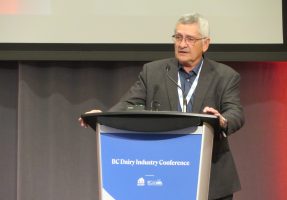
There’s finally some good news for BC dairy producers as processing capacity is set to rise. MYRNA STARK LEADER

May 1, 2024 byPeter Mitham

ABBOTSFORD – Dairy processing capacity is on the rise in Western Canada, and BC dairy producers have received an extra 3% quota to keep pace with demand.

The increase approved February 1 has leveled out quota issuance to each of the four provinces in the Western Milk Pool at approximately 101%.

“In previous years, we haven’t had the processing, so we haven’t been able to allocate all of our quota,” Jeremy Wiebe, executive treasurer with the BC Milk Marketing Board, told producers attending their spring meeting online on April 12. “But we have got some processing online in the past year so we have been able to allocate to 100% now, and in some provinces right up to 101%.”

BC is one of two provinces at 101%, thanks in part to the expansion of milk processing capacity in the province.

“We’ve been hearing really positive feedback from the processors on what’s taken place in the Western Milk Pool,” says Wiebe. “I’ve been on the milk board for 10 years, and I can honestly say I’ve never been as positive about processor expansion in the West as I am right now.”

Saputo’s consolidation of its BC operations in a $240 million state-of-the art milk plant in Port Coquitlam three years ago as well as the plans Surrey’s Punjab Milk Foods Inc. announced last fall to consolidate its four locations in a 296,000-square-foot plant producing a variety of South Asian dairy products are both signs of the confidence.

And there’s more to come, with Vitalus Nutrition Inc. building a plant to process 500 million litres in Abbotsford. Colloquially known as the P500 project and backed with $25 million in provincial funding, it’s set to be operational by fall 2026.

“It’s a big deal for the West. It’s going to result in a lot of quota growth for farmers,” Wiebe says.

Production will need to increase 17% across the Western Milk Pool, starting with a 5% increase in the 12 months prior to completion followed by 4.5% in the first year of operation.

“We’re going to have to have a lot of increased production to supply this plant,” says Wiebe. “It’s complicated, and it probably won’t all be issued as quota. We might have to change a little bit of the ratio on how we pay for our milk to get more litres of milk and some more protein for the plant.”

Written agreements are falling into place, but Wiebe cautions that delays are possible.

The plant has faced significant hurdles to date, with permission required from the Agricultural Land Commission as well as consultation with local Indigenous groups before construction began.

“There have been a lot of delays already, and they were unforeseen, and there may be more unforeseen delays,” Wiebe says.

Greater production volume means greater revenue for producers, who continue to grapple with the high cost of producing those volumes.

BC Milk vice-chair Tom Hoogendoorn said a 1.77% increase to the farmgate price of milk that kicked in May 1 is good news, and follows on a 22% increase over the past five years.

The average WMP price has been 99 cents per litre for the last several months and is currently around $22 per kg of butterfat.

“Farmers receive a pretty good price right now with an increase over the last two years, quite a big increase, and another expected May 1,” he told the meeting. “I know everybody doesn’t like the price; they want more, but this is what it is, and it’s quite strong, actually.”

Despite “very concerning” declines in fluid milk consumption overall, specialty products like ultrafiltered and lactose-free milk, as well as yogurt have seen strong growth.

“The demand is quite strong; the growth over time is very strong,” Hoogendoorn said. “A real growth market right now is the ultrafiltered milk, like Fairlife. Extremely high growth, and lactose-free is up 10% year over year.”

Related Posts

You may be interested in these posts from the same category.

Greater interest in dairy

Comeau reappointed to milk board

Milk board undertakes review

Collaboration key to dairy growth

Demand for milk, lower input costs good for dairy

Dairy quota rules change

Dairy quota increases

BC Milk caught out

BC FIRB challenges WMP plans

Province funds Vitalus plant expansion

Non-foaming milk continues

Ben Janzen recognized for service

Previous Post: « BCFGA holds pre-election rally
Next Post: Chetwynd rancher leaves a lasting legacy in the organic sector »

Copyright © 2026 Country Life in BC · All Rights Reserved