• Menu
  • Skip to primary navigation
  • Skip to main content
  • Skip to primary sidebar

Country Life In BC Logo

The agricultural news source in British Columbia since 1915

  • Headlines
  • Calendar
  • Subscribe
  • Advertise
  • About
  • Archives
  • Contact
  • Search
  • Headlines
  • Calendar
  • Subscribe
  • Advertise
  • About
  • Archives
  • Contact
  • Search

Primary Sidebar

Originally published:

June 2018
Vol. 104 Issue 6

Subscribe Now!

Sign up for free weekly FARM NEWS UPDATES

Loading form…

Your information will not be
shared or sold ever

Stories In This Edition

A Taste of Spring

Flooding wallops southern interior

Ottawa wires CAP cash

Minimum wage hike squeezes farm margins

Editorial: The new democracy

Back Forty: Horgan on receiving end of pipeline challenge

Viewpoint: BC has led country in national check-off support

New chair appointed to land commission

Richmond expands farmhouse provisions

Demand for land drives farmland values higher

Biosolids raise a stink with neighbours

Rising wine sales boost demand for red grapes

Game-changer on dividend splitting

Mushroom merger

Wildfire, flood review has First Nations focus

Sidebar: Snapshot of recommendations

Labour tops issues as hothouse growers meet

Growers on look-out for activists

Antimicrobial lockdown

Ag briefs: Island farmers on lookout for armyworm

Ag briefs: AgSafe elects new chair

Ag briefs: No flood of licences

Ag briefs: Direct delivery

Hops revival gains traction with feds

Wildfire top concern of grape growers

Sidebar: Preparing for fires in the Okanagan

Nuffield scholars

Two studies promise to ensure slaughter capacity

Sidebar: Consultation schedule

Oversight sought

Bumper crop of invasive weeds after wildfires

Elk sights have producers concerned

Guichon heads back to life on the ranch

Research: Grazing cattle the sustainable way

Farmers markets focus on cultivating trust

Veggie days open house

Co-ops offer values-based alternatives

Region focuses on boosting local food usage

Bonus coupon

Growing opportunity

Garden City project breaks sustainable ground

Weevils pose challenges

Protecting pollinators key for crop yields

Wannabe: Keeping up with the times

Young farmers turn on, tune in and download

Woodshed: Kenneth has another go at the Massey

4-H BC thanks partners for their support

Jude’s Kitchen: Co-op food


More Headlines

Follow us on Facebook

Comments Box SVG iconsUsed for the like, share, comment, and reaction icons

8 hours ago

There is SOME good news among all the otherwise dire economic outlooks being floated this year. An annual survey of capital expenditures in agriculture by StatsCan says projected investments in construction and machinery will trend upwards this year. We've crunched some numbers in this week's Farm News Update from Country Life#BCAgC.

#BCAg
... See MoreSee Less

Link thumbnail

Capital spending to rise

www.countrylifeinbc.com

BC livestock producers are poised for record capital spending this year, according to Statistics Canada. Results of Statscan’s annual survey of capital expenditures, released February 25…
View Comments
  • Likes: 0
  • Shares: 0
  • Comments: 0

Comment on Facebook

1 day ago

A family farm on Seabird Island is proving grain can thrive in the Fraser Valley — if you choose the right varieties. Cedar Isle Farm grows three heritage and locally adapted winter wheats, rotating them with organic forages to manage weeds and weather. Three generations in, they're still evolving. Read how diversification keeps this mixed organic operation resilien#BCAg#BCAg ... See MoreSee Less

Link thumbnail

Farm finds resilience going with the grain

www.countrylifeinbc.com

AGASSIZ – A family-run mixed organic farm on Seabird Island highlights the potential for grain and other crops in the Fraser Valley, and the importance of diversification to long-term resilience.
View Comments
  • Likes: 5
  • Shares: 0
  • Comments: 0

Comment on Facebook

1 day ago

At the 137th annual BC Fruit Growers Association AGM yesterday in Kelowna, sitting vice president Deep Brar was elected president, defeating his only competitor for the role, Kelly Wander. Avi Gill became VP. He was the only candidate. Long-time president Peter Simonsen looked on from the podium as the 2026 board of directors offered congratulations to one another prior to having a group picture taken.

#BCAg
... See MoreSee Less

At the 137th annual BC Fruit Growers Association AGM yesterday in Kelowna, sitting vice president Deep Brar was elected president, defeating his only competitor for the role, Kelly Wander. Avi Gill became VP. He was the only candidate. Long-time president Peter Simonsen looked on from the podium as the 2026 board of directors offered congratulations to one another prior to having a group picture taken.

#BCAg
View Comments
  • Likes: 6
  • Shares: 1
  • Comments: 0

Comment on Facebook

2 days ago

Today is a busy day in BC agriculture. The BC Egg conference is underway in Vancouver. Fruit growers are meeting in Kelowna for the BC Fruit Growers AGM. Grain producers up in the Peace are meeting for Below Ground 2026, billed as a "farmer-first" look at soil health. BC Blueberry Council, the Raspberry Industry Development Council and BC Strawberry Growers Association are hosting the 8th annual BC Berries Research Review online today and tomorrow, and ... the University of the Fraser Valley in Chilliwack is hosting an open house for students considering post-secondary studies in agriculture. All this and more is on our online calendar.

#BCAg
... See MoreSee Less

Link thumbnail

Calendar

www.countrylifeinbc.com

View Comments
  • Likes: 4
  • Shares: 0
  • Comments: 0

Comment on Facebook

3 days ago

Berryhill Foods Inc. is expanding into fresh berries by acquiring Driediger Farms' main Langley processing plant and 78-acre property for $23.3 million. The frozen berry processor will operate the farm and build on the Driediger legacy. Rhonda Driediger, whose family has farmed the property since 1959, will support the new owners during the first year before pursuing other ventur#BCAg#BCAg ... See MoreSee Less

Berryhill Foods Inc. is expanding into fresh berries by acquiring Driediger Farms main Langley processing plant and 78-acre property for $23.3 million. The frozen berry processor will operate the farm and build on the Driediger legacy. Rhonda Driediger, whose family has farmed the property since 1959, will support the new owners during the first year before pursuing other ventures.

#BCAg
View Comments
  • Likes: 139
  • Shares: 8
  • Comments: 14

Comment on Facebook

Congratulations Berryhill Foods!!!

Good to hear👏

Awesome business move!

Congratulations!

Will it be Canadian owned?

Great job Berryhill Foods!

Good job

Does that mean fresh strawberries this year? Dredigers are the best.

Oh thank goodness. They are the absolute BEST berries!

I sure hope they do.

Congratulations !

Congratulations to all parties involved! It was pleasure brokering the deal with Greg Walton & BC Farm & Ranch Realty Corp.

No more strawberries ?

Congratulations Tom and sons🥰

View more comments

Subscribe | Advertise

The agricultural news source in British Columbia since 1915
  • Email
  • Facebook

Elk sightings have producers concerned

Elk haven’t been seen on Gulf Islands in nearly five decades

June 1, 2018 //  by Cathy

PENDER ISLAND – Residents of the Southern Gulf Islands are sharing photos of newly arrived Roosevelt elk in the last few weeks on social media, creating quite a stir after an absence of decades.

Translocation of elk from areas of high population to low population have been part of the provincial government’s elk management plan for the past 40 years. Appearing to be more of an unintended consequence of the program rather than an intentional relocation, the appearance of the elk in the southern-most archipelago of islands in the Strait of Georgia took everyone by surprise. Prevost, Salt Spring, Mayne, Pender and Saturna Islands all have experienced sightings of roaming elk this spring.

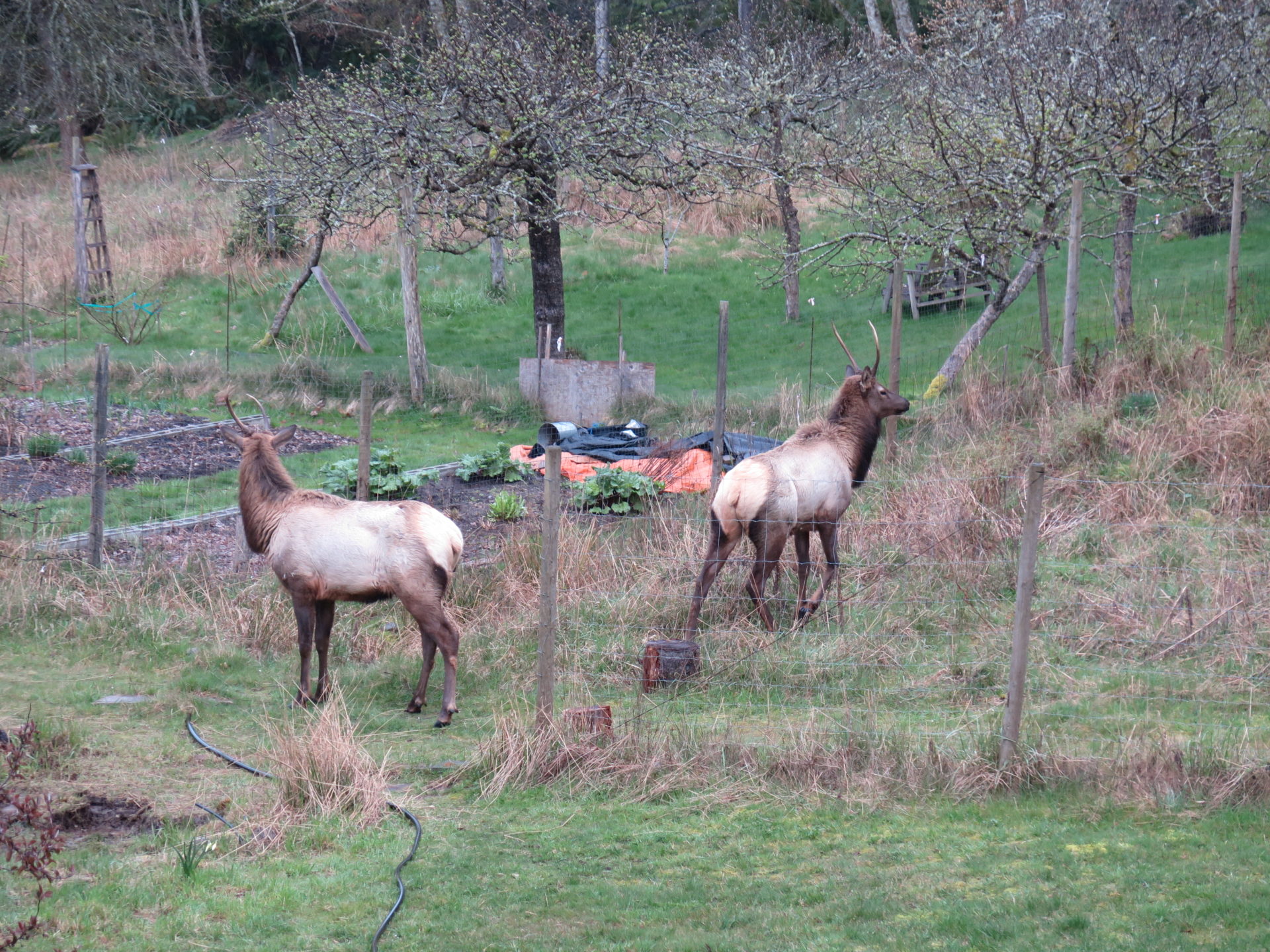
Sightings were confirmed by conservation officers and Parks Canada biologists as reports and photographs came in. Richard Lamy, superintendent of Gulf Islands National Park Reserve, said the male, sub-adults are likely siblings and the two photographed on Salt Spring in April are probably the same two photographed on Saturna Island in May.

Elk have not been seen on Salt Spring since the 60s, according to sheep producer Ted Ackerman.

“I saw a single male in the mid-1950s; another male about 10 years later.”

Many are happy to see the return of the majestic elk. Farmers see it differently.

Destructive

Roosevelt elk have caused extensive damage to farms on Vancouver Island.

“We don’t need elk on agricultural land,” says Tanya Vanden Dungen, who with a few family members milk 165 Holstein cows on their farm south of Duncan which has been operating since 1977.

“The elk showed up 15 years ago – first, one bull, then three, increasing to 44 elk in the field this winter. Just last week we saw 15. They knock down fences, trample newly seeded pasture and four years ago, they ate all the corn.”

Elk are clever. Herds are led throughout the season by a lead cow. In many agricultural areas, settlements are too close together to use rifles. Bow and arrow creates a hide and seek game for the elk; they spot the hunters, then hide in the woods until dark.

Oliver Balme of Cobble Hill has seen a steady increase in the elk population over the last ten years. Balme Ayr Farms was started by Oliver’s father John in 1961. With his wife Shelley, Oliver farms 200 owned and 180 leased acres, with 280 Ayrshires fed and 125 cows milked.

“At present, it is not uncommon to witness a herd of 60 or more come through the farm,” says Balme.

The Balmes grow grass forage and 30 acres of feed corn.

“In the last three years, we have had to put up temporary fencing around the corn to stop the elk from decimating the crop. This has evolved into six strands of electric over six feet high, on as high a voltage as we could purchase.”

Both the Vanden Dungens and the Balmes claim that government estimates of the elk population are too low, as their two farms alone exceed the government count. They are concerned that the government numbers are used to decide on the limited entry draw for hunting elk, as well as culling and herd management.

“Our farm and others cannot sustain a herd of wild life that is nearly as big as the milking herds,” says Balme. “Farmers are having to purchase feed to supplement their feed supply because of elk, bear and migratory bird damage. There is damage done to the land and grass by elk herds coming into the fields in the winter [and] major damage to fencing as elk tend to run into the fencing and rip it out. For government decisions being made that do not address this situation realistically is very discouraging to farmers and food producers.”

Province-wide issue

BC Cattlemen’s Association general manager Kevin Boon says the elk problem is growing throughout the province.

“There are transplant issues for certain,” says Boon. “Once they habituate to an area, the problems increase. They not only eat the crops, they defecate and cause damage with their antlers.”

Boon has had conversations with the BC Ministry of Agriculture regarding wildlife management and is on a stakeholder committee that will meet soon. The government has budgeted $14 million for wildlife management and habitat protection. Seeing the impacts from last year’s wildfires, Boon recognizes it is an “ever-changing landscape.”

“The Agriculture Wildlife Program (AWP) is helpful; it compensates for crop losses but never covers full value,” says Boon, something the Vanden Dungens and Balmes agree with.

Graeme Fowler, the ministry’s AWP representative on Vancouver Island, says there are currently 120 clients on the AWP compensation program covering over 10,000 acres of crops on the island.  Damage to harvested and unharvested crops by a range of wildlife (bison, bear, cranes, deer, elk, moose, mountain sheep and waterfowl) are covered throughout the province. Besides compensation, there are also limited funds for mitigation to lessen wildlife impacts over the long term.

“AWP is available to all bonafide farmers who suffer wildlife damage to standing forage to feed livestock,” says Fowler.

The mitigation budget is $300,000 for the entire province. The budget covers up to 50% of wildlife fencing costs. On Vancouver Island, farmers can enroll their lure crops for reimbursement –  $75 per acre for cover crops planted specifically for wildlife use). Applicants must be AWP clients with a history of compensation so the merits of mitigation can be weighed against the cost of compensation claims.

“There isn’t much that farmers can do for mitigation of elk other than call the conservation officer, First Nation hunters, or put up fences (temporary or permanent electric or page wire),” admits Fowler.

Fowler moved to Vancouver Island in 1990 and became involved in waterfowl management with Ducks Unlimited and Environment Canada, initially with the Trumpeter Swan project. He also farms, raising cattle, poultry and forage. He spoke to a packed room at the Islands Agriculture Show earlier this year about the agriculture wildlife compensation program as well as mitigation options for wildlife damage on agricultural land.

John Ferris of Ferris Fencing spoke to the same crowd, describing fencing systems that work through his experience in the field. A former deer farmer, he now specializes in fencing wild ungulates out, rather than keeping them in.

“The average farmer is a game farmer by feeding the wildlife,” says Ferris, indicating that it is important to educate the wildlife to electrified fences and educate the farmer in the proper use of electric fencing.

As for the Southern Gulf Islands elk, it isn’t known if the elk will stay or continue island-hopping back to Vancouver Island.

The province’s elk management plan released in September 2015 states the estimated carrying capacity for elk in the southern Gulf Islands is zero, due to “excessive human development and/or agricultural activity, precluding suitability of the area for elk population.”

“A goal of the 2015 Elk Management Plan is the mitigation of damage on agricultural lands, something not mentioned in earlier plans,” says Fowler. “A big misconception is that the more wildlife, the more damage. There is an intricate recipe of soils, moisture, drainage, duration of stay and concentration of animals – a web of factors that make it hard to generalize. Each farm is different. As wildlife become habituated to the areas, they stay longer and cause greater damage.”


Related Posts

You may be interested in these posts from the same category.

Producers at a loss with elk damages

Ranchers plead with province to address elk issue

Previous Post: « New chair appointed to land commission
Next Post: Perseverance, ingenuity aid haskap harvest »

Copyright © 2026 Country Life in BC · All Rights Reserved