• Menu
  • Skip to primary navigation
  • Skip to main content
  • Skip to primary sidebar

Country Life In BC Logo

The agricultural news source in British Columbia since 1915

  • Headlines
  • Calendar
  • Subscribe
  • Advertise
  • About
  • Archives
  • Contact
  • Search
  • Headlines
  • Calendar
  • Subscribe
  • Advertise
  • About
  • Archives
  • Contact
  • Search

Primary Sidebar

Originally published:

APRIL 2023
Vol. 109 Issue 4

Subscribe Now!

Sign up for free weekly FARM NEWS UPDATES

Loading form…

Your information will not be
shared or sold ever

Stories In This Edition

Back to business
$200 million draws fire
Farmland values ease
Delta farmland gets new lease on life
Editorial: Genuine connection
Back 40: Different worldviews, common ground
Viewpoint: Unlocking an unsustainable trajectory
Crossroads ahead for BC farmland
Ag industry hub sparks regional interest in OK
Show offs
Ag Briefs: New “underused” home tax has a wide impact
Ag Briefs: Richard Ranch hosts bull sale
Ag Briefs: Canadian Foodgrains Bank supproted
Ag Briefs: Poultry leaders recognized
Province steps up surveillance after sting operation
Watershed strategy coulg hang ag out to dry
Flood victims struggle with recovery deadline
Sidebar: Disaster Financial Assistance funds inconsequential for producers
Rising ferry fares sink producer profits
Sidebar: Ferry traffic another hurdle for island producers
Fruit growers keep calm, carry on at convention
Signs of spring
Producers at a loss with elk damages
New AI insights shared at poultry conference
Birds of a feather
Sidebar: Vaccination under discussion
Potato growers buoyed by strong markets
Rising cost of dairy production drives agenda
Export markets focus of upbeat cherry meeting
Sidebar: Provincial survey tracks spread of Little Cherry Disease
Cranberry crop dips in 2022 but growers optimistic
New rules for pesticide applications
Sidebar: Spraying tips
Rodenticide restrictions now permanent
Homemade food rules are too restrictive
Sunflowers are multi-purpose helpers
Boosting value with great apples
Farm Story: Heavy lifting not a retirement plan
New soil assessment tool in development
Woodshed Chronicless: Just when things start going right, stuff happens
BC breeder wins national Jersey award
Jude’s Kitchen: Celebratory foods for friends and family

All content on this website is copyrighted, and cannot be republished or reproduced without permission.
More Headlines

Follow us on Facebook

Comments Box SVG iconsUsed for the like, share, comment, and reaction icons

11 hours ago

A draft update to the Code of Practice for the Care and Handling of Beef Cattle is now open for public comment until June 12. The code, one of 14 animal care codes developed and maintained by the National Farm Animal Care Council, is undergoing a routine 10-year review. "Your feedback will help shape the industry's guide to cattle welfare for the next decade," says Canadian Cattle Association policy manager Jessica Radau, urging producers to weigh in. For more information, visit tinyurl.com/58a3u9fz.

#BCAg
... See MoreSee Less

A draft update to the Code of Practice for the Care and Handling of Beef Cattle is now open for public comment until June 12. The code, one of 14 animal care codes developed and maintained by the National Farm Animal Care Council, is undergoing a routine 10-year review.  Your feedback will help shape the industrys guide to cattle welfare for the next decade, says Canadian Cattle Association policy manager Jessica Radau, urging producers to weigh in. For more information, visit https://tinyurl.com/58a3u9fz.

#BCAg
View Comments
  • Likes: 2
  • Shares: 0
  • Comments: 1

Comment on Facebook

I sat in the webinar yesterday by the Canadian Cattle Association. My initial concern was that this would be another "play" into the government's hands. It has been worked on by people that are actually in the Beef industry from Cow calf to feedlot. The thrust is an update of the 2013 Code of Practice which was reviewed in 2018. The changes are more a move from "left to the producers discretion" to clearer directions regarding pain management, proper transport of animals which are impaired and keeping cattle in in good condition. Much of what is recommended is what producers who care about animal husbandry already do. The important part is to GIVE THEM FEEDBACK good, bad or otherwise. The document is about 60 pages long, and I ran it through CHAT to see what had been changed. It is important to understand that the PUBLIC is invited to comment on the draft not just producers. Think about it... do you really want the public influencing how you manage your cattle. If you think that this is just one of those things, I have been following Bill 22 in Alberta which will grant the SPCA a proactive roll in entering farms and checking on animals. When I asked CHAT how the new bill relates to the Cattle Code, it came back that the Code although not a regulation will be able to be used as a guide by producers for backup in dealing with the SPCA regarding cattle conditions, sick animal handling etc. Take the time.... Go onto the Canadian Cattle Association website and speak to those parts that you wish to input.

1 day ago

According to the BC River Forecast Centre, the Okanagan snowpack stood at just 58% of normal on April 1 — the lowest reading since measurements began in 1980 — raising concerns about drought conditions in the region this summer. The rest of the province sits at 92% of normal.

#BCAg
... See MoreSee Less

According to the BC River Forecast Centre, the Okanagan snowpack stood at just 58% of normal on April 1 — the lowest reading since measurements began in 1980 — raising concerns about drought conditions in the region this summer. The rest of the province sits at 92% of normal.

#BCAg
View Comments
  • Likes: 3
  • Shares: 0
  • Comments: 0

Comment on Facebook

2 days ago

At her first AGM as executive director of BC Meats, held Saturday in Abbotsford, Jennifer Busmann spoke about her strong ties to agriculture and her optimism for the organization's future. Busmann has cattle of her own and came to the role with existing relationships with members and the board of directors that helped her feel integrated from the start. She stepped into the position in Februa#BCAg#BCAg ... See MoreSee Less

At her first AGM as executive director of BC Meats, held Saturday in Abbotsford, Jennifer Busmann spoke about her strong ties to agriculture and her optimism for the organizations future. Busmann has cattle of her own and came to the role with existing relationships with members and the board of directors that helped her feel integrated from the start. She stepped into the position in February.

#BCAg
View Comments
  • Likes: 6
  • Shares: 0
  • Comments: 0

Comment on Facebook

4 days ago

Shannon Wiggins of Headwind Farm in North Saanich is this year's Mary Forstbauer Grant recipient from the BC Association of Farmers Markets. The $500 grant will help Wiggins expand her plot at Sandown Centre for Regenerative Agriculture, growing more storage crops to extend her harvest season. Wiggins credits farmers markets with inspiring her own farming journey and commitment to building community through food. Congratulations!

tinyurl.com/45bdd#BCAg#BCAg
... See MoreSee Less

Shannon Wiggins of Headwind Farm in North Saanich is this years Mary Forstbauer Grant recipient from the BC Association of Farmers Markets. The $500 grant will help Wiggins expand her plot at Sandown Centre for Regenerative Agriculture, growing more storage crops to extend her harvest season. Wiggins credits farmers markets with inspiring her own farming journey and commitment to building community through food. Congratulations!

https://tinyurl.com/45bddtw8

#BCAg
View Comments
  • Likes: 46
  • Shares: 2
  • Comments: 3

Comment on Facebook

Wahoo! Congrats Shannon! I love your produce. Can’t wait for the radishes 🫜

Congratulations!

Well done!! 🩷🩷🩷

6 days ago

New farmers can avoid costly mistakes by learning from those who've been there. At a Young Agrarians mixer in Penticton, five BC farmers shared hard-won lessons on pricing, pivoting, relationships and burnout. From coyote losses to business burnout, their message was clear: set prices that reflect true costs, make decisions quickly and don't let farming define your worth. Myrna Stark Leader's story appears in our April e-edition, now available to view online at: tinyurl#BCAg2uw53vvm

#BCAg
... See MoreSee Less

New farmers can avoid costly mistakes by learning from those whove been there. At a Young Agrarians mixer in Penticton, five BC farmers shared hard-won lessons on pricing, pivoting, relationships and burnout. From coyote losses to business burnout, their message was clear: set prices that reflect true costs, make decisions quickly and dont let farming define your worth. Myrna Stark Leaders story appears in our April e-edition, now available to view online at: https://tinyurl.com/2uw53vvm

#BCAg
View Comments
  • Likes: 15
  • Shares: 0
  • Comments: 0

Comment on Facebook

Subscribe | Advertise

The agricultural news source in British Columbia since 1915
  • Email
  • Facebook

Producers at a loss with elk damages

Government needs to step up, farmers say

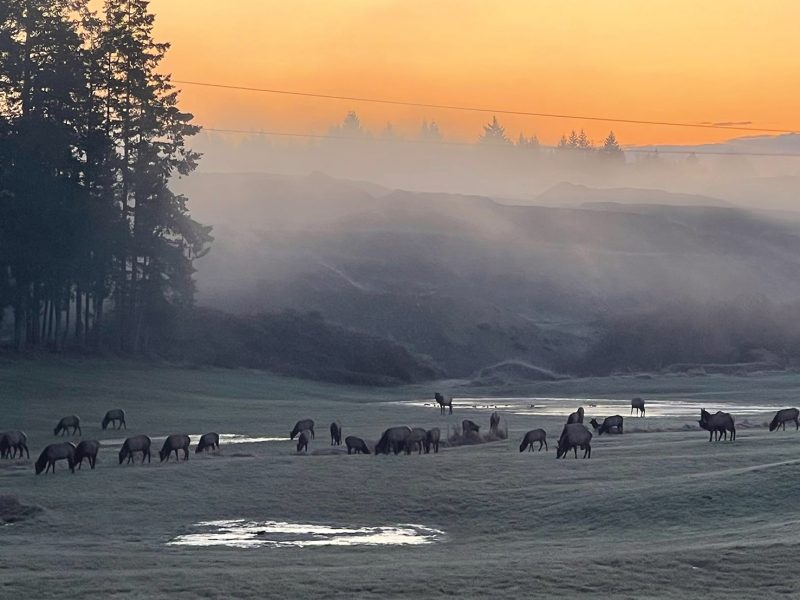
A herd of protected Roosevelt elk have moved onto Ken Ellison’s Dellison Farm in Duncan, and show no sign of leaving. SUBMITTED

April 1, 2023 byKate Ayers

LADYSMITH – Elk continue to damage farm infrastructure and government compensation is not enough, producers say. They want long-term solutions that balance land and species protection.

“The grass that should be starting to grow, getting ready for crops come June, is chewed right down to half an inch on the ground. So, they’ve devoured all that,” says Misty Valley Farm owner Howie Davis of Ladysmith.

Davis runs 150 cattle on 180 acres and four years ago had about a dozen elk on his land. Last month, he counted 42 animals that have remained on his property since December. The herd have put holes in his pastureland and run through sections of fencing.

When he calls the province to report the damage to his property, staff offer compensation through the Agriculture Wildlife Program.

“I’d like to see people that are responsible for them to keep their elk off my property the same as I have to keep my cattle off other people’s property. But they don’t do anything,” Davis says. “They’ll throw more money at it but that isn’t what solves it. It’s terrible. They just don’t seem to care at all.”

While the compensation is a start, he says the amount is not enough to cover all the losses caused by the elk.

“It’s not nearly what it costs for me to go ahead and repair my fences and try to do something with my ground after they’ve chewed it all up,” Davis says. “[Annual repairs] are not what I want to do with my land. I want to grow hay and feed my cattle.”

In 1998, the Roosevelt elk was added to the list of species of special concern in BC. But since then, the elk population has nearly doubled, rising from 3,800 in 2001 to an estimated 7,000 last year. Of these, the BC Wildlife Federation estimates about 4,500 live on Vancouver Island. The remainder are concentrated in the mainland’s southwest.

The elk’s protected status means farmers cannot legally take matters into their own hands.

“The Wildlife Act doesn’t authorize the owner of agricultural property to destroy wildlife that is damaging or eating crops,” online guidance from the province states. “If there is a lawful hunting season open at the time and in the location that the crop damage is taking place, there is the option of contacting the local rod and gun club to arrange for hunters to come and harvest the conflict animals.”

While there is not an open season for elk during the year, outfitters can obtain permits to shoot bulls, Davis says. Each year, resident hunters submit over 15,000 applications for approximately 300 permits in a lottery system.

“If you shoot a bull you got rid of one elk, but the cows are the ones that are producing. The herd that’s out here, there are five bulls, so you can figure that out,” he says.

Davis would like to see a designated hunting season to thin the herds.

Misty Valley Farm sits about as far north as the elk will go on Vancouver Island, Davis says, but the problem persists in the Duncan and Mill Bay areas, too. Davis fears the herd will continue to grow, expanding its range and the number of affected farms.

The Vancouver Island Cattlemen’s Association hosted the BC Forage Council on March 9 for an advanced grazing workshop, where the issue arose in discussion. Producers noted that they cannot use rotational grazing and best management practices or enroll in provincial grazing programs if they have lost all their grass to elk. It was apparent to Davis and Dellison Farm owner and VICA vice-president Ken Ellison of Duncan that producers are at a loss for viable long-term solutions.

“I talked to a couple of different people just today. They’ve put up fencing and different fence types,” Davis says. “There’s just nothing they’ve been able to do to keep them out permanently. A couple of them have just thrown up their hands. They don’t know what to do.”

Ellison has dealt with a herd of about 90 resident elk on his property that have damaged fences and property.

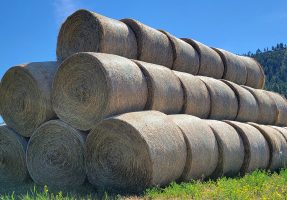
He manages about 240 acres of owned and leased land for his 150 head of cattle. Last year, the elk caused enough damage to his pastures that Ellison had to buy 400 round bales and 80 large squares to feed his cattle.

“I’ve never had to buy feed before. … And then the government says, ‘Well, we’re giving you compensation for it.’ But it doesn’t come close to what we’re losing. Not close,” Ellison says.

BC Cattlemen’s Association general manager Kevin Boon acknowledges that elk are “a huge issue for our ranchers and farmers throughout the province that we have been dealing with for decades. It comes to management of numbers of elk out there and then how to compensate for it.”

While the issue is perennial, Ellison has never seen the situation so dire. Thirty years ago, he had one bull and two cows on his property. Now, two herds have come together and live in the area year-round.

“I’ve never seen what we’re dealing with right now, ever. This time of year, even in February, we used to have six or eight inches of new green growth in our fields. We have lawns right now,” Ellison says. “Forget about what’s going to grow in our peak April and May growing season. With the damage that these animals are doing to the roots of our grass because they’re chewing it down, … that grass is never going to recover.”

Ranchers have raised this issue with the province, including BC Ministry of Forests wildlife biologist William Wilton, who leads development and implementation of the Roosevelt elk management plan.

Wilton says the ministry is doing everything it can to increase herd numbers.

As the herd grows, human-wildlife conflicts are expanding beyond local farms. Since December, four elk have been hit by vehicles while crossing over Highway 1 to Davis’s property, all of which had to be euthanized due to injuries.

“I believe what they’re waiting for is someone to get killed so that they can do something more about it. The one police I talked to; those were the words that she said,” Davis says.

In addition to elk on the road, Ellison worries about cattle getting out and causing accidents.

“It’s difficult to find an insurance company that will actually sell us insurance. What happens when the insurance companies have to start paying out [for] cattle being out on the roads and getting hit by cars because elk have broken down fences, and that’s starting to happen right now,” Ellison says. “That’s something that nobody’s even thought about, like the lovely biologists at the Ministry of Environment who caused this problem.”

The BC Ministry of Environment and Climate Change Strategy, which oversees the Conservation Officer Service, declined to comment. The Ministry of Forests did not respond before deadline.

All content on this website is copyrighted, and cannot be republished or reproduced without permission.
Related Posts

You may be interested in these posts from the same category.

Traceability reprieve for livestock

Breathing new life into historic ranches

Cowichan title decision creates uncertainty

Crown land conflicts reveal policy gaps

Beef herd drops

Feed available but stocks low

Land Act firestorm

Communication critical to solve water issues

Province funds feed access

Ranchers’ markets, practices praised

Frustration over “timber-centric” range bill

Douglas Lake challenge dismissed

Previous Post: « Wage pressures increase
Next Post: Wine industry faces losses »

© 2026 COUNTRY LIFE IN BC - ALL RIGHTS RESERVED