• Menu
  • Skip to primary navigation
  • Skip to main content
  • Skip to primary sidebar

Country Life In BC Logo

The agricultural news source in British Columbia since 1915

  • Headlines
  • Calendar
  • Subscribe
  • Advertise
  • About
  • Archives
  • Contact
  • Search
  • Headlines
  • Calendar
  • Subscribe
  • Advertise
  • About
  • Archives
  • Contact
  • Search

Primary Sidebar

Originally published:

JULY 2022
Vol. 108 Issue 7

Subscribe Now!

Sign up for free weekly FARM NEWS UPDATES

Select list(s) to subscribe to


By submitting this form, you are consenting to receive marketing emails from: Country Life in BC. You can revoke your consent to receive emails at any time by using the SafeUnsubscribe® link, found at the bottom of every email. Emails are serviced by Constant Contact
Your information will not be
shared or sold ever

Stories In This Edition

Good land at risk

Borrowing costs rising

Biosecurity rules limit bird flu outbreaks

From far and white

Back 40: A reality check for those living in a virtual world

Viewpoint: Don’t overlook tax incentives for innovation

Chicken growers battle disease, high feed costs

Delayed seeding means lighter crop, higher prices

Dairy farmers welcome price increase

Ag Briefs: Dutch Treat

Ag Briefs: Bearing fruit

Ag Briefs: Photo finish

Ukraine’s loss in the global market is everyone’s loss

Diesel prices plateau but gas pains continue

Farms expected to meet carbon emission targets

Sidebar: Regulating cannabis emissions

Carbon tax tops greenhouse grower concerns

New extension initiatives for orchard sector

Langley farmers air grievances to politicians

Drought, fires mark chaotic year for ranchers

Reduced forage quality complicates the math

Targeted grazing project reduces wildfire risk

BC bee colonies see significant winter losses

Hay down

Slocan market garden finds its sweet spot

Farm co-operatives aim to do business right

Sidebar: What about larger scale cooperatives?

Researchers close in on grapevine trunk disease

Sidebar: Fighting fungi with fungi

Summer sweet

Industry collaborates on smoke taint research

Farm Story: The usual thing isnt working

Researchers investigate sunscreen for fruit

Sidebar: Larger rootstocks could alleviate heat stress

Startup supports seasonal worker payments

Woodshed: Kenneth’s rescue is TikTok worthy

Family and friends honour rancher’s legacy

Jude’s Kitchen: Summer salads are cool and refreshing

More Headlines

Follow us on Facebook

Comments Box SVG iconsUsed for the like, share, comment, and reaction icons

2 weeks ago

The Canadian Food Inspection Agency is preparing to implement changes to its livestock traceability rules that will include mandatory computer reporting within seven days on movement of animals for veterinary appointments, community pastures, exhibitions, carcass and on-farm disposal and the births and deaths of every animal on your farm. Writer Tom Walker first brought these changes to the attention of our readers back in June 2023. We've posted his story to our website:

www.countrylifeinbc.com/cfia-proposes-traceability-updat#BCAg#BCag
... See MoreSee Less

The Canadian Food Inspection Agency is preparing to implement changes to its livestock traceability rules that will include mandatory computer reporting within seven days on movement of animals for veterinary appointments, community pastures, exhibitions, carcass and on-farm disposal and the births and deaths of every animal on your farm. Writer Tom Walker first brought these changes to the attention of our readers back in June 2023. Weve posted his story to our website: 

https://www.countrylifeinbc.com/cfia-proposes-traceability-updates/

#BCag
View Comments
  • Likes: 11
  • Shares: 21
  • Comments: 15

Comment on Facebook

I love hpw the cow in the picture hasn't even got a RFID tag in it but I digress. We can not read the link, it says "we are not permitted to read drafts". Please post again with the correct link.

Dairy farmers having been doing this several years. The app we use has become quite simple to use

Including equine?

Premise ID was slowly rolled through the country, voluntary then mandatory. Transparency and 'Consultation' has been light. Those who tried to bring this for discussion a couple years ago, because of forseen overreach, were quite often labeled conspiracy theorists and that it wasnt meant to be so heavily regulated and controlled. Gardens and seeds will be next. "Invasive species" reporting, check out the plants medicinal properties. Read the BC intentions papers. The premise ID that already heavy regulated commodities have claims to be treated different in the intentions papers on page 8. www2.gov.bc.ca/assets/gov/farming-natural-resources-and-industry/agriculture-and-seafood/food-saf...

Says i am "not allowed to preview draft".

Also concerning is the part on compliance...they can 'stumble onto' any farm and if you're not complying there are consequences.

When the CFIA stumbles into the wrong place compliance will be met with civil engagement

Says I can't preview draft

This is government overreach - Do Not Comply!

Do not comply

Fu

As if the price of beef isn't bad enough for consumers,,,,,be prepared to be gouged some more now

Ridiculous!!

Let's hold up on the beef exports tell we can get our own house in order... we need to deregulated, cheapen up the supply chain back into a 5 buck a pound rage so the good people canada can eat healthy food.. fuck your bean diets, that's retarded

This, along with the majority of new legislation pertaining to any type of farm, is a blatant squeeze on any sort of small, alternative agricultural venture. I am a massive believer in working together and sharing resources and costs and solutions - do not get me wrong - but this and the water registration among others, is an overreach (at most generous) and an absolute killer to smaller, local initiatives that LITERALLY save lives during extreme events. There is ONE ROAD into and out of my community. We don’t need or want some sort of backlogged government response when shit goes sideways. We want the ability AND SUPPORT to provide for our communities without penalty when things go badly. We want to produce sustainability for our communities. We live here, we work here, we want to STAY HERE. Stop making it harder.

View more comments

3 weeks ago

BC's minimum piece rates for 15 hand-harvested crops increased 2.6% on December 31. Crops include peaches, apricots, brussels sprouts, daffodils, mushrooms, apples, beans, blueberries, cherries, grapes, pears, peas, prune plums, raspberries and strawberries. Farm-worker piece rates in BC were increased by 11.5% in January 2019 and 6.9% in December 2024. BC’s current minimum wage sits at $17.85 per hour.

#BCAg
... See MoreSee Less

BCs minimum piece rates for 15 hand-harvested crops increased 2.6% on December 31. Crops include peaches, apricots, brussels sprouts, daffodils, mushrooms, apples, beans, blueberries, cherries, grapes, pears, peas, prune plums, raspberries and strawberries. Farm-worker piece rates in BC were increased by 11.5% in January 2019 and 6.9% in December 2024. BC’s current minimum wage sits at $17.85 per hour. 

#BCAg
View Comments
  • Likes: 10
  • Shares: 0
  • Comments: 2

Comment on Facebook

I'm not sure what they're telling us. Did peace rates have to increase so that Farm workers could make minimum wage?

They deserve it, but the general public will be whining about increased prices in the stores. Will need to make more information average to the g.p.

3 weeks ago

... See MoreSee Less

View Comments
  • Likes: 14
  • Shares: 0
  • Comments: 1

Comment on Facebook

105 Mile Ranch

4 weeks ago

... See MoreSee Less

View Comments
  • Likes: 7
  • Shares: 0
  • Comments: 0

Comment on Facebook

1 month ago

Water volumes from the Nooksack River are at levels similar to 1990 and 2021, but the province says flows should peak at 10pm tonight. The shorter duration, as well as conditions in other watercourses within the watershed and performance of flood protection infrastructure should avoid a catastrophe on the scale of 2021. However, several landslides mean road closures have once again effectively isolated the Lower Mainland from the rest of the province.

#BCAg
... See MoreSee Less

Water volumes from the Nooksack River are at levels similar to 1990 and 2021, but the province says flows should peak at 10pm tonight. The shorter duration, as well as conditions in other watercourses within the watershed and performance of flood protection infrastructure should avoid a catastrophe on the scale of 2021. However, several landslides mean road closures have once again effectively isolated the Lower Mainland from the rest of the province.

#BCAg
View Comments
  • Likes: 9
  • Shares: 3
  • Comments: 1

Comment on Facebook

Family living in Sumas WA say it's very much like '21. They have the same amount of water in their house as last time.

Subscribe | Advertise

The agricultural news source in British Columbia since 1915
  • Email
  • Facebook

Good land at risk

Ottawa’s plan for Surrey farmland raises alarm

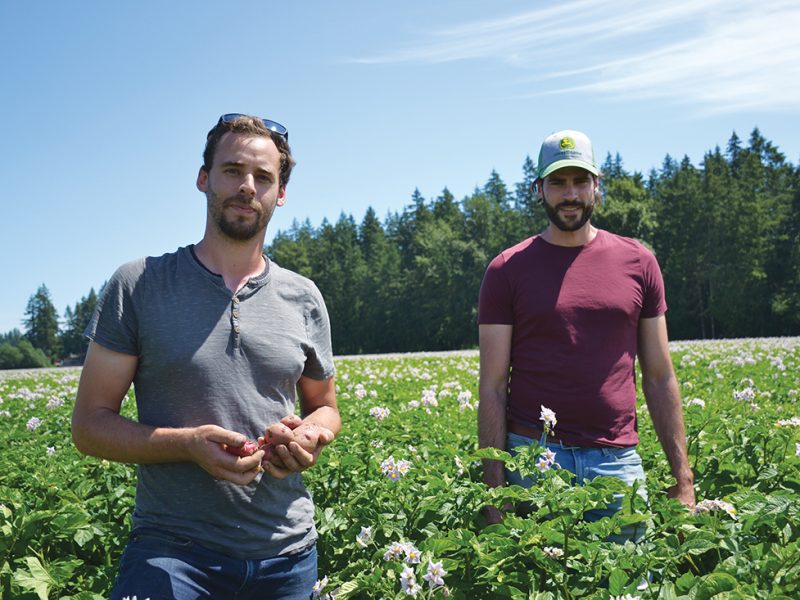
Tristin Bouwman, left, and Tyler Heppell say the 220 acres the Heppell family farms in Surrey’s Campbell Heights is irreplaceable. It’s one of the first to be seeded and the first to supply the BC market with potatoes, carrots and cabbage. They’re petitioning the federal government to work with the province to include the land in the province’s Agricultural Land Reserve to maintain its agricultural integrity. RONDA PAYNE

July 4, 2022 byPeter Mitham

SURREY – This spring’s cool, wet weather has made it difficult for farmers to get on fields across the Lower Mainland, particularly in low-lying areas of Delta and on Sumas Prairie.

But in Campbell Heights, the Heppell family was seeding its 220 acres in early March – a little bit later than usual, but earlier than most others. Good drainage and a warm microclimate makes it among the first fields seeded in Canada each year and the first to supply the BC market with potatoes, carrots and cabbage. This puts it at the forefront of the local supply; without it, the marketing window for imported vegetables would be longer.

“It is integral to Western Canada’s food production, in that it pushes back Mexico and California product,” says Wes Heppell, whose family has farmed the land since 1974.

Heppell farms a total of 650 acres, the majority of it on Sumas Prairie. Wet conditions this year meant that even in mid-June, equipment was getting stuck. That wasn’t the case in Campbell Heights, which makes it unique for the Lower Mainland, if not Canada.

“There is no other land like it in Canada,” he says. “We’ve looked all over the province – the Interior, everywhere – and you just cannot find what we have here.”

But the future of the site, which totals about 300 acres including forested land, is in jeopardy.

Declared surplus by Innovation, Science and Economic Development Canada in 2016, it’s been farmed on a year-to-year lease ever since. Public Works and Government Services Canada began preparing for disposition of the property last year. This summer, Crown corporations, provincial and municipal governments and First Nations will be asked to express interest in the property prior to it being offered to private buyers.

“This could be the last season that the land is producing before it gets put into a trajectory of disappearing from agriculture, as we understand it,” says Tristin Bouwman, crop manager with Heppell and vice-president with the Surrey Farmers Institute, who has been working to raise awareness of the potential loss of the land.

Bouwman has launched a petition on Change.org calling on Ottawa to work with the province to include the property within the Agricultural Land Reserve and urging Surrey to amend its official community plan to designate the land for farming and greenspace.

“Are we prepared to take the most resilient, fertile land and pave it over?” he asks. “If this piece is lost, there’s nothing that could replace this land’s productive capacity.”

A leading option for the land – if local First Nations don’t express interest in it – is industrial space. The property lies within the Campbell Heights area, a key source of industrial land for Metro Vancouver, which claims the tightest industrial market in North America with virtually no space available unless it’s built. Unlike a smaller tract on the south side of Campbell Heights,  also in line for development, it doesn’t need rezoning.

“Since about 2000, it’s been in the official community plan for industrial development,” Bouwman says. “We’re moving towards that now, and it’s the time that people have to be heard as to whether or not this critical piece of land should be lost forever.”

There’s growing momentum to save the land. Dozens of politicians from all levels of government have toured the property in recent weeks, just as the first nugget potatoes headed to local stores – the first of close to 50 million servings the land will produce this year.

With a civic election looming this fall, Surrey mayor Doug McCallum has offered to purchase the site.

“If the federal government were to make this property available to the City of Surrey, I would ensure an offer would be made,” he said in a statement, June 21. “If successful, I would pledge that the property would remain as farmland so it can produce harvest after harvest for generations to come.”

Bouwman hopes the candidates who run in this fall’s civic election will stand up for the land.

“We think decision-makers at all levels of government should come out in support of the local food supply and protect this land by committing to amend municipal plans and by including the land in the ALR,” he says.

The BC Agriculture Council supports the inclusion of the land in the ALR, saying the collaboration of the federal and provincial governments would send a strong message.

“If these lands are recognized as part of the Agricultural Land Reserve, it would send a powerful signal that agriculture is valued in British Columbia and that different levels of government can cooperate effectively to ensure our communities’ food security,” BCAC executive director Danielle Synotte said in a statement.

The public is watching, Bouwman says.

“This is an issue that is a public issue, that whenever they hear about it, really cares, because it’s about the future of our food,” he says. “We’ve learned in the last two years how vulnerable supply chains are. We’ve learned the importance of domestic supply. To lose this piece of land would be a significant blow to our local food production.”

Related Posts

You may be interested in these posts from the same category.

Task force presents blueprint for growth

Ag Days foregrounds sector priorities

Islands Trust sidelines ag in policy statement

ALC rejects Cowichan dike removal

Council calls for review of farm classification rules

Regulatory hurdles threaten farm income solutions

BCAC holds AGM

BC boosts agriculture spending

Ag leaders honoured at gala

BC farm income plummets

Budget recognizes climate risks

Orchardists seek frost assistance

Previous Post: « Irrigation shouldn’t be an afterthought
Next Post: Guaranteed returns for apples »

Copyright © 2026 Country Life in BC · All Rights Reserved