• Menu
  • Skip to primary navigation
  • Skip to main content
  • Skip to primary sidebar

Country Life In BC Logo

The agricultural news source in British Columbia since 1915

  • Headlines
  • Calendar
  • Subscribe
  • Advertise
  • About
  • Archives
  • Contact
  • Search
  • Headlines
  • Calendar
  • Subscribe
  • Advertise
  • About
  • Archives
  • Contact
  • Search

Primary Sidebar

Current Issue:

DECEMBER 2025
Vol. 111 Issue 11

Subscribe Now!

Sign up for free weekly FARM NEWS UPDATES

Select list(s) to subscribe to


By submitting this form, you are consenting to receive marketing emails from: Country Life in BC. You can revoke your consent to receive emails at any time by using the SafeUnsubscribe® link, found at the bottom of every email. Emails are serviced by Constant Contact
Your information will not be
shared or sold ever

Follow us on Facebook

Comments Box SVG iconsUsed for the like, share, comment, and reaction icons

6 days ago

... See MoreSee Less

View Comments
  • Likes: 4
  • Shares: 0
  • Comments: 0

Comment on Facebook

7 days ago

On the last day of the BC Organic Conference, Thursday, Molly Thurston of Pearl Agricultural Consulting helped growers learn how to manage bugs such as codling moth, wireworm, and rootworm in organic growing systems. Her talk alongside Renee Prasad included hands-on activities in which participants checked out various traps and examined pests under microscopes. Be sure to look for more upcoming ag events on our online calendar at www.countrylifeinbc.com/calendar/

#BCAg
... See MoreSee Less

On the last day of the BC Organic Conference, Thursday, Molly Thurston of Pearl Agricultural Consulting helped growers learn how to manage bugs such as codling moth, wireworm, and rootworm in organic growing systems. Her talk alongside Renee Prasad included hands-on activities in which participants checked out various traps and examined pests under microscopes. Be sure to look for more upcoming ag events on our online calendar at www.countrylifeinbc.com/calendar/

#BCAg
View Comments
  • Likes: 15
  • Shares: 0
  • Comments: 0

Comment on Facebook

1 week ago

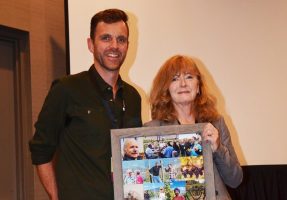
Well-known organic farmer and podcaster Jordan Marr gets interviewed by Country Life in BC’s own columnist and potato mavin Anna Helmer during the opening session of the BC Organic Conference at Harrison Hot Springs yesterday. Sessions run today (Wednesday) and Thursday and include organic and regenerative growing practices and expanding and advocating for the organic sector, all under the background of the newly launched Organic BC banner.

#BCAg
... See MoreSee Less

Well-known organic farmer and podcaster Jordan Marr gets interviewed by Country Life in BC’s own columnist and potato mavin Anna Helmer during the opening session of the BC Organic Conference at Harrison Hot Springs yesterday. Sessions run today (Wednesday) and Thursday and include organic and regenerative growing practices and expanding and advocating for the organic sector, all under the background of the newly launched Organic BC banner.

#BCAg
View Comments
  • Likes: 37
  • Shares: 2
  • Comments: 1

Comment on Facebook

Interested in finding out more about this

3 weeks ago

Today, we remember those who sacrificed their lives or their well-being for our freedom. Lest we forget. ... See MoreSee Less

Today, we remember those who sacrificed their lives or their well-being for our freedom. Lest we forget.
View Comments
  • Likes: 8
  • Shares: 0
  • Comments: 0

Comment on Facebook

1 month ago

FarmFolk CItyFolk is hosting its biennial BC Seed Gathering in Harrison Hot Springs November 27 and 28. Farmers, gardeners and seed advocates are invited to learn more about seed through topics like growing perennial vegetables for seed, advances in seed breeding for crop resilience, seed production as a whole and much more. David Catzel, BC Seed Security program manager with FF/CF will talk about how the Citizen Seed Trail program is helping advance seed development in BC. Expect newcomers, experts and seed-curious individuals to talk about how seed saving is a necessity for food security. ... See MoreSee Less

Link thumbnail

BC Seed Gathering - FarmFolk CityFolk

farmfolkcityfolk.ca

Save the date for our upcoming 2023 BC Seed Gathering happening this November 3rd and 4th at the Richmond Kwantlen Polytechnic University campus.
View Comments
  • Likes: 1
  • Shares: 0
  • Comments: 0

Comment on Facebook

Subscribe | Advertise

The agricultural news source in British Columbia since 1915
  • Email
  • Facebook

Growers, wineries welcome sustainability launch

Third-party audit essential for program’s credibility

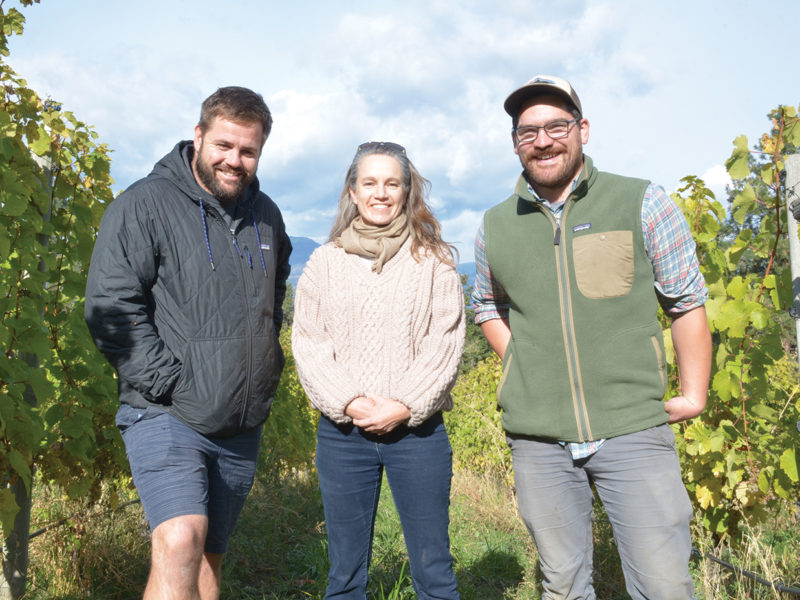
Tantalus Vineyards general manager and wine maker David Paterson, left, Sustainable Winegrowing BC program manager Katie Pease and Tantalus vineyard manager and long-time SWBC board member Felix Egerer are happy to see the launch of a new initiative to recognize wine that meets sustainable standards. PHOTO / TOM WALKER

November 19, 2020 byTom Walker

KELOWNA – The first wines certified under a new made-in-BC sustainability program could be on shelves as early as next spring.

“We are excited to be finally launching our official certification process,” says Katie Pease, program manager for Sustainable Winegrowing BC (SWBC).

Originally scheduled to launch this past April, COVID-19 delayed the program’s launch until November 1. With the program up and running, BC vineyards and wineries are now able to apply for a third-party audit, receive certification and describe their wine as “made from grapes grown in a certified sustainable vineyard” or “made in a certified sustainable winery.”

Program development began more than 10 years ago, driven mostly by industry volunteers under the auspices of the BC Wine Grape Council. Since then, the council’s sustainability committee has drawn members from across the sector.

“We have representatives from the big players like Arterra and Andrew Peller, as well as medium-size wineries like Quails’ Gate and Hillside Estate, and a smattering of boutiques like Tantalus and Le Vieux Pin/La Stella,” Pease says.  Vineyard owners, consultants and Summerland Research and Development Centre scientists round out the membership.

“This group who developed SWBC really wanted to create both a profitable, environmentally friendly and socially just wine-growing region, that could see prosperity today,” says Pease. “Ten years ago, here in BC, as far as I can tell, it was a pretty small and select group of people who understood that line of thinking (planet, people, profit), but today, of course, I think much more so.”

Sustainability goals

Over the years, the committee has written sustainability goals and developed a self-assessment tool for both vineyards and wineries. Vineyard sustainability goals include management of the watershed, soil, irrigation, integrated pest management (IPM) and social equity. Winery goals include water and energy efficiency, waste management and climate action as well as social equity. To date, 68 vineyards and 37 of the province’s 280 grape wineries have completed the self-assessments.

Pease says it was always the committee’s aim to provide a formal audited certification. Organizations claim they are sustainable, but they need to be able to back it up.

“It is not just being able to say, ‘I conserve water because I use drip irrigation,’” she says. “It is taking the next step and saying, ‘What does that mean in comparison to an industry best practice of how much water you should be using?’”

Pease and the committee worked to develop outcomes with metrics that would back any claims made.

“I feel we are leading-edge in launching something newish in the certification industry,” she says. “Other certification programs still don’t collect data; they work more from a laundry list of

to-dos.”

Operations that have completed the self-assessments will be able to apply for an audit, Pease explains.

“What certification means different from just doing self-assessments, really, is that the self-assessment has been verified by a third party,” she says.

SWBC will run courses throughout the winter to help growers and wineries prepare for their audits, which will begin in the 2021 growing season.

Auditors come from the local agriculture industry, with experience in organic certification or environmental farm planning.

“We will train them to our standards and they will go out and do the verification,” says Pease. “They will have a pretty high level of knowledge of the content of the standards and they should be a resource as well.”

The auditor will visit the vineyard or winery and walk through each of the criteria within the standard, she explains.

“Some of the criteria will require documentation such as chemical, water or energy use, while some just require that the auditor see the process of how they do something, like store toxic chemicals,” says Pease.

The auditor makes the recommendation about how they do against the SWBC standards and SWBC will grant certification to those that measure up.

SWBC is designing a certification logo for members to use, and the BC Wine Grape Council will be developing a communications program, adds Pease.

“We work on a very slim budget and we are hoping to receive some grant funding which would allow us to give much more energy to the communications piece,” she says. “But it will be our members who really tell the story.”
Related Posts

You may be interested in these posts from the same category.

Vineyards enter new year with recovery in sight

Grapegrowers discuss freeze event

Moon shines among BC grape growers

Short grape crop confirmed

Pat Bowen’s achievements recognized

Grape growers assess damage

Warm winter stalls icewine

Grower takes issue with groundwater limits

Phylloxera found on Vancouver Island

Cold snap hits Okanagan fruit growers

Merlot, Pinot Gris tops in BC

Wineries reopen amid COVID-19

Previous Post: « Raspberry growers hold AGM
Next Post: BC agritech for India »

Copyright © 2025 Country Life in BC · All Rights Reserved