• Menu
  • Skip to primary navigation
  • Skip to main content
  • Skip to primary sidebar

Country Life In BC Logo

The agricultural news source in British Columbia since 1915

  • Headlines
  • Calendar
  • Subscribe
  • Advertise
  • About
  • Archives
  • Contact
  • Search
  • Headlines
  • Calendar
  • Subscribe
  • Advertise
  • About
  • Archives
  • Contact
  • Search

Primary Sidebar

Originally published:

MAY 2020
Vol. 106 Issue 5

Subscribe Now!

Sign up for free weekly FARM NEWS UPDATES

Select list(s) to subscribe to


By submitting this form, you are consenting to receive marketing emails from: Country Life in BC. You can revoke your consent to receive emails at any time by using the SafeUnsubscribe® link, found at the bottom of every email. Emails are serviced by Constant Contact
Your information will not be
shared or sold ever

Stories In This Edition

Rapid response

Worker health crisis

Spring melt floods Cariboo

Foreign Labour an essential service for fruit growers

Editorial: Watershed moments

Back Forty: COVID-19 will be a reality check for many

Viewpoint: Register now, question later to keep water rights

COVID-19 has varied impact on poultry sector

Social distancing

Honey producers keep focus on research

Beekeepers stung about import issues

Sidebar: Advocating for technology transfer

Farmland values facing headwinds

IAFBC defers major decisions

BCAC focuses on public trust with lower budget

AgSafe governance set for a shake-up

COVID-19 leads to oversupply of dairy

BC Fairs positive as large events banned

Peace growers facing multiple challenges

Co-op considers four-way fix at crossroads

Surprise audits to double

Co-op focuses on cutting costs, increasing sales

Volatility from plant shutdowns could hit BC

Island farmers renew request for local abattoir

Meat processing capacity stable despite closures

Direct marketing saves producers’ bacon

Small producers ride the online sales wave

Farm equipment dealers keep sale smoving

Strawberry growers pin survival on levies

Sidebar: Blueberry and raspberry AGMs postponed

Raspberry growers target fresh market, quality

Apple soda breaks ground in saturated market

Chilliwack family cracks open direct sales

EFB-resistant trees not out of the woods

Distillery shows resilience as it adapts to market

Home gardeners overwhelm seed companies

Sidebar: Commercial seed supply affected

Research: Viruses pursue unique strategies to evolve

Moisture sensors are not created equal

Woodshed: Kenneth gives new meaning to social isoluation

Farmers’ markets go online as channels shift

Farm Story: Pandemic forces a hard pivot to stay in the game

Cheesemaker adapts to coronavirus restrictions

Jude’s Kitchen: Stay-healty food in uneasy times

More Headlines

Follow us on Facebook

Comments Box SVG iconsUsed for the like, share, comment, and reaction icons

6 days ago

... See MoreSee Less

View Comments
  • Likes: 4
  • Shares: 0
  • Comments: 0

Comment on Facebook

7 days ago

On the last day of the BC Organic Conference, Thursday, Molly Thurston of Pearl Agricultural Consulting helped growers learn how to manage bugs such as codling moth, wireworm, and rootworm in organic growing systems. Her talk alongside Renee Prasad included hands-on activities in which participants checked out various traps and examined pests under microscopes. Be sure to look for more upcoming ag events on our online calendar at www.countrylifeinbc.com/calendar/

#BCAg
... See MoreSee Less

On the last day of the BC Organic Conference, Thursday, Molly Thurston of Pearl Agricultural Consulting helped growers learn how to manage bugs such as codling moth, wireworm, and rootworm in organic growing systems. Her talk alongside Renee Prasad included hands-on activities in which participants checked out various traps and examined pests under microscopes. Be sure to look for more upcoming ag events on our online calendar at www.countrylifeinbc.com/calendar/

#BCAg
View Comments
  • Likes: 15
  • Shares: 0
  • Comments: 0

Comment on Facebook

1 week ago

Well-known organic farmer and podcaster Jordan Marr gets interviewed by Country Life in BC’s own columnist and potato mavin Anna Helmer during the opening session of the BC Organic Conference at Harrison Hot Springs yesterday. Sessions run today (Wednesday) and Thursday and include organic and regenerative growing practices and expanding and advocating for the organic sector, all under the background of the newly launched Organic BC banner.

#BCAg
... See MoreSee Less

Well-known organic farmer and podcaster Jordan Marr gets interviewed by Country Life in BC’s own columnist and potato mavin Anna Helmer during the opening session of the BC Organic Conference at Harrison Hot Springs yesterday. Sessions run today (Wednesday) and Thursday and include organic and regenerative growing practices and expanding and advocating for the organic sector, all under the background of the newly launched Organic BC banner.

#BCAg
View Comments
  • Likes: 37
  • Shares: 2
  • Comments: 1

Comment on Facebook

Interested in finding out more about this

3 weeks ago

Today, we remember those who sacrificed their lives or their well-being for our freedom. Lest we forget. ... See MoreSee Less

Today, we remember those who sacrificed their lives or their well-being for our freedom. Lest we forget.
View Comments
  • Likes: 8
  • Shares: 0
  • Comments: 0

Comment on Facebook

1 month ago

FarmFolk CItyFolk is hosting its biennial BC Seed Gathering in Harrison Hot Springs November 27 and 28. Farmers, gardeners and seed advocates are invited to learn more about seed through topics like growing perennial vegetables for seed, advances in seed breeding for crop resilience, seed production as a whole and much more. David Catzel, BC Seed Security program manager with FF/CF will talk about how the Citizen Seed Trail program is helping advance seed development in BC. Expect newcomers, experts and seed-curious individuals to talk about how seed saving is a necessity for food security. ... See MoreSee Less

Link thumbnail

BC Seed Gathering - FarmFolk CityFolk

farmfolkcityfolk.ca

Save the date for our upcoming 2023 BC Seed Gathering happening this November 3rd and 4th at the Richmond Kwantlen Polytechnic University campus.
View Comments
  • Likes: 1
  • Shares: 0
  • Comments: 0

Comment on Facebook

Subscribe | Advertise

The agricultural news source in British Columbia since 1915
  • Email
  • Facebook

Island farmers renew request for local abattoir

Demand for local meat, shutdowns spur new push

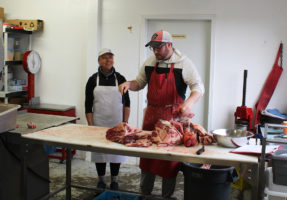
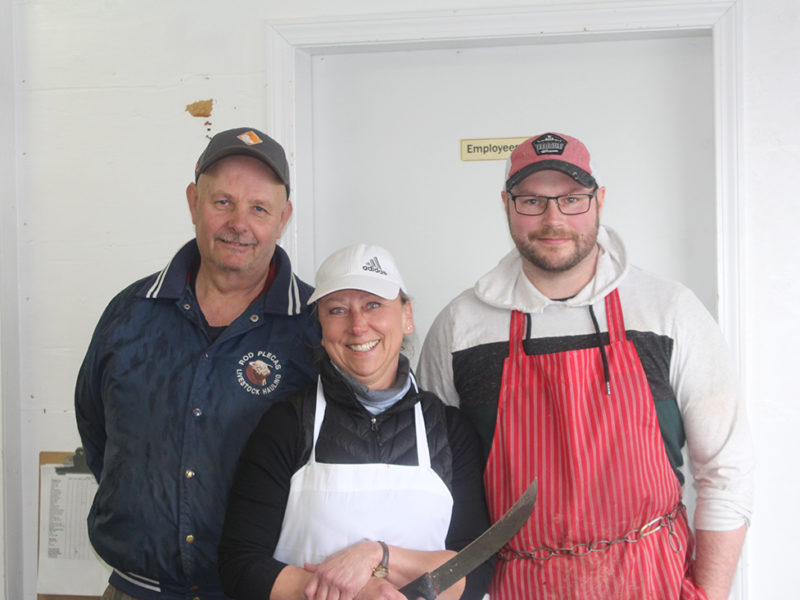
The closure of Plecas Meats in Nanaimo means one less abattoir option among already too few for Vancouver Island farmers. Rod Plecas, left, with Susan Toth and butcher Brad Lester, retired at the end of March, closing the doors on the plant his dad started back in 1962. The last slaughter day was March 16. PHOTO / BOB COLLINS

May 1, 2020 byTom Walker

PORT ALBERNI – The Alberni Farmers’ Institute is renewing a request to have the Alberni-Clayoquot Regional District (ACRD) designated a Class D and E licensing area under BC’s Meat Inspection Regulation.

“The regional district first made a formal application to the government back in 2017,” says Lisa Aylard, president of the Alberni Farmers’ Institute. “They sent a follow-up request last September during the province’s consultation with regional districts about Class D slaughter licences as part of their on-going contact with the government over this issue. But no decision has been made.”

ACRD lacks an A or B-class processing plant for red meat. The recent closure of Plecas Meats in Nanaimo means the closest provincially licensed abattoir to Port Alberni is 103 km away in Courtenay. The next closest is in Duncan, 134 km away.

Aylard says the COVID-19 crisis has just made the situation worse.

“Travelling that far is not acceptable for health and safety reasons,” she says. “We are seeing an increase in consumers wanting to purchase local meat during this time and producers in our region are facing an unfair economic hurdle to have to travel away and back to provide meat for those customers.”

Paying someone else to process animals means less profit for small farmers.

“We have lost a lot of local agriculture because of this,” says Aylard. “There used to be a lot of people in the valley who had one or two cows.”

While the number of animals in the area doesn’t warrant a Class A facility, she says a Class D plant could go a long way to encourage more meat production.

Affordable land in the Alberni Valley is attracting new farmers.

“We have these young people in our farmers’ institute that are all gung-ho and then they get hit with these regulations [against on-farm slaughter,” says Aylard.

Increased demand

The lack of a local abattoir was highlighted as a barrier to development of the regional livestock industry in the ACRD agriculture plan drafted in 2011. A feasibility study for a Class A plant for red meat in 2016 highlighted many benefits but the community said it was not feasible due to a lack of funding, management and inadequate production volume.

But demand remains, and has even increased.

“The lack of access to red meat slaughter services has been a key roadblock to sustaining livestock production within our region,” the ACRD told BC agriculture minister Lana Popham last September. ”Our producers are suffering due to the competitive disadvantage of having to transport out of the region and the lack of access to services.”

“What we need is the ability to do on-farm slaughter the way farmers always have,” says Aylard. “When the regulations changed after BSE, it took away our control and our ability to make economic development on local farms.”

She is not opposed to a change to provincial inspection for remote facilities.

“If they can do long-distance support for remote medical surgery, I’m sure we can put something in place for animal processing,” she says.

The lack of government response to the issue is frustrating.

“The wheels on the bus are turning awfully slowly,” says Aylard.
Related Posts

You may be interested in these posts from the same category.

New licences, new inspections

Challenges linger for meat plants

BC abattoir volume up 30% in 2020

Province reveals abattoir changes

SlaughterRight training launched by ag ministry

Rural recovery funds agriculture

New executive director for Small-Scale Meat Producers

Meat producers frustrated by consultations

Abattoir association calls for action

Closures underscore need for licensing reform

Province expands slaughter licences

Rethinking the concept for mobile abattoirs

Previous Post: « Chilliwack family cracks open direct sales
Next Post: COVID-19 leads to oversupply of dairy »

Copyright © 2025 Country Life in BC · All Rights Reserved