• Menu
  • Skip to primary navigation
  • Skip to main content
  • Skip to primary sidebar

Country Life In BC Logo

The agricultural news source in British Columbia since 1915

  • Headlines
  • Calendar
  • Subscribe
  • Advertise
  • About
  • Archives
  • Contact
  • Search
  • Headlines
  • Calendar
  • Subscribe
  • Advertise
  • About
  • Archives
  • Contact
  • Search

Primary Sidebar

Originally published:

JANUARY 2021
Vol. 107 Issue 1

Subscribe Now!

Sign up for free weekly FARM NEWS UPDATES

Select list(s) to subscribe to


By submitting this form, you are consenting to receive marketing emails from: Country Life in BC. You can revoke your consent to receive emails at any time by using the SafeUnsubscribe® link, found at the bottom of every email. Emails are serviced by Constant Contact
Your information will not be
shared or sold ever

Stories In This Edition

Full moon rising

New year, new era

Insurance premiums soar

Popham looks forward to a new term

Editorial: New openings

Back 40: New farmers are a crop worth growing

Viewpoint: Let’s get real about mental wellness on the farm

Trade issues, pandemic dog dairy producers

Dairy associations pull through challenging year

Second wave of pandemic hits close to home

Grain producers mark one of their worst harvests

Grower takes issue with groundwater limits

Grape phylloxera found on Vancouver Island

Pioneering entomologist remembered

Leasing farmland a vital strategy for farmers

Raspberry growers tackle new pest challenge

Province comes through with replant money

Pacific Ag Show embraces the digital realm

Berries, berries and more berries

Sidebar: Short course continues to educate growers

Green shoots on the vegetable front

Gala closes out opening day

Ag innovation day

The show must go on

CannaTech West returns

Optimism follows on the heels of 2020’s challenges

Rotational grazing improves soil health

Taking the guesswork out of herd management

Research: Highly sensitive pigs help solve soybean allergies

Bill Awmack honoured with leadership award

Farmers put electric tractors to the test

Kootenay farm advisors resume field days

Kelowna school embraces new container farm

Farm Story: Winter is a good time to problem-solve

Farm women encouraged to take a stand

Woodshed: Breaking the good (and not so good) news

Uncertainty prevails for BC fairs in new year

Jude’s Kitchen: Leftovers re-imagined make tasty meals

More Headlines

Follow us on Facebook

Comments Box SVG iconsUsed for the like, share, comment, and reaction icons

6 days ago

... See MoreSee Less

View Comments
  • Likes: 4
  • Shares: 0
  • Comments: 0

Comment on Facebook

7 days ago

On the last day of the BC Organic Conference, Thursday, Molly Thurston of Pearl Agricultural Consulting helped growers learn how to manage bugs such as codling moth, wireworm, and rootworm in organic growing systems. Her talk alongside Renee Prasad included hands-on activities in which participants checked out various traps and examined pests under microscopes. Be sure to look for more upcoming ag events on our online calendar at www.countrylifeinbc.com/calendar/

#BCAg
... See MoreSee Less

On the last day of the BC Organic Conference, Thursday, Molly Thurston of Pearl Agricultural Consulting helped growers learn how to manage bugs such as codling moth, wireworm, and rootworm in organic growing systems. Her talk alongside Renee Prasad included hands-on activities in which participants checked out various traps and examined pests under microscopes. Be sure to look for more upcoming ag events on our online calendar at www.countrylifeinbc.com/calendar/

#BCAg
View Comments
  • Likes: 15
  • Shares: 0
  • Comments: 0

Comment on Facebook

1 week ago

Well-known organic farmer and podcaster Jordan Marr gets interviewed by Country Life in BC’s own columnist and potato mavin Anna Helmer during the opening session of the BC Organic Conference at Harrison Hot Springs yesterday. Sessions run today (Wednesday) and Thursday and include organic and regenerative growing practices and expanding and advocating for the organic sector, all under the background of the newly launched Organic BC banner.

#BCAg
... See MoreSee Less

Well-known organic farmer and podcaster Jordan Marr gets interviewed by Country Life in BC’s own columnist and potato mavin Anna Helmer during the opening session of the BC Organic Conference at Harrison Hot Springs yesterday. Sessions run today (Wednesday) and Thursday and include organic and regenerative growing practices and expanding and advocating for the organic sector, all under the background of the newly launched Organic BC banner.

#BCAg
View Comments
  • Likes: 37
  • Shares: 2
  • Comments: 1

Comment on Facebook

Interested in finding out more about this

3 weeks ago

Today, we remember those who sacrificed their lives or their well-being for our freedom. Lest we forget. ... See MoreSee Less

Today, we remember those who sacrificed their lives or their well-being for our freedom. Lest we forget.
View Comments
  • Likes: 8
  • Shares: 0
  • Comments: 0

Comment on Facebook

1 month ago

FarmFolk CItyFolk is hosting its biennial BC Seed Gathering in Harrison Hot Springs November 27 and 28. Farmers, gardeners and seed advocates are invited to learn more about seed through topics like growing perennial vegetables for seed, advances in seed breeding for crop resilience, seed production as a whole and much more. David Catzel, BC Seed Security program manager with FF/CF will talk about how the Citizen Seed Trail program is helping advance seed development in BC. Expect newcomers, experts and seed-curious individuals to talk about how seed saving is a necessity for food security. ... See MoreSee Less

Link thumbnail

BC Seed Gathering - FarmFolk CityFolk

farmfolkcityfolk.ca

Save the date for our upcoming 2023 BC Seed Gathering happening this November 3rd and 4th at the Richmond Kwantlen Polytechnic University campus.
View Comments
  • Likes: 1
  • Shares: 0
  • Comments: 0

Comment on Facebook

Subscribe | Advertise

The agricultural news source in British Columbia since 1915
  • Email
  • Facebook

Leasing farmland a vital strategy for farmers

Land-matching initiative builds on strong foundation

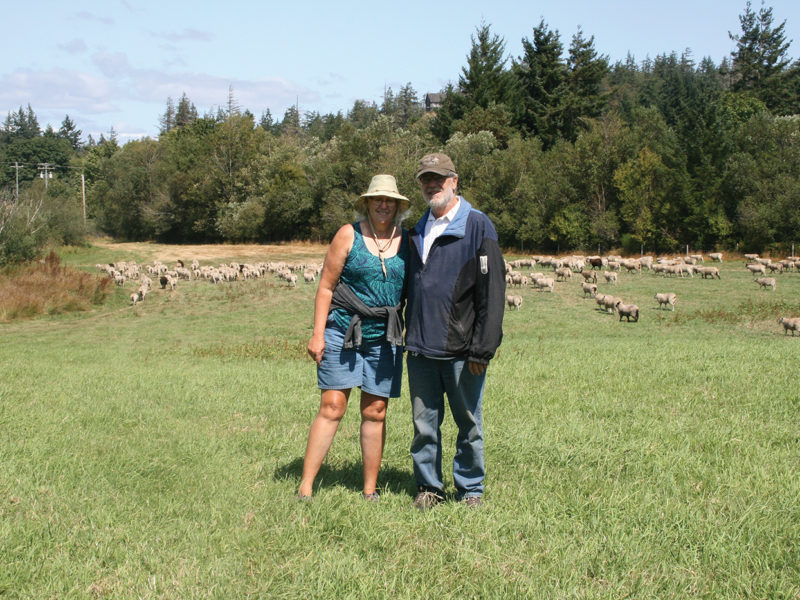
Lorraine and John Buchanan of Parry Bay Sheep Farm own just two of the 1,000 acres they manage on southern Vancouver Island. It’s the most economical way to get onto land, they say. PHOTO / BARBARA JOHNSTONE GRIMMER

January 1, 2021 byBarbara Johnstone Grimmer

METCHOSIN – While the province has been keen to support land-matching to help new farmers launch their operations, leasing farmland is a long-standing practice in BC that’s been vital to many farm businesses.

Recent research by the provincial government’s Behavioural Insights Group underlined the importance of land leases to agriculture, stating that it’s commonplace for BC landowners to lease unused farmland to farmers.

John and Lorraine Buchanan of Parry Bay Sheep Farm in Metchosin on southern Vancouver Island only own two acres, yet they are one of the biggest operations on Vancouver Island.

“We lease all of the land we farm,” says Buchanan. “The land ranges from two to 200 acres for about 1,000 acres in total.”

Parry Bay has 30 pastures and croplands spread over a large geographic area, from Central Saanich to Metchosin. The Buchanans grow barley, wheat, oats, kale and turnips, as well as hay and pasture for their large flock of sheep.

“In the mostly suburban areas where we farm, it is the most economical way to get onto the land,” explains Buchanan. “We have had no issues in the 40 years that we have been farming with this arrangement.”

Economical

Bill Zylmans of W & A Farms in Richmond agrees with that observation.

“Of the 400 acres that we are farming, we own 70 of that,” says Zylmans. “The costs are much less to lease compared to buying in an area that has become quite urban.”

Zylmans calls himself the “biggest dirt farmer in Richmond,” based on the number of cultivated acres that he farms, outside of the region’s blueberry and cranberry farms.

He leases a range of parcel sizes. As a seed potato farmer, he is happy if he can rent six to 12-acre parcels for the different seed potato varieties he grows. He has a long-term lease for 200 acres from the Vancouver Fraser Port Authority, along with leases from non-farmers and other farmers.

“I lease from older farmers who want to see their land farmed,” says Zylmans. “One of the farms that I lease is from a widow whose husband passed away. It is a win-win for people who want their land farmed and looked after, and they can receive a property tax reduction.”

Zylmans also subleases to other farmers for rotational purposes. It introduces diversity into the cropping system, which in turn benefits the land.

One thing that Zylmans stresses is the importance of good-quality land.

“We have the [Agricultural Land Reserve] which provides great protection to good land. We can’t afford to farm marginal land anymore. It has to be top-notch,” says Zylmans, a former vice-chair of the Agricultural Land Commission’s South Coast panel. “They aren’t making any more farmland.”

Zylmans says that it’s more cost-effective to keep good quality farmland in good shape. It no longer pays to put in infrastructure improvements and extra inputs to upgrade marginal land. However, lower quality farmland can host greenhouse operations and other uses that don’t require highly productive soil.

Long-term leases preferred

He prefers long-term leases that give him the confidence to make investments and manage the land with a view to its long-term quality. A short-term lease doesn’t offer the same incentive.

“I like to see a five to 10-year timeframe with a first-refusal option to purchase so that I can put money in and do necessary work like cleaning ditches, fertilizing or enhancing the land,” says Zylmans. “Farmers are the best stewards of the land.”

The BC Land Matching Program managed by the Young Agrarians provides a new spin on the old practice of leasing land, providing a customized service to help match those looking for farmland to rent with landowners who are interested in leasing part – or all – of their land for farm use. The program launched in Metro Vancouver in 2016, and matching began in 2017.

With support from the province, the program expanded across BC in 2018. Young Agrarians now has five trained land-matchers in BC covering Vancouver Island and Gulf Islands, Metro Vancouver and the Fraser Valley, the Okanagan-Thompson, Columbia Basin and Central and Northern BC. The team offers a range of support services, lease forms and materials and recently released a “BC Transition Tool Kit” to help with non-family land transfers.

To date, just under 600 people have registered for the program: 334 land-seekers and 264 landowners. Early in the COVID-19 pandemic enquiries for land from land-seekers doubled but this has since levelled off, says Darcy Smith, BC Land Program Manager at Young Agrarians. At the same time, there has been a slight decline in landowner enquiries.

“I would say that there’s a wide variety of people participating in the BCLMP for both land seekers and landholders – folks of all ages, production types, backgrounds, etc. – where the unifying thread is a focus on building resilient food systems and providing opportunities to farmers to grow viable farm businesses,” explains Smith.

The program recently made its 100th match. For the 81 land matches with statistics available from the BC Ministry of Agriculture, Food and Fisheries, 4,653 acres are being leased for farming through the program.

Tenure documented

Statistics Canada’s Census of Agriculture, which is set to take place this May, records land tenure. The last census in 2016 reported 17,528 farms in BC covering a total of 6.4 million acres. Nearly half of this acreage was owned, with the rest leased from governments, non-farmers, other farmers, or rented under other arrangements such as crop-sharing.

BC Assessment reports 11,138 farm properties on the 2021 tax roll, of which 869,382 acres are leased. This does not reflect area leased from one farmer to another for cover crop rotations or other arrangements. It also doesn’t reflect properties being farmed but not holding farm class status. It is also not indicative of the total number of leases in the province, as a farm can have more than one tenant.
Related Posts

You may be interested in these posts from the same category.

Popham back as ag minister

On-farm innovation fuels turnaround

Farm class numbers drop

Kelowna fallow farmland returns

Farm values stable despite market shifts

Generational change in BC potato business

Budget consultation picks priorities

Farm status requires proof

Co-ops’ importance highlighted

Nelson farm builds soil and local community

Help available for farm business succession

Farm property assessments increase

Previous Post: « Kelowna school embraces new container farm
Next Post: Grower takes issue with groundwater limits »

Copyright © 2025 Country Life in BC · All Rights Reserved