• Menu
  • Skip to primary navigation
  • Skip to main content
  • Skip to primary sidebar

Country Life In BC Logo

The agricultural news source in British Columbia since 1915

  • Headlines
  • Calendar
  • Subscribe
  • Advertise
  • About
  • Archives
  • Contact
  • Search
  • Headlines
  • Calendar
  • Subscribe
  • Advertise
  • About
  • Archives
  • Contact
  • Search

Primary Sidebar

Originally published:

March 2018
Vol. 104 Issue 3

Subscribe Now!

Sign up for free weekly FARM NEWS UPDATES

Loading form…

Your information will not be
shared or sold ever

Stories In This Edition

ALR sessions closed to public

Kissin’ cousins

Wine spat heads to court

ALR sidebar: Points for review

Budget boosts ag funding for strategic initiatives

AgProud

Editorial: Good intentions

Back forty: Fires, floods and earthquakes: are your ready?

So where do I get a social license

FIRB review pleases commodities

Islands Ag

Dairy outlook faces growing headwinds

Trade negotiations boost grower uncertainties

Chicken price slides despite new pricing formula

Fruit growers elect Dhaliwal president

Growers discuss SVC audits

This little tyke

Orchard app unveiled at BC Tree Fruit forum

Gala celebrates ag leadership

Ag show attendance down from record set last year

Canadian Ag Partnership “open for business”

Weed will be an ag product unlike any other

Sidebar: Crop rich in histroy, controvery

BC MP appointed ag critic

Research money key to berry sector’s future

Sidebar: Weather hurts 2017 blueberry Yields

Cowichan Valley showcases Islands agriculture

Wildfire season offers valuable lessons

Make a plan and get fire smart

Cattle producers must champion codes of practice

Producers need training for disaster response readiness

For the kids

How do I move forward

Pine Butte kicks off bull sales

High-tech grass production showcased on tour

Environmentally friendly weed control

Sidebar: Mixed results

Hazelnut inventory sets industry baseline

Collaboration ups ante in fight against Wireworm

Sidebar: Going for control

New pest game-changers for BC forage producers

Farm safety is a family tradition on island

New varieties key to industry’s future

Successful farm tours pay attention to detail

Sidebar: No detail too small

Research: UBC perfects test of smoke taint in wine grapes

Sensors help nurseries cut water use up to 60%

Producers encouraged to monitor irrigation water quality

Sidebar: Water sampling tips

Urgan farmers take their dreams up country

Processor capacity challenges small scale producers

New entrants give fresh life to old dairy barns

KPU student receives Tim Armstrong award

Wannabe: Hurry up, Spring!

Woodshed: Clay lives up to all of Ashley’s expectations

Jude’s Kitchen: Spring brunch

More Headlines

Follow us on Facebook

Comments Box SVG iconsUsed for the like, share, comment, and reaction icons

1 day ago

It takes a village! The Small Scale Meat Producers Association welcomed provincial and community leaders and stakeholders to an open house at the North Okanagan Butcher Hub in Spallumcheen earlier today. The butcher hub opened for business last September to provide local, small-scale meat producers a dedicated cut-and-wrap facility and access to a mobile butcher trailer to get their products to market. The first of its kind in BC, it addresses a critical gap in the provincial meat supply chain and is designed as a reproducible model for rural communities across the province. The project is a partnership between the Small Scale Meat Producers Association, the provincial government, the Township of Spallumcheen, the Regional District of the North Okanagan and the Agricultural Land Commission.

@Small-Scale Meat Producers Association
#BCAg
... See MoreSee Less

It takes a village! The Small Scale Meat Producers Association welcomed provincial and community leaders and stakeholders to an open house at the North Okanagan Butcher Hub in Spallumcheen earlier today. The butcher hub opened for business last September to provide local, small-scale meat producers a dedicated cut-and-wrap facility and access to a mobile butcher trailer to get their products to market. The first of its kind in BC, it addresses a critical gap in the provincial meat supply chain and is designed as a reproducible model for rural communities across the province. The project is a partnership between the Small Scale Meat Producers Association, the provincial government, the Township of Spallumcheen, the Regional District of the North Okanagan and the Agricultural Land Commission. 

@Small-Scale Meat Producers Association 
#BCAg
View Comments
  • Likes: 27
  • Shares: 7
  • Comments: 0

Comment on Facebook

2 days ago

The Agricultural Land Commission is laying off staff after years of flat funding under the BC NDP. ALC chair Jennifer Dyson warns that application volumes, enforcement activity and legal obligations have all risen while its operating budget has stayed effectively flat — meaning longer wait times ahead for some services.

#BCAg
... See MoreSee Less

Link thumbnail

Land Commission lays off staff

www.countrylifeinbc.com

With no budget increase this year, the Agricultural Land Commission (ALC) is laying off six staff to make ends meet. “Ongoing financial constraints and the requirement to operate within the approved...
View Comments
  • Likes: 2
  • Shares: 4
  • Comments: 5

Comment on Facebook

Not quite on the subject but.. could you please share how the requirements have changed for changing Ag land to development land? Honest respectful question. I see a bunch of ag land being developed and I was wondering what or how it has changed

Dyson makes $725 a day!

Cut that government bloat!

Biggest problem , people doing what they don't know how to do it . Hire farmers . Dykes and drainage commission should also be maintained and managed by farmers . These city folk should all be kicked to the curb

We need to just abolish the ALC, it is a useless bureaucratic entity.

View more comments

1 week ago

A BC Forest Practices Board investigation has found overgrazing has damaged grasslands in the Coutlee Range Unit near Merritt — and the range-use plan meant to prevent it was unenforceable. With complaints about overgrazing on the rise and grasslands covering just 1% of BC's land mass, the findings raise fresh questions about how the province manages one of its most vulnerable — and valuable — food-producing ecosyste#BCAg#BCAg ... See MoreSee Less

Link thumbnail

Board finds overgrazing rules unenforceable unmeasurable

www.countrylifeinbc.com

MERRITT – A BC Forest Practices Board investigation has found instances of non-compliance related to overgrazing have damaged open grasslands in the Mine pasture, part of the Coutlee Range Unit near...
View Comments
  • Likes: 6
  • Shares: 6
  • Comments: 6

Comment on Facebook

Several ranchers in recent years have gone into temporary non use on that range , so that means the grass should grow. But drought conditions/lack of rain and snow don’t allow that to happen . Dried up springs , creeks waterholes in various pastures add to over grazing where there is water , as livestock and everything else stay close to the water source . So even though less cattle are on it , over grazing appears. There is a large volume of horses on it 365 days/year which is wrong ! They pull grass right out of the ground when it’s just trying to grow ,, opens the door for weeds to grow in. That don’t help it. Aging infrastructure ( fences) laying on the ground, pipe line building , ( lack of commitment to fence maintenance) amongst all users contributes also to over grazing. Recreational atv users leaving gates open between pastures allows livestock to go back or ahead in pastures also expidites over grazing. Logging ( bcts) has no problem laying out cut locks on both sides of a fence , then it gets smashed down during logging and they don’t take responsibility to stand it back up or clean the cattle gaurds out when they are done , that happened 4 years ago on pasture 5 up there . I bet it is still not fixed . There are lots of contributing factors to the problem.

Tragedy of the commons.

I looked through the report. I saw nothing about the effects of noxious weeds on productive grasslands. This particular area is vulnerable because of the Ministry’a efforts to diversify the use of the Grasslands.

This pasture is under tremendous pressure not only from cattle but from irresponsible local residents who treat it as a landfill dumping all manner of household debris here. And don't even get me started on the mud bogging and camping in sensitive riparian areas. The feral horses are in this pasture 365 days a year just hammering it. Would sure be nice to see some enforcement action on people who are intentionally ripping up the grasslands and riparian areas. Cattle could be a valuable resource for rebuilding soils and native grasses in this area with the help of electric fencing and/or e-collars. The humans will be harder to manage.

The Forest and Range Practices Act was written by lawyers for global forest licencee shareholders. Results-based = unenforceable.

Also, can we talk about the impact of a pipeline being built through the middle of this field for multiple years?

View more comments

2 weeks ago

East Kootenay rancher Randy Reay is digging a new well after two natural water sources dried up on his Crown tenures. A new Living Lakes Canada assessment found 15% of mapped aquifers in the region are high-priority for monitoring, yet 80% of those go unmonitored. With over 48% of BC's provincial observation wells reporting below-normal groundwater levels, ranchers and researchers are sounding the alarm on water security. The story is in our March edition, and we've posted it to our website thi#BCAgk.

#BCAg
... See MoreSee Less

Link thumbnail

Water woes: groundwater under pressure across BC

www.countrylifeinbc.com

JAFFRAY – As a young boy growing up in the Kootenay-Boundary region, Randy Reay never expected to run out of water. But this year, in mid-February, his fields are bare. There is no snow halfway up t...
View Comments
  • Likes: 8
  • Shares: 7
  • Comments: 1

Comment on Facebook

Jaffrey is in the east Kootenays not kooteney boundary

2 weeks ago

BC farmers are bracing for prolonged higher input costs as war in the Middle East drives up fuel and fertilizer prices. Nitrogen fertilizer costs were already climbing before the Iran conflict began, with prices still roughly 60% above pre-pandemic levels. Farm Credit Canada warns that unlike 2022, strong commodity prices may not offset rising costs this time. Local suppliers expect supply challenges and further price increases ahead.

#BCAg
... See MoreSee Less

Link thumbnail

Fertilizer prices on the rise

www.countrylifeinbc.com

War in the Middle East has delivered a generational shock to energy prices, meaning BC farmers can expect a prolonged period of higher costs not just for fuel but also for fertilizer.
View Comments
  • Likes: 2
  • Shares: 1
  • Comments: 0

Comment on Facebook

Subscribe | Advertise

The agricultural news source in British Columbia since 1915
  • Email
  • Facebook

Producers need training for disaster response

Wildfires boosted awareness of emergency planning

March 1, 2018 byDavid Schmidt

ABBOTSFORD – It is critical for the livestock industry to have both an emergency response plan and people trained to implement it, says BC Cattlemen’s Association general manager Kevin Boon.

He admits he was skeptical about the value of participating in last spring’s discussions to develop an emergency response plan (targeted at animal diseases) but last summer’s wildfires have made him a believer.

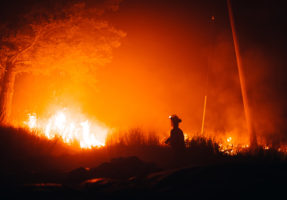
“2017 was an extremely challenging year for BC ranchers. We started with floods and within days were fighting fires on the same land,” he told the Centre for Organizational Governance in Agriculture livestock seminar in Abbotsford, February 14. “Our industry is still tallying the losses.”

While few people in the Fraser Valley were directly impacted by wildfire, Boon warns snowmelt will happen more quickly on land denuded by the fires. This promises a shorter, more intense freshet and the potential for spring flooding in the Lower Mainland.

Ranchers will also feel a lingering impact, Boon says, because invasive weeds will take over scorched acreage if grass isn’t planted soon.

Although there were emergency response plans, farms were not prepared for the size of the emergency.

“There’s a plan, and there’s being prepared,” Boon says. “They are not the same. Each region had its own plan and there were minor variations, which was a pain for us.”

Ranchers had no way of tracking cattle but that turned out to have an unexpected benefit. Since moving cattle out of danger areas was conditional on having premises ID, “we went from having 25% to 100% enrollment in premises ID in the Chilcotin in 36 hours.”

Boon says the biggest problem was the fact no one in the emergency operations centres knew how to deal with ranchers who defied evacuation orders to care for their animals and put up winter feed. That changed when rancher and BCCA’s AgSafe rep Reg Steward moved into the Williams Lake command centre.

“He didn’t work for government and had ‘skin in the game’ so ranchers could relate to him,” Boon says. “The trouble was I only had one Reg Steward. He was in the EOC for 48 days straight.”

Boon says last summer’s experience has created huge awareness about emergency preparedness.

“This is where associations become important. We have to develop a plan and train people to get in the EOCs,” he says.

Boon has high hopes for the Canadian Animal Health Coalition emergency management plan initiative.

He says it needs to include both animal health emergencies and natural disasters. He would like to see a cross-sectoral approach with a focus on training industry representatives to participate in government-run EOCs.

“If we teach the right principles, there’s no reason we can’t have a chicken producer spell off a livestock producer or vice versa,” Boon says.
Related Posts

You may be interested in these posts from the same category.

Disaster preparedness lacking

Province pledges emergency funding

Farmers struggle to get insurance coverage Insurance

Insolvency concerns grow

Hurry up and wait

Don’t stress, plan

“Big number” tough to get

Cattle industry seeks cash

Federal assistance falls short

Going solo

Flood mitigation funding available

Apple growers fight low prices

Previous Post: « Processor capacity challenges small-scale farmers
Next Post: Processor capacity challenges small-scale farmers »

Copyright © 2026 Country Life in BC · All Rights Reserved